


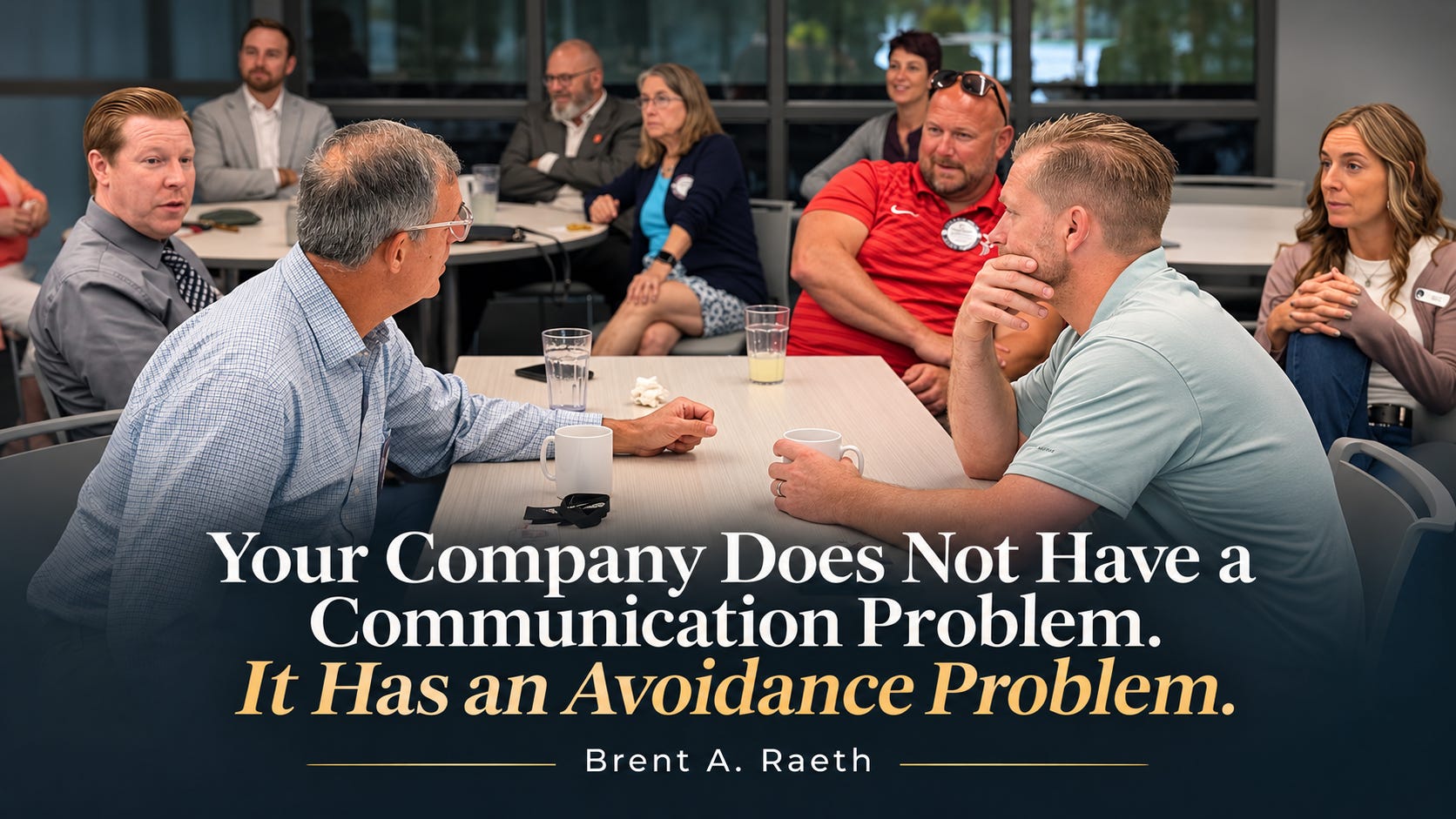
I have been in more meetings than I can count where someone eventually says some version of the same thing: “We just need to communicate better.”
It is one of the safest conclusions an organization can reach.
A project went sideways, so it becomes a communication problem. An employee was surprised by a performance conversation, so that becomes a communication problem. Two departments are frustrated with each other, a customer expected something different, or nobody knew who was responsible for making the decision, and again we blame communication.
Sometimes that diagnosis is correct. But I have become convinced that many organizations do not actually have a communication problem.
They have an avoidance problem.
The information usually exists. People often know what needs to be said. The problem is that saying it might create tension, disappoint someone, expose poor performance, force a difficult decision, or require someone to take responsibility.
So instead, everyone agrees that the organization needs to “communicate better.”
It sounds constructive, but it also allows everyone to avoid confronting what is actually happening.
Most People Already Know What the Problem Is
Think about the recurring problems inside almost any organization. The employee who is not performing usually is not a secret. The process everyone knows is broken usually is not a secret. The customer relationship that has become unreasonable usually is not a secret. The project everyone suspects will miss its deadline usually is not a secret either.
People know.
More importantly, they are often talking about it. They are discussing it in hallways, private messages, side conversations, closed-door meetings, and phone calls on the drive home.
The irony is that everyone may be talking about the problem except with the person who can actually do something about it.
That is not a lack of communication. That is avoidance.
Organizations are often full of conversations that accomplish very little because the one conversation that actually matters never happens.
Ambiguity Gives Us Somewhere to Hide
Another reason avoidance gets mislabeled as a communication problem is that vague language feels safer than clear language.
“We need to improve accountability.”
“We should communicate more proactively.”
“We need better customer service.”
“We all need to do a better job following through.”
All of those statements sound reasonable, but they are also vague enough that nobody is really responsible for anything.
Now compare that with something more direct: “John owns this project, it needs to be completed by Friday, and if it is going to miss the deadline, we need to know by Wednesday.”
Or: “When a customer has a critical outage, we expect a response within fifteen minutes.”
The moment we get specific, things become more uncomfortable because specificity creates accountability. Once the expectation is clear, everyone can see whether it was met.
Ambiguity gives us somewhere to hide. We can say we misunderstood, thought someone else was handling it, or never realized that was the expectation.
Clarity removes those escape routes.
That is one reason organizations sometimes resist clarity even while claiming they want more of it. Clear expectations create clear responsibility, and clear responsibility creates the possibility of being held accountable.
Leaders Teach People What Is Safe to Say
Leaders often complain about communication, but leaders also create many of the conditions that make people avoid difficult conversations.
If every disagreement is met with defensiveness, people eventually stop disagreeing with you. If bad news gets punished, people stop bringing bad news. If managers are allowed to tolerate poor performance indefinitely, employees learn that standards are optional. If leadership repeatedly delays uncomfortable decisions, the rest of the organization learns to do the same thing.
You cannot create a culture where telling the truth is expensive and then wonder why people stop speaking honestly.
Healthy organizations need people who can say things like, “This is not working,” “I disagree,” “We are going to miss the deadline,” “I made a mistake,” or “This person is not performing at the level the role requires.”
Those are not complicated sentences, but they can be very difficult to say.
The responsibility of leadership is not to eliminate discomfort. It is to create an environment where people can speak honestly, respectfully, and early enough that the issue can still be addressed.
Delayed Conversations Become Expensive Conversations
The irony of avoidance is that it rarely makes anything easier. It simply delays the discomfort.
A small performance issue becomes a serious personnel problem. A questionable project becomes an expensive failure. A misunderstanding with a customer becomes a damaged relationship. A minor frustration between coworkers becomes resentment. A decision that could have taken ten minutes consumes months of meetings.
Avoidance does not eliminate conflict. It finances it.
You borrow discomfort from today and agree to pay it back later with interest.
I have seen this most clearly in employee performance situations. A manager notices something is wrong. Maybe the employee is missing deadlines, creating friction, struggling with the role, or simply not meeting expectations.
The manager sees it early but waits. They hope the employee improves. They drop hints. They soften the message. They tell themselves they need more examples. They discuss the issue with other leaders rather than directly with the employee.
Then, months later, the situation becomes serious enough that something finally has to happen.
The employee is surprised, leadership is frustrated, and someone eventually says, “We should have communicated better.”
Maybe.
But usually somebody should have had an uncomfortable conversation six months earlier.
The Same Problem Shows Up With Customers
Organizations do the same thing in customer relationships.
A customer begins asking for work outside the agreement. Expectations slowly expand. The team absorbs extra effort because nobody wants to risk upsetting the relationship. Maybe the customer becomes increasingly demanding or disrespectful, but people keep accommodating it because confrontation feels risky.
Eventually, the relationship becomes unsustainable.
At that point, both sides are frustrated, and again the problem gets described as communication.
But the real failure happened much earlier, when someone knew a boundary needed to be established and chose not to establish it.
Good customer relationships require clear expectations just as much as good employee relationships do. Saying yes to everything is not good service. Sometimes good service means being willing to say, “That is outside the scope,” “That is not something we can support,” or “If you want that level of service, we need to change the agreement.”
Avoiding those conversations does not protect the relationship. It usually weakens it.
More Meetings Will Not Fix Avoidance
Organizations often respond to communication problems by adding more communication infrastructure.
More meetings. More emails. More reports. More dashboards. More documentation. More project-management tools. More Teams or Slack channels.
Sometimes those things help, but none of them solve avoidance.
You can have the most advanced communication systems in the world and still have an organization where nobody says what actually matters.
In fact, meetings can become one of the best places to hide from difficult conversations. A room full of people can discuss the process without addressing the person. They can review the numbers without asking why the numbers are bad. They can talk about lessons learned without identifying what actually needs to change.
They can spend an hour discussing a problem without making a decision.
Everyone leaves believing communication happened.
It did.
It just was not the communication that mattered.
Healthy Organizations Make Difficult Conversations Normal
Healthy organizations are not organizations without conflict. They are organizations that know how to deal with conflict before it becomes destructive.
People can disagree without becoming enemies. Managers can give feedback without humiliating employees. Employees can raise concerns without being labeled difficult. Leaders can admit mistakes. Customers can be told no. Standards can be enforced, expectations can be clarified, and poor performance can be addressed before it becomes a crisis.
None of this requires people to become cold or harsh.
Directness and kindness are not opposites.
You can care about someone and still tell them the truth. You can respect someone and still hold them accountable. You can listen carefully to someone’s perspective and still make a decision they do not like.
One of the mistakes we make is assuming that avoiding discomfort is a form of kindness.
Most of the time, it is not.
Leaving someone confused about where they stand is not kind. Allowing resentment to quietly build is not kind. Letting poor performance continue until termination becomes inevitable is not kind. Pretending everything is fine when it clearly is not is not kind.
Eventually, kindness without honesty stops being kindness.
Ask a Better Question
The next time someone says your organization has a communication problem, resist the urge to immediately schedule another meeting.
Ask a different question:
What are we avoiding talking about?
What does everyone already know but nobody wants to say? What decision are we postponing? Whose performance needs to be discussed? What expectation has never been clearly stated? What customer boundary needs to be established? What disagreement are we pretending does not exist?
Most importantly, what issue keeps appearing in private conversations but never makes it into the actual room?
Those questions will tell you more about the health of your organization than another communication survey ever will.
Communication Requires Courage
The hardest communication inside an organization is rarely about transmitting information. It is about courage.
It takes courage to be clear, to disagree, to disappoint someone, to hold a standard, to admit you were wrong, and to make a decision that someone may not like.
It takes courage to tell someone what they need to hear instead of what is easiest to say.
Organizations improve when important conversations happen sooner, before frustration becomes resentment, before small problems become expensive problems, and before avoidance becomes part of the culture.
So the next time somebody says, “We need to communicate better,” they might be right.
But there is another possibility worth considering.
Maybe everyone already knows exactly what needs to be said.
Maybe the real problem is that nobody wants to say it.