


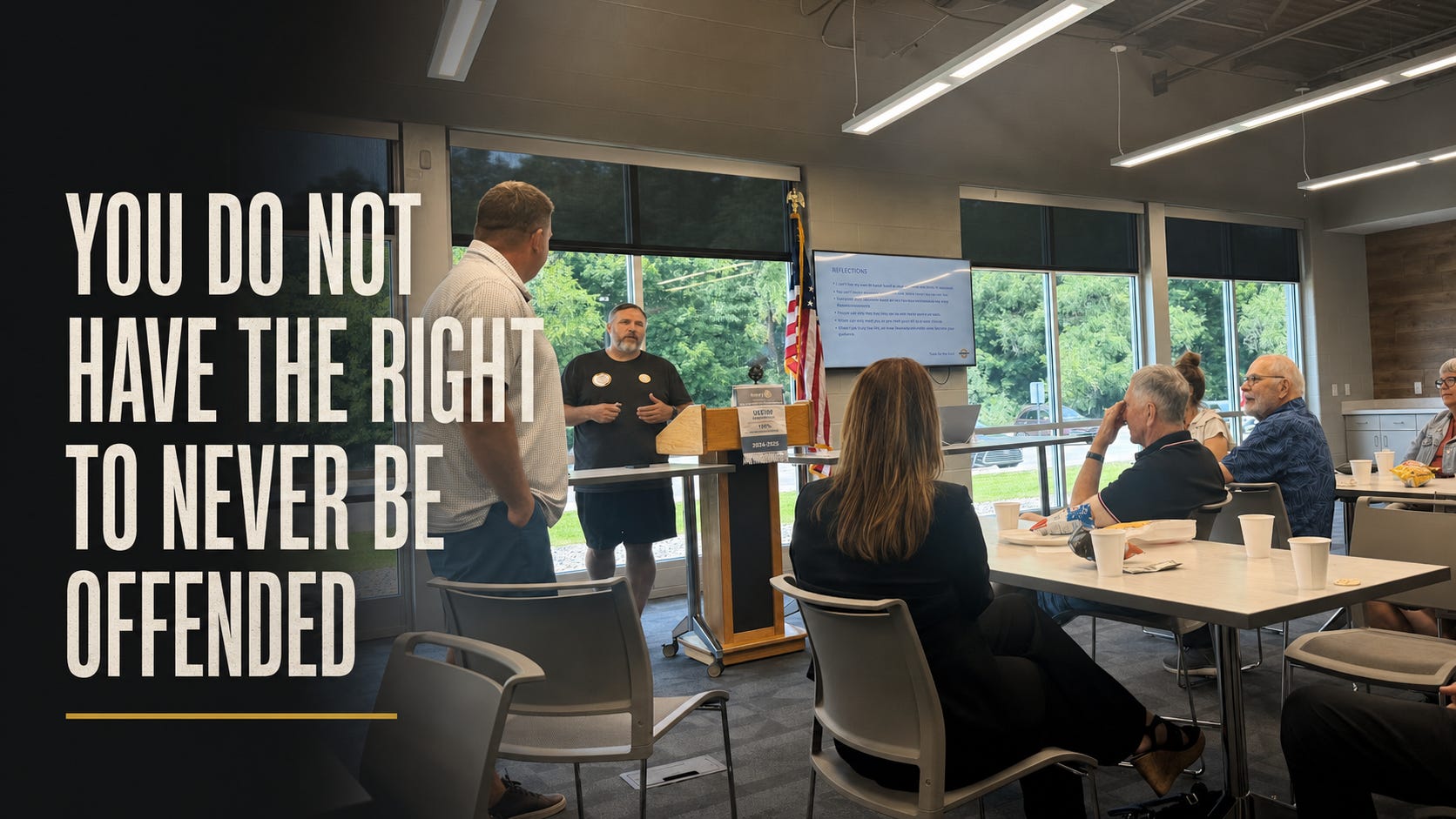
I watched a local governmental meeting the other day where a councilmember made a statement and received pushback.
It quickly went from discourse to hurt feelings. The actions that followed turned into fifteen minutes of discussion about how they did not feel as though they had been treated correctly. Disagreement over the facts was positioned as disrespect, and meaningful discourse broke down because someone had been disagreed with.
The original issue became secondary.
Instead of evaluating the argument, considering the evidence, or defending the decision, the conversation shifted toward how the disagreement made someone feel.
This is not unique to government meetings. It happens in workplaces, schools, families, community organizations, and increasingly throughout public life. We have started treating hurt feelings as evidence that someone else has done something wrong.
Someone criticizes our work, and we call it disrespect. Someone questions our version of events, and we accuse them of attacking us. Someone challenges an idea we care about, and we respond as though they have challenged our value as a person.
But nobody has the right to move through life protected from offense, insult, embarrassment, criticism, or hurt feelings.
That is not how society works.
It cannot be how society works.
Disagreement Is Not Disrespect
We have confused respect with agreement.
Respect does not require approving of every decision, affirming every opinion, or remaining silent whenever someone might become uncomfortable. It does not mean accepting a claim simply because questioning it may hurt the person making it.
Respect means recognizing another person’s humanity while remaining free to believe they are wrong.
Two people can strongly disagree without either person being hateful. A leader can challenge someone’s performance without attacking their worth. A citizen can question an elected official without disrespecting the office. A friend can criticize our decisions without rejecting us as a person.
In fact, honest disagreement is necessary for any healthy organization or community.
Good decisions rarely come from rooms where everyone is afraid to push back. Accountability cannot exist when every correction is interpreted as a personal attack. Public service becomes meaningless if officials expect to make statements without being questioned.
If disagreement automatically becomes disrespect, the conversation is effectively over.
The person most willing to claim emotional injury gains control, while everyone else learns to remain silent.
Discomfort Is Not Harm
There is a meaningful difference between being uncomfortable and being unsafe.
There is a difference between hearing an opinion you dislike and being threatened. There is a difference between receiving criticism and being abused. There is a difference between having your feelings hurt and having your rights violated.
When we collapse all of those experiences into the same category, we lose the ability to respond appropriately to any of them.
Real threats matter.
Harassment matters.
Discrimination matters.
Abuse matters.
Those things should be taken seriously. But taking them seriously requires us to stop treating every uncomfortable interaction as though it carries the same weight.
Sometimes someone has not harmed us. They have simply disappointed us, disagreed with us, corrected us, or failed to speak as carefully as we would have preferred.
Feelings are real, but they are not always reliable evidence.
Feeling disrespected does not prove that we were treated disrespectfully. Feeling attacked does not mean that someone attacked us. Feeling embarrassed does not necessarily mean that someone intended to humiliate us.
Sometimes our feelings are revealing something about the other person.
Sometimes they are revealing something about us.
Maturity requires being willing to consider both possibilities.
Offense Cannot Become the Standard
What offends one person may not offend another.
The same statement can be viewed as honest by one person, insensitive by another, and harmless by someone else. Even the same person may react differently depending on the setting, the speaker, or the mood they are in that day.
That makes offense a terrible standard for deciding what other people should be allowed to say.
If the rule becomes that nobody may say anything another person finds offensive, the most easily offended person controls every conversation. Truth, intent, fairness, and reason become secondary to the emotional reaction of whoever objects most strongly.
That does not create a respectful society.
It creates a fearful one.
People stop speaking honestly. Leaders avoid necessary conversations. Teachers hesitate to challenge students. Coworkers whisper instead of addressing problems directly. Public officials spend more time managing reactions than solving problems.
We may prevent a few uncomfortable moments, but we lose honesty, accountability, growth, and trust in the process.
Hurt Feelings Are Sometimes Part of Growth
Some of the most important things we hear in life will hurt.
You were wrong.
You did not meet expectations.
You handled that poorly.
Your behavior affected other people.
The facts do not support your conclusion.
You are capable of more than you are currently giving.
None of those statements are particularly comfortable. They may embarrass us, frustrate us, or make us defensive. But discomfort does not make them untrue, and hurt feelings do not make the person saying them cruel.
Growth requires friction. It requires having our assumptions challenged, our weaknesses exposed, and our decisions examined. It requires discovering that our intentions did not produce the results we imagined.
If we demand protection from every feeling we dislike, we also demand protection from many of the experiences that could make us better.
It is easier to label criticism as disrespect than to consider whether it is accurate. It is easier to focus on tone than to answer the argument. It is easier to describe ourselves as mistreated than to admit we may have been wrong.
Those reactions protect our pride, but they do not help us grow.
Kindness Still Matters
None of this excuses deliberate cruelty.
Honesty does not require humiliation. Strength does not require being unnecessarily harsh. Freedom does not eliminate responsibility for how we treat others.
We should care about the effect our words have. We should listen when someone tells us we have caused unnecessary pain. We should apologize when we communicate carelessly, misjudge a situation, or treat someone without dignity.
But consideration cannot become submission to every emotional reaction.
People communicate imperfectly. They choose the wrong words. They become frustrated. They misunderstand one another. They sometimes say something true without saying it particularly well.
A functioning society cannot require flawless communication before allowing honest disagreement.
Sometimes the appropriate response is an apology.
Sometimes it is a clarification.
Sometimes it is forgiveness.
Sometimes it is accepting that the other person could have communicated better while still recognizing that their underlying point was correct.
Kindness is a responsibility.
Permanent comfort is not a right.
Emotional Resilience Is Also a Responsibility
We spend a great deal of time talking about how other people should speak to us and far less time discussing how we should respond.
That balance needs to change.
Each of us is responsible for developing the ability to tolerate disagreement, process criticism, regulate our emotions, and recover from uncomfortable interactions. Nobody else can do that work for us.
Not every criticism deserves a response.
Not every insult requires retaliation.
Not every disagreement needs to become a conflict.
Not every hurt feeling needs to become someone else’s punishment.
Sometimes maturity means asking whether there was truth in what was said. Sometimes it means recognizing that the other person was wrong. Sometimes it means setting a boundary. Sometimes it means walking away.
Resilience is not pretending that words never hurt. It is refusing to let every hurt become an identity, a grievance, or a demand that the world rearrange itself around us.
Society Requires Some Emotional Calluses
Living among other people is difficult.
They will disappoint us. Misunderstand us. Criticize us. Reject our ideas. Question our decisions. Occasionally, they will offend us.
We will do the same to them, often without realizing it.
The answer is not to build a society where nobody ever feels uncomfortable. That society cannot exist. Attempting to create it will only make us more fragile, more suspicious, and less capable of honest relationships.
The better goal is to create a society where consideration and resilience coexist.
Speak with care.
Listen with humility.
Apologize when appropriate.
Forgive human imperfection.
Challenge ideas without destroying people.
And learn to separate disagreement from disrespect.
Nobody has the right to live completely protected from offense, insult, criticism, or hurt feelings.
We do have the responsibility to treat others with dignity.
We also have the responsibility to become strong enough to live among imperfect people who will not always agree with us.
That includes all of us.