


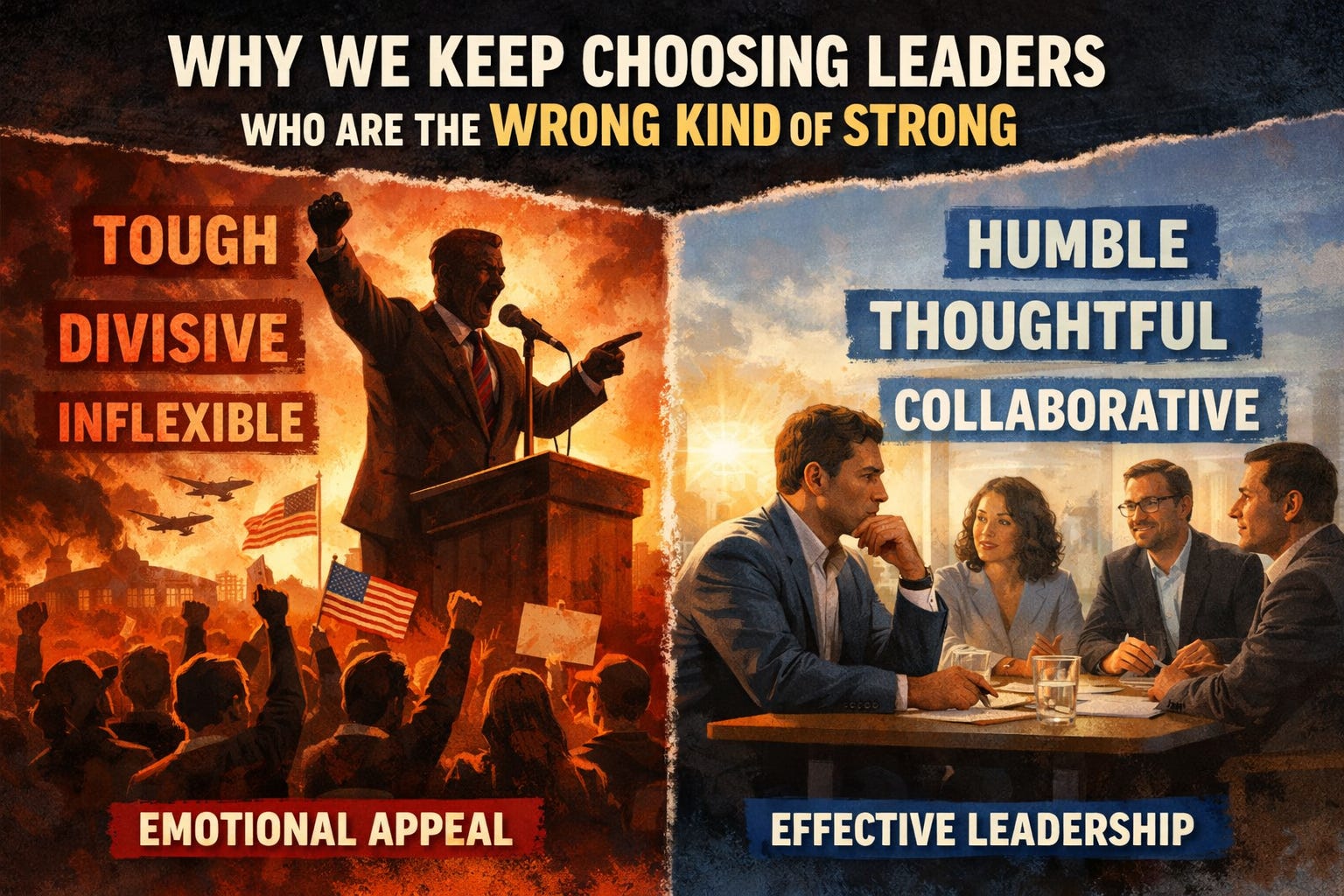
Recently, I watched a friend defend President Trump’s childish comments and behavior as “strong leadership.” The justification was simple. He was “going after” the people who hurt our country. He was fighting. He was unapologetic. He was aggressive. To my friend, that was strength.
But at what cost?
Before you read any further, I know something.
Some of you are already preparing your response.
Your natural reaction to this post will likely fall into one of two camps:
“Heck yeah, Trump sucks.”
Or…
“Yeah, but the other side did this.”
“Yeah, but what about Biden?”
“Yeah, but what about Obama?”
“Yeah, but what about…”
If that is your instinct, you are proving the point. And respectfully, you are contributing to the very divisiveness you claim to dislike.
Here is a reality we seem to struggle holding at the same time: I can vote for someone and still believe they have significant flaws. I can align with policies and still think the person delivering them often behaves poorly. Supporting a candidate does not require blind loyalty. Criticizing a leader does not require total rejection.
We have lost the ability to live in that tension.
If we truly want a country that is more connected, more stable, more unified, should we tolerate leaders who use language and take actions that undermine that very goal? Can we honestly say we value unity while celebrating behavior that deepens division? Are we moving closer to the ideal we claim to want, or farther away from it?
This is not about one president. It is about a pattern. It is about how we define strength in leadership.
And statistically, culturally, and historically, we often get it wrong.
The Myth of the Strong Leader
We are drawn to certainty. We are comforted by bold declarations. We like leaders who sound sure of themselves, who never hesitate, who charge forward with confidence and defiance.
We equate loudness with courage.
We equate stubbornness with conviction.
We equate aggression with strength.
But leadership research consistently shows something different. The most effective leaders are not the most domineering. They are the most self aware. They create psychological safety. They invite dissent. They admit when they are wrong. They adjust when new information emerges.
In high performing organizations, leaders who model vulnerability consistently outperform those who project invincibility. Teams make fewer catastrophic errors. Innovation improves. Trust deepens.
That does not look like traditional strength.
But it produces far better results.
Confidence is easy to recognize.
Humility requires maturity to appreciate.
Jensen Huang and the Strength of Uncertainty
On The Joe Rogan Experience, NVIDIA CEO Jensen Huang spoke candidly about the company’s path. Today, NVIDIA sits at the center of the AI revolution. Its market dominance makes it look inevitable in hindsight.
It was not.
Huang openly acknowledged that there were many times he made the wrong decision. Many times he was unsure. Many times the company faced existential risk.
He did not pretend he always knew the answer. He did not frame doubt as weakness. He described leadership as navigating uncertainty honestly, adjusting quickly, and learning relentlessly.
NVIDIA did not become what it is because its leader projected flawless certainty. It became what it is because its leader was willing to confront reality, admit mistakes, and adapt.
That is strength.
The Danger of the Wrong Kind of Strong
History is filled with leaders who were widely supported because they appeared decisive, bold, and fearless.
Elizabeth Holmes projected unwavering confidence while building Theranos into a nine billion dollar company. Investors, politicians, and media outlets praised her vision. Behind the scenes, however, the technology did not work as promised. Her refusal to confront reality led to one of the most infamous corporate collapses in modern history.
Adam Neumann aggressively expanded WeWork with grand visions and boundless confidence. For a time, the world applauded. Then governance failures and inflated assumptions caught up to the company.
Political history offers even starker examples. Leaders who rally people with certainty and aggression often consolidate loyalty quickly. They can also fracture institutions just as quickly when dissent is punished and self correction is viewed as weakness.
The pattern is consistent.
Overconfidence without self reflection is combustible.
Add power to that equation and the damage multiplies.
When leaders cannot admit they are wrong, mistakes compound.
When leaders silence critics, blind spots grow.
When leaders equate criticism with betrayal, division deepens.
And when followers reward that behavior as “strength,” we reinforce the cycle.
Why We Keep Rewarding It
We reward it because certainty feels safe.
In uncertain times, we crave clarity. We want someone to take charge and eliminate ambiguity. A leader who says, “I might be wrong,” does not scratch that emotional itch.
But leadership is not about scratching emotional itches. It is about stewarding responsibility.
The strongest leaders are not those who never question themselves. They are those who question themselves first.
It is far easier to cheer aggression than to evaluate character. It is far easier to reward bravado than to measure integrity. It is far easier to defend our side than to hold it accountable.
But if we refuse to hold leaders accountable because they align with us politically, we are not defending our country. We are defending our tribe.
And tribes fracture nations.
Strength Redefined
Strength is not the absence of doubt.
Strength is the discipline to confront it.
Strength is not humiliating opponents.
Strength is disagreeing without dehumanizing.
Strength is not charging forward at all costs.
Strength is adjusting course when evidence demands it.
If our goal is a more connected country, more resilient organizations, and healthier communities, then we must rethink what we reward.
Leaders who inflame division may energize their base. But they erode the fabric that holds us together.
We cannot say we want unity while applauding behavior that fractures it.
We cannot say we value character while excusing its absence for political convenience.
We cannot say we want better outcomes while continuing to reward the wrong traits.
The myth of the strong leader persists because it is emotionally satisfying.
But emotionally satisfying leadership and effective leadership are not the same thing.
Until we learn the difference, we will keep choosing leaders who are the wrong kind of strong.
Your headline asks, “Why do we keep choosing the wrong kind of leaders who are the wrong kind of strong?” While you address some thoughts about what is wrong about some leaders I think we have to look more at ourselves to find the reason.
Our society has now made sport of attacking the character of anyone that dares to aspire to leadership and especially governmental leadership. A person engages themself in the pursuit of an elected office and suddenly the public and press begin to delve into the candidates personal life and highlights every flaw that can be found from real character flaws to cheating on a science test in middle school. The candidate, no matter how far they have put who they used to be behind, will see their character besmirched and smeared with vehemence in the public square of the media.
If the person does have any character, they generally wouldn’t incline themself to be treated so and therefore, do not pursue public office. If the person has a flawed character or lacks character, they won’t care and lustfully pursue the power of the office. The result is that the choice often left to the voter are people lacking the proper character and motivation to serve the community well. We don’t choose the right leaders because often they aren’t in the race.
It is our fault for engaging in that sport of character assassination and media is all too happy to feed the frenzy that we are all too eager to swallow.