


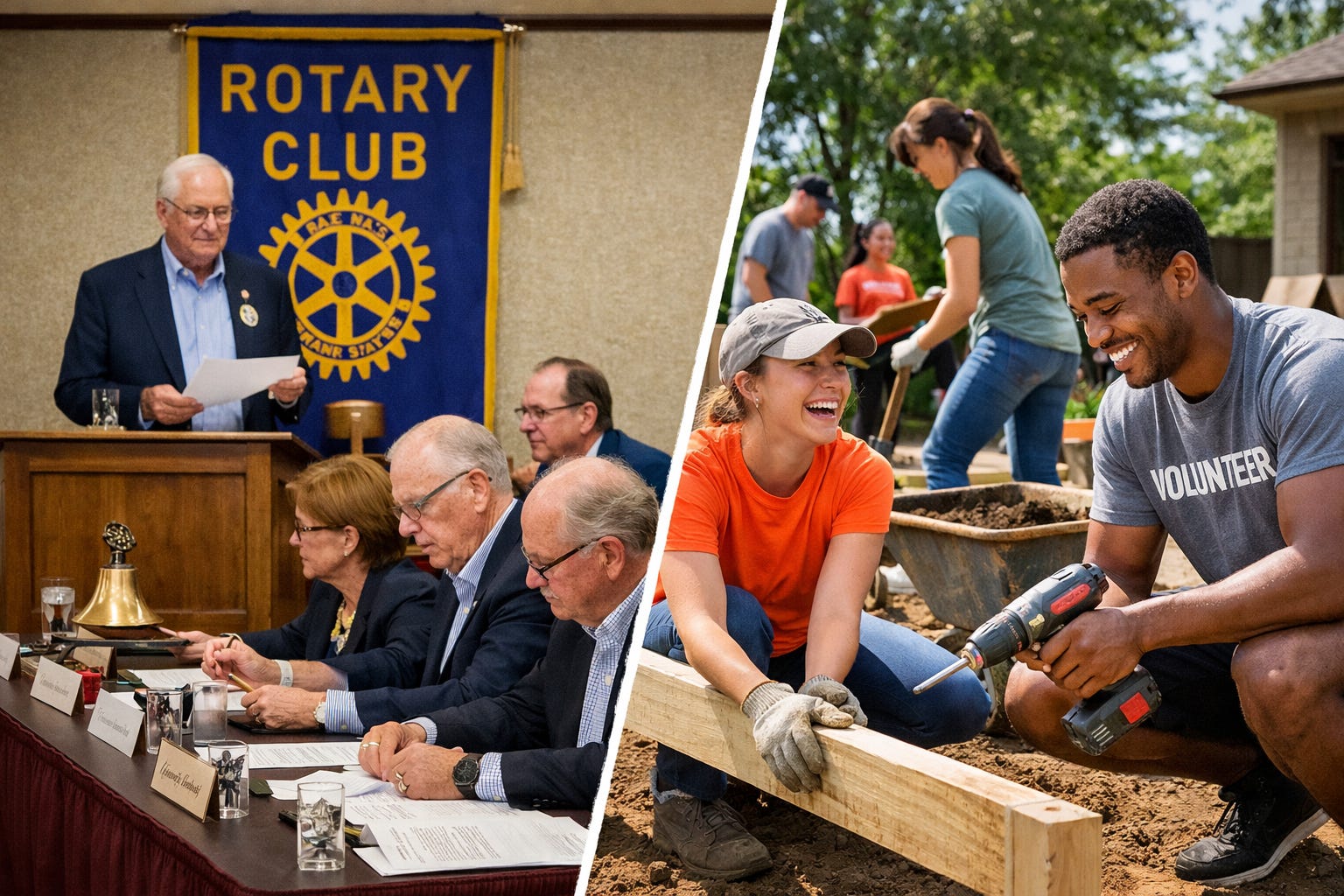
I recently sat in my Rotary Board meeting debating whether the pomp and circumstance of member orientation and induction ceremonies were valuable. I struggled to see how spending my time, or any other member’s time, significantly added to the value of our club, our members, or our community. The bureaucracy and the stubborn ceremonies all seem like barriers to the true meaning of service and, at times, reinforce ego and social status more than impact.
This is not a comfortable thing to say, especially as someone who believes deeply in service above self. But brutal honesty demands we confront reality. Service clubs, in their traditional form, are dying. If we do not change, they will not simply decline. They will disappear.
The Cold, Hard Numbers
The decline is not anecdotal, it’s measurable. Traditional service clubs like Rotary, Kiwanis, Jaycees, Masons, and others have seen decades-long drops in membership. In the past two decades, Rotary membership has fallen roughly 20 percent in some regions, Jaycees by 64 percent, and Masons by 76 percent. Researchers like Robert Putnam have documented that attendance at club meetings has declined by as much as 58 percent over the last few decades.
Rotary itself adds tens of thousands of new members each year, yet it also loses nearly as many annually. Many local clubs that once boasted over one hundred members now struggle to maintain a few dozen. Some barely have enough active participants to sustain operations.
At the same time, volunteering in the United States has reached some of its lowest levels in decades before showing a modest rebound. The rebound reveals something important. People still want to help. They simply do not want to help the way traditional clubs require.
It Is Not That People Do Not Care
Younger generations, especially Millennials and Gen Z, want impact now. They want flexible, value aligned ways to serve. They are far less interested in hour long meetings, formal induction rituals, or spending limited free time on ceremonies that feel outdated or performative.
They prefer project based involvement. They prefer half day service opportunities. They prefer clear outcomes. They want to see where their time goes and what it produces.
Research consistently shows that younger volunteers prioritize alignment with mission, visible impact, and flexibility. They are less loyal to institutions and more loyal to causes. They do not reject service. They reject inefficiency.
The narrative that the next generation lacks commitment is simply wrong. They are committed to different service models not conformity to decades-old structures.
What We Lose When We Refuse to Change
When clubs cling to tradition at the expense of relevance, the cost is real.
We lose credibility. Meetings about meetings, rigid rituals, and heavy administrative layers communicate that tradition matters more than mission.
We create barriers to entry. Complex onboarding processes, hierarchy, and etiquette requirements introduce friction that busy professionals and young leaders will not tolerate.
We dilute impact. Every hour spent on bureaucracy is an hour not spent serving the community.
We also lose future leadership. If younger professionals do not see themselves reflected in our structure, tone, and priorities, they will build new communities elsewhere. They will not fight to reform ours. They will simply walk away.
This isn’t just about membership numbers it’s about meaningful service. The world has changed; community leaders have changed; and so have the ways people want to effect change.
Make the Non Valuable Things Easy
If we are honest, not everything a club does is equally valuable.
The mission is valuable. The service projects are valuable. The relationships are valuable. The leadership development is valuable.
But the administrative layers are not.
The multi step approvals, the rigid attendance requirements, the ceremonial processes, the outdated communication systems. Those things are not the mission. They are infrastructure. And infrastructure should be simple and easy.
It should be easy to join.
It should be easy to understand expectations.
It should be easy to plug into a project.
It should be easy to step back for a season of life and re engage later.
It should be easy to connect with other members digitally and in person.
Bureaucracy is hard. And hard things create friction. Friction repels people.
When someone raises their hand to join, the system should not respond with paperwork, orientation hoops, committee approvals, and calendar rigidity. It should respond with opportunity.
The next generation of leaders lives in an on demand world. They can start a business from a phone. They can launch a fundraiser in minutes. They can organize a community effort through a group chat. When they encounter a system that feels unnecessarily complex, they do not try to fix it. They route around it.
We have to decide whether we are building gateways or gatekeeping structures.
If we remove friction from everything that is not core to service, we create space for what actually matters.
Impact.
Community.
Leadership.
Service.
This Is About Resurrection, Not Removal
This is not a call to dismantle service clubs. It is a call to protect them from their own inertia.
If we do not evolve, we will continue to shrink. If we continue to prioritize ceremony over service, we will lose the very people we need to carry the mission forward.
But if we are willing to simplify, modernize, and focus relentlessly on meaningful impact, service clubs can become powerful engines of local leadership again. They can be places where community builders gather, not because of tradition, but because of traction.
The choice is not between honoring the past and embracing the future. The choice is whether we love these institutions enough to change them.
If we do, they will not die.
They will be reborn.