


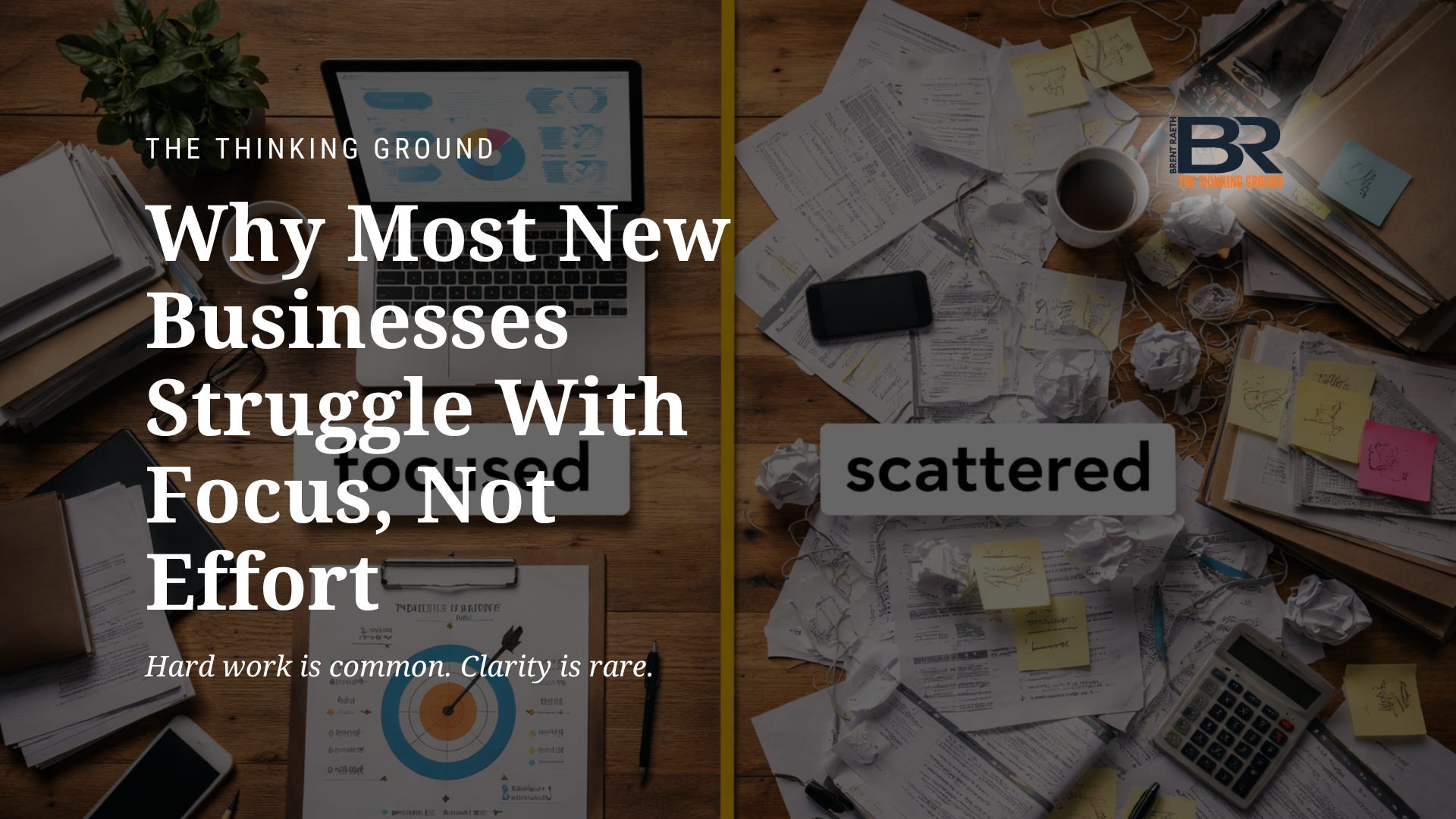
There is no shortage of effort in early-stage businesses.
If anything, most new business owners work too hard. Long hours. Late nights. Constant problem solving. A willingness to do whatever it takes to get things moving. From the outside, it often looks like the level of effort should guarantee success.
But it does not.
Because effort, by itself, is not the constraint.
Focus is.
The Myth of “Working Hard Enough”
When a business struggles early, the default assumption is simple. Work harder. More calls. More meetings. More services. More opportunities. More activity. It feels productive. It feels responsible. It feels like the right response.
But in many cases, it makes the problem worse.
The issue is not that the business lacks effort. It is that the effort is scattered across too many directions. Instead of building momentum, the business dilutes it.
Where Focus Breaks Down
In the early stages, everything looks like opportunity.
Every potential customer seems worth pursuing
Every service feels like something you should offer
Every idea feels like something you should explore
Without clear boundaries, the business begins to expand in all directions at once. I have seen this repeatedly, and I have experienced it myself.
In the early days of building and growing multiple businesses, there is a natural tendency to say yes to everything. You want revenue. You want traction. You want proof that the business works. So you take the project that is slightly outside your core. Then another. Then another.
Individually, each decision makes sense.
Collectively, they create confusion.
The Cost of Being Everything to Everyone
When focus breaks down, the impact shows up quickly.
Messaging becomes unclear
Operations become inconsistent
Teams begin to interpret priorities differently
Customers experience variability instead of reliability
Internally, the business feels busy. Externally, it feels unfocused.
This is one of the most overlooked reasons early-stage businesses stall. Not because they are not working hard, but because they are working in too many directions at once.
And the cost is not always obvious right away.
It shows up over time in slower growth, increased rework, and missed opportunities that required clarity to capture.
Clarity Creates Momentum
The businesses that begin to break through tend to make a shift.
They narrow.
They define:
Who they serve
What they do exceptionally well
What they will not do
This is not easy. It requires saying no to revenue in the short term. It requires discipline when opportunities present themselves. It requires confidence in a direction that may not feel fully proven yet.
But it creates something powerful.
Alignment.
When a business is clear:
Teams execute with consistency
Customers understand the value immediately
Decisions become faster and more repeatable
Effort compounds instead of resets
Focus turns effort into momentum.
Lessons From Experience
Across the businesses I have been involved in, the pattern is consistent.
The periods of greatest struggle were not when we lacked effort. They were when we lacked clarity.
We were working hard. Sometimes extremely hard. But we were chasing too many directions at once. Trying to serve too many types of customers. Offering too many variations of services. Reacting instead of deciding.
The turning point came when we simplified.
Not by doing less work, but by directing the work more intentionally.
We became clearer about who we were as a business. Clearer about what problems we solved. Clearer about what did not align.
And with that clarity, performance improved.
Not because we suddenly worked harder, but because the work started to matter more.
Focus Is a Leadership Decision
Focus does not happen by accident.
It is not something that emerges naturally from activity. It is created through deliberate decisions, often by leadership.
It requires:
Defining priorities clearly and repeatedly
Reinforcing what matters and what does not
Holding the line when distractions appear
Accepting that saying no is part of building something meaningful
This is where many early businesses struggle. Not because they are unwilling to work, but because they are unwilling to constrain themselves.
But constraint is what creates strength.
The Better Question
For anyone starting or growing a business, the key question is not:
“Am I working hard enough?”
A better question is:
“Am I focused on the right things?”
Because effort without focus leads to exhaustion.
Effort with focus leads to progress.
And over time, that difference determines which businesses grow and which ones quietly stall.