


A few weeks ago, Kara and I closed on our home.
Our Realtor, Sarah Riehl, who is wonderful by the way, reminded us the day before closing to bring our driver’s licenses and Social Security cards. The title company needed to verify that we were who we said we were before allowing us to sign papers and transfer ownership.
It made perfect sense.
We were about to execute documents that would transfer hundreds of thousands of dollars in assets. Of course they wanted proof of identity. No one in the room viewed that requirement as oppressive. No one protested the inconvenience. No one suggested the request was discriminatory. It was simply understood: something important requires validation.
This is not a new concept. It is as old as civilization itself.
In ancient Rome, citizens were registered in the census and assigned documentation to establish legal standing. In medieval Europe, seals and signet rings authenticated royal decrees. In early America, property deeds were recorded publicly and notarized to validate identity and prevent fraud. As societies grew more complex, systems of verification grew with them.
Trust has always required proof.
In the digital age, the principle has only intensified. Entire industries are built around identity and access management. Multi factor authentication, biometric verification, encryption keys, privileged access controls. Billions of dollars and some of the brightest minds in cybersecurity are devoted to a simple premise: authenticate identity before granting access.
The entire cybersecurity body of knowledge rests on that idea. Before you access data, before you transfer funds, before you administer systems, you must prove who you are.
Which brings me to a question I have wrestled with.
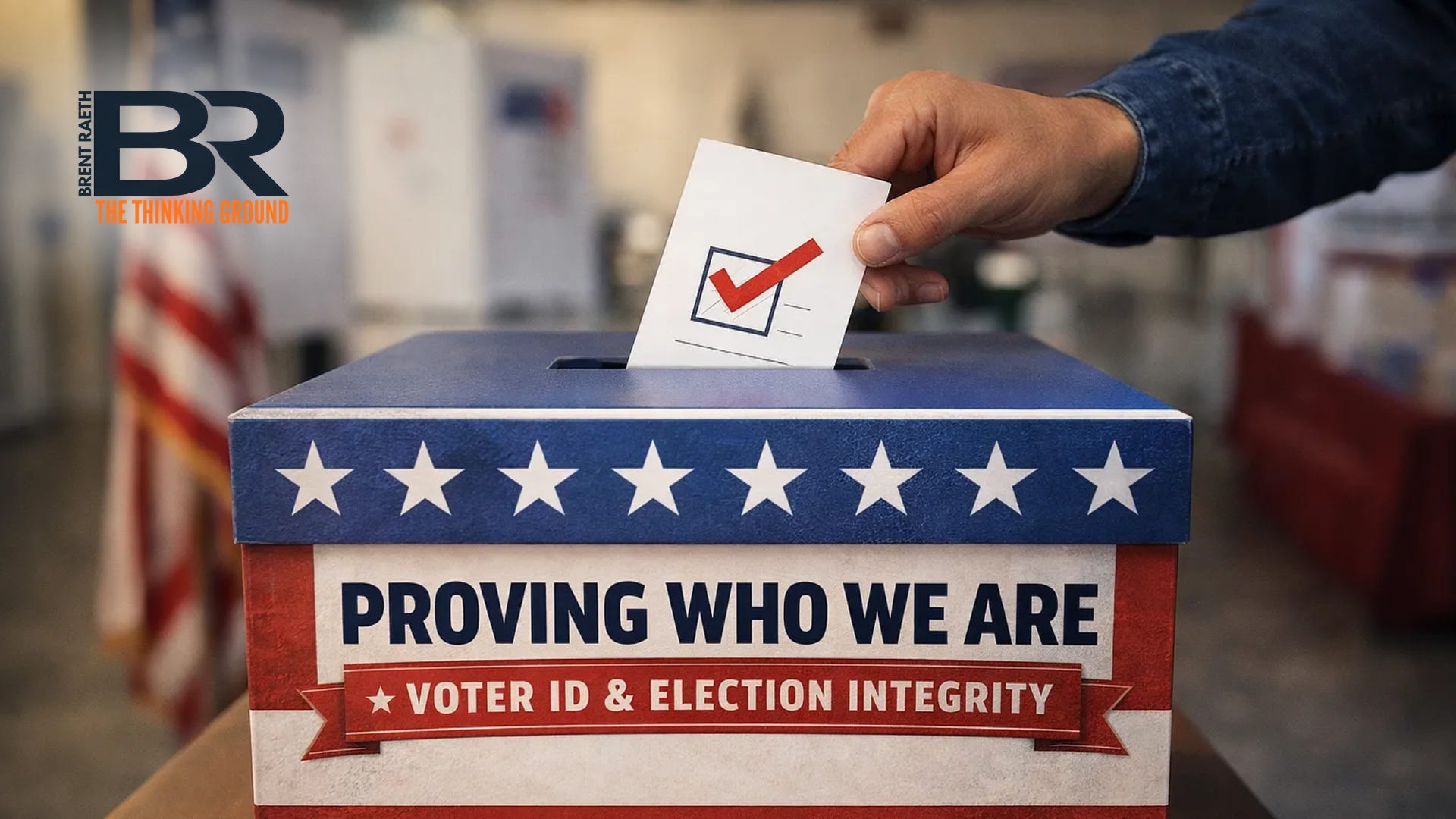
Why is it so controversial to require proof of identity to vote?
The right to vote is one of the most important and sacred rights in the world. Wars have been fought over it. Blood has been shed to secure it. It is a pillar of our republic. If anything deserves protection, integrity, and careful validation, surely it is the ballot.
We require identification to board a plane.
We require identification to buy cigarettes or alcohol.
We require identification to open a bank account.
We require identification to purchase a firearm.
We require identification to complete a real estate transaction.
Yet when the subject turns to voting, the conversation shifts. Opposition becomes intense. Emotions rise. Accusations fly.
So I have had to ask myself: what am I missing? What do I not understand?
That is what I want to attempt to unpack.
Understanding the SAVE Act
The Safeguard American Voter Eligibility Act, commonly referred to as the SAVE Act, seeks to amend federal law to require proof of United States citizenship when registering to vote in federal elections.
At a high level, the bill would:
• Require documentary proof of citizenship when registering to vote in federal elections
• Mandate that states remove non citizens from voter rolls
• Establish criminal penalties for officials who knowingly register ineligible voters
• Require verification of citizenship status against available federal databases
Supporters argue that the Act strengthens election integrity by ensuring that only eligible citizens vote in federal elections. They frame it as a preventative measure, reinforcing confidence in outcomes.
Critics argue that it could create barriers for eligible voters, particularly those who do not have ready access to documentation such as passports or certified birth certificates. They raise concerns about administrative burdens, database inaccuracies, and the potential for lawful voters to be wrongly removed from rolls.
What Is Good
There is merit in the core principle of the SAVE Act.
Citizenship matters in federal elections. If we agree that voting is a defining act of civic participation, then confirming eligibility is reasonable. Standardizing verification processes could improve consistency across states and reinforce public trust.
In an era where institutional confidence is fragile, measures that increase transparency and clarity should not be dismissed outright.
What Is Controversial
The controversy centers on access.
Opponents argue that documentation requirements may disproportionately affect:
• Elderly citizens who were born at home and lack formal birth records
• Low income individuals who may not possess passports
• Married women whose birth certificates do not match current legal names
• Citizens facing bureaucratic delays in obtaining certified documents
There is also concern about implementation. Government databases are not perfect. Errors occur. False positives and mismatches could temporarily disenfranchise lawful voters if safeguards are not carefully designed.
These concerns are not trivial. If the goal is to protect the right to vote, any policy that risks suppressing lawful participation deserves scrutiny.
Looking Around the World
It is helpful to step back and examine global practice.
Many democratic nations require some form of identification to vote.
Germany requires a voter notification card and government issued ID.
France requires official identification at polling stations.
Canada requires voters to prove identity and address using government documents.
India uses voter ID cards with photographs.
Mexico employs biometric voter identification cards.
In fact, voter ID requirements are common across developed democracies. They are generally viewed as ordinary administrative safeguards rather than existential threats to liberty.
That does not mean every system is flawless. It does suggest that identity verification and democratic participation are not inherently incompatible.
Taking a Position
After wrestling with both sides, here is where I land.
Requiring proof of identity to vote is not unreasonable. It is consistent with how we treat virtually every other important civic and economic transaction. The ballot is too important to leave vulnerable to doubt.
However, if we are going to require identification, we must remove unnecessary barriers to obtaining it.
If identification is mandatory, it should be:
• Free
• Easily accessible
• Efficiently processed
• Supported by robust appeal mechanisms
We cannot champion integrity while neglecting access. Protection and participation are not enemies. They must be partners.
When Sarah reminded us to bring our identification to closing, we did not question her integrity or assume malice. We understood the responsibility that came with transferring ownership. Verification was simply part of the process.
Voting transfers something even more significant than property. It transfers power.
If we are serious about preserving the sanctity of that transfer, we should not be afraid to ask a simple question at the ballot box:
Who are you?
And we should be equally serious about making sure every lawful citizen can answer it without undue burden.
That balance, not outrage on either side, is where the conversation belongs.