


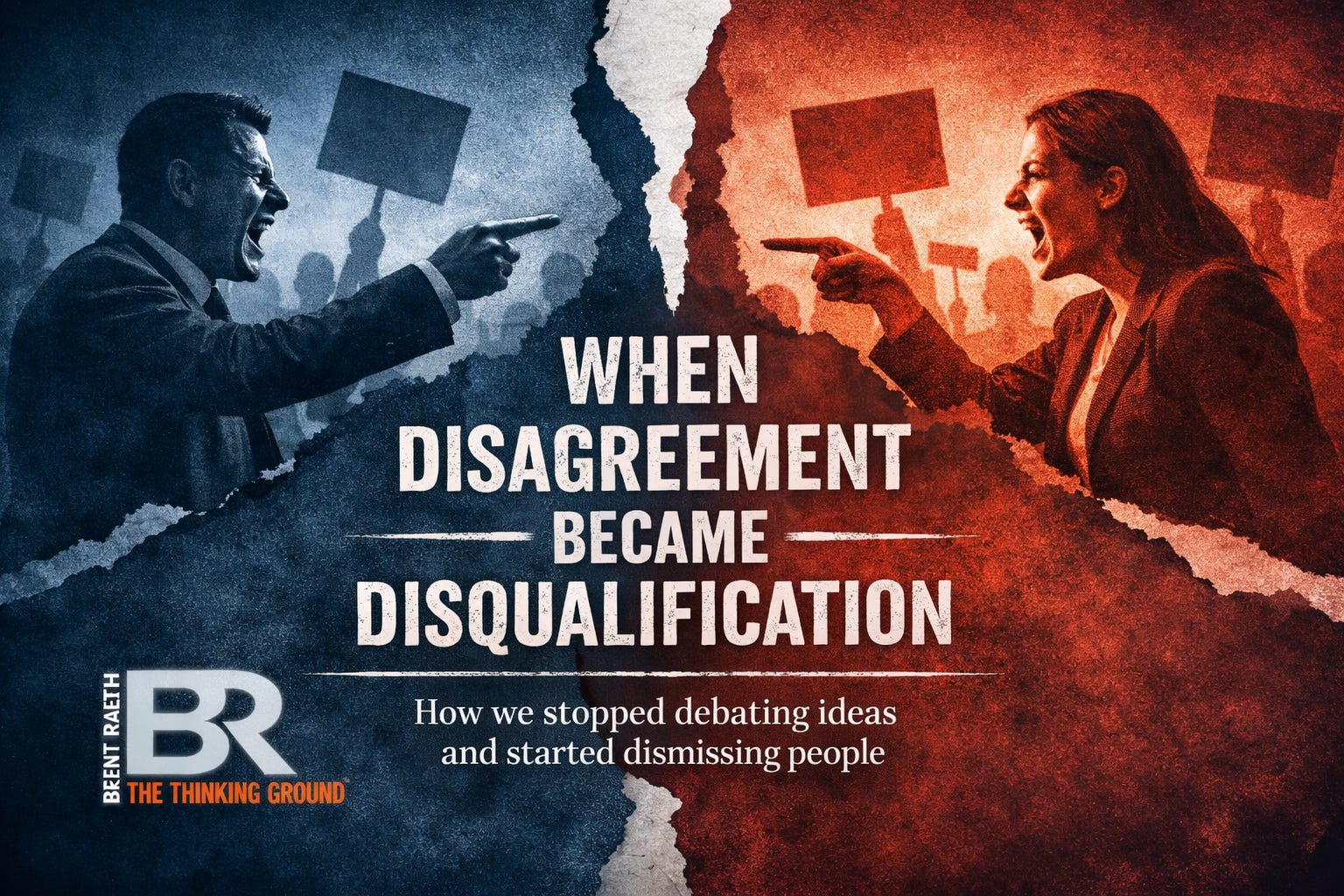
A few years ago, disagreement still had a purpose.
It was not always comfortable, but it was productive. People could sit across from each other, hold different views, and work through ideas. There was an understanding, even if unspoken, that disagreement was part of the process of getting to something better.
That has changed.
Today, disagreement is often treated as disqualification. The moment someone expresses a view that does not align, the response is no longer to examine the idea. It is to label the person.
They are ignorant.
They are extreme.
They are part of the problem.
And once that label is applied, the conversation is effectively over.
From Ideas to Identities
The shift did not happen all at once, but it is now difficult to ignore. We have moved from debating ideas to assigning identities. Instead of asking, “Is this argument valid?” we ask, “What kind of person would believe this?”
That distinction matters more than most people realize.
When ideas are tied to identity, disagreement becomes personal. It is no longer about the strength of the reasoning. It becomes about defending who you are and where you belong. That makes honest conversation nearly impossible.
In business, this would be considered a failure of decision-making. If a leadership team dismissed ideas based on who said them rather than what was said, the organization would quickly lose its ability to solve problems. Yet in broader culture, this behavior has become normalized.
The Incentives Are Misaligned
Part of the problem is the environment we operate in.
Social platforms reward speed, certainty, and emotional reaction. The faster and sharper the response, the more attention it receives. There is little incentive to slow down, ask questions, or acknowledge complexity. Those behaviors are often overlooked, or worse, interpreted as weakness.
It is much easier, and far more rewarded, to respond with a label than with a thoughtful argument.
Over time, this reshapes how people engage. The goal shifts from understanding to winning. And “winning” is no longer about presenting the strongest idea. It is about discrediting the other person as quickly and decisively as possible.
The Illusion of Being Right
There is a certain satisfaction in dismissing someone. It creates a sense of clarity. It reinforces the belief that you are on the right side of the issue. It simplifies a complex situation into something manageable.
But it is an illusion.
Dismissing a person does not strengthen your position. It only removes the need to examine it. The idea itself remains untested, unchallenged, and often underdeveloped.
In leadership, this is a dangerous pattern. The strongest organizations are built on the ability to challenge assumptions, not protect them. When people stop engaging with opposing views, blind spots grow. Decisions become weaker. Confidence increases, but competence does not.
The same principle applies at a societal level.
A Practical Example of the Shift
A pattern I have seen repeatedly, both in business and outside of it, looks like this.
A leader introduces a new initiative. The idea is sound, but not perfect. Someone in the room raises a concern. Not to derail the idea, but to strengthen it.
Instead of engaging the concern, the response becomes defensive.
“You’re just being negative.”
“You don’t see the bigger picture.”
“You always push back on change.”
In that moment, the discussion shifts. The concern is no longer evaluated on its merit. The person raising it is labeled instead.
What happens next is predictable. The concern goes unaddressed. The initiative moves forward with blind spots. Weeks or months later, those blind spots show up as real problems.
Not because the team lacked intelligence or effort, but because they chose dismissal over discussion.
I have seen this play out in leadership meetings where everyone in the room is capable and well-intentioned. The failure is not in talent. It is in the breakdown of how ideas are handled under pressure.
And while this example comes from business, the same pattern shows up everywhere. In public discourse, in relationships, and in everyday conversations.
The moment we label the person instead of engaging the idea, we lose the opportunity to get better.
What We Are Losing
The cost of this shift is not just civility. It is capability.
When disagreement disappears, so does refinement. Ideas improve through pressure. They become stronger when they are tested, questioned, and forced to hold up under scrutiny. Without that process, we are left with positions that feel right but have never been fully examined.
We are also losing the ability to listen with intent. Not to respond, not to correct, but to understand. That skill is foundational, not just for healthy discourse, but for leadership, relationships, and problem-solving.
Without it, everything becomes more reactive and less thoughtful.
Reintroducing the Discipline of Engagement
This is not a call for everyone to agree. It is a call to engage differently.
Disagreement should be an invitation to think more deeply, not a trigger to shut someone down. It requires discipline to separate ideas from identity, to evaluate arguments on their merit, and to remain open to the possibility that you may not have the complete picture.
That discipline is becoming rare. But it is also becoming more valuable.
The individuals and organizations that can maintain it will think more clearly, decide more effectively, and ultimately lead better.
The rest will continue to talk past each other, increasingly certain and increasingly divided.
And none of us benefit from that.