


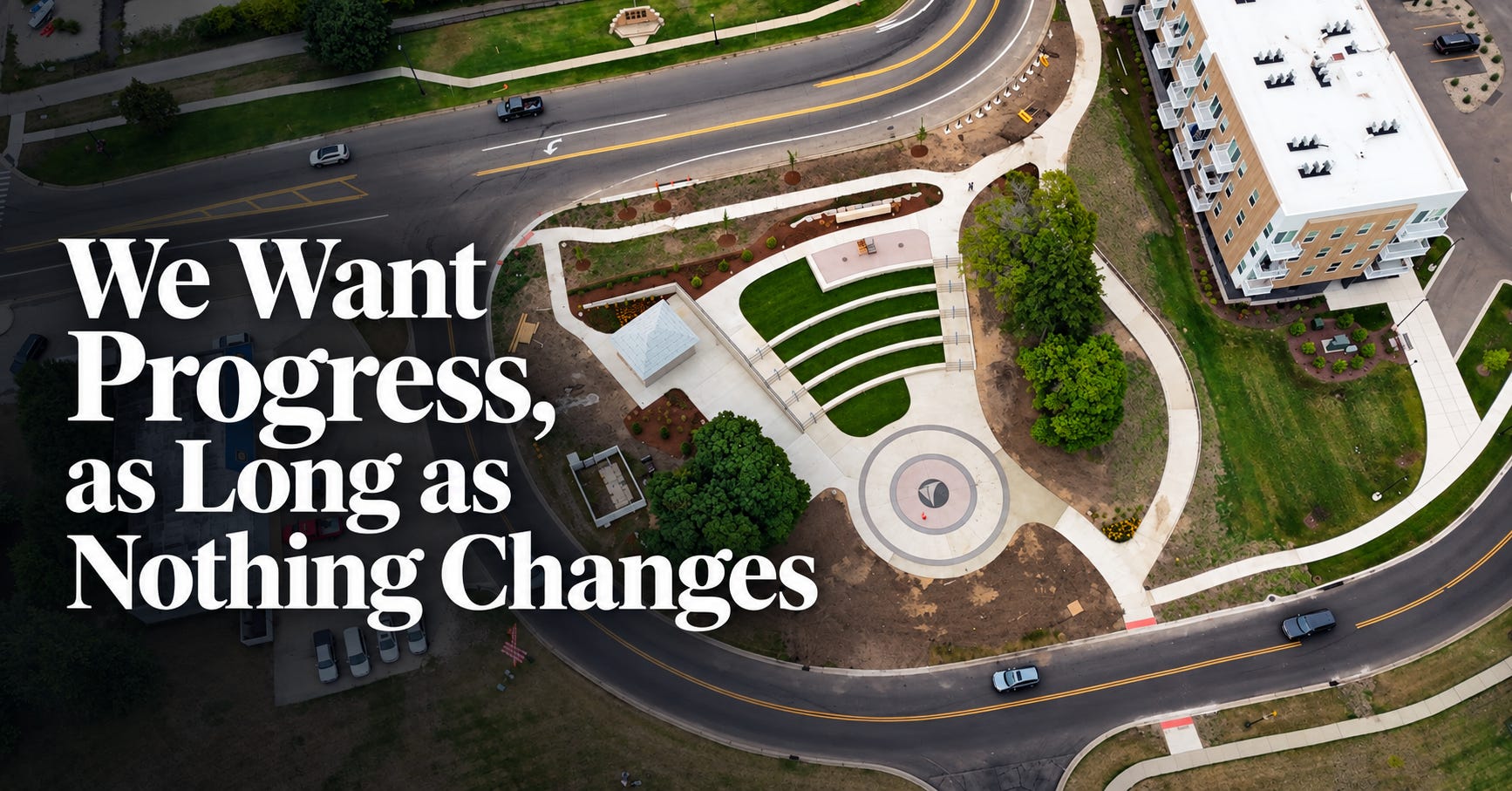
Watching the conversations around changes in Whitehall lately, I keep coming back to the same question: When did complaining become our default response to everything?
We say we need housing. Someone builds housing, and suddenly we need to explain why it is the wrong housing. We want an interesting downtown with places to gather and things to do. Someone works toward creating those spaces, and we immediately focus on everything that will be different.
We want the outcome. We resent the process. And somehow, we expect our communities to get better without allowing them to change.
The Harwood Flats building and the new amphitheater have brought that contradiction into focus for me. But this reaches far beyond Whitehall. Our incessant negativity feels like a pandemic, spreading through comment sections, conversations, workplaces, and community meetings until finding something wrong becomes practically automatic.
At some point, we need to ask what all that complaining is actually accomplishing.
We Need Housing, but Not “That” Housing
Harwood Flats is a useful example. The development brought 32 apartments to a downtown site previously occupied by a bowling alley and later left vacant. That is a tangible change: a property that had been sitting empty now provides places for people to live. CatchMark Community’s coverage describes the project and the history of the site.
Does that mean everyone has to like the building? Of course not. Architecture, affordability, scale, and how a development fits its surroundings are reasonable subjects for discussion. Adding apartments does not automatically solve every housing problem, particularly for people who still cannot afford them.
But there is a contradiction worth confronting when we acknowledge a need for housing and then reject each actual attempt to build it.
We need housing, but not that housing. We support development, but not there. We want investment, but only if it looks exactly like the picture in our own heads.
Eventually, support with that many conditions starts to look a lot like opposition.
A Better Downtown Will Be a Different Downtown
The amphitheater raises a similar question. We talk about wanting cool downtown spaces, community activities, and reasons for people to spend time here. Yet creating those opportunities requires making decisions about how space will be used. Something will look different. Something will function differently. Familiar surroundings may become unfamiliar for a while.
That is part of building something.
A lively downtown has activity. Gathering spaces bring people together. Events create sound and movement. Those effects deserve thoughtful planning, but the expectation that we can create a more active community without changing anyone’s experience of it is impossible to satisfy.
So why do we keep demanding it?
Complaining Is Easier Than Building
I think part of the answer is that complaining is easy. Building requires you to work within constraints. Criticizing lets you imagine a version without any.
The person responsible for a project has to consider the property, the money, the timing, the rules, and competing needs. The person commenting on it can simply announce that they would have done it differently. They never have to show whether their alternative could actually work.
That imbalance makes criticism a very comfortable place to stand.
There is also comfort in familiarity. We know how things used to look. We know where we parked, what we could see, and how a space felt. A change can register as a loss before we have given ourselves any opportunity to experience what it adds.
That feeling is understandable. It is also worth examining. “I am used to this” cannot be the only standard by which we judge what comes next.
The community we remember fondly was itself built through changes. Buildings went up. Businesses opened. Roads and public spaces were created. The places that feel permanent to us were once new, and someone probably had an objection to those, too.
Our memories deserve respect. So do the people who need this community to serve their lives today.
Negativity Feeds on Itself
Another reason we complain is that negativity gives us something to share. It is remarkably easy to start a conversation by pointing out what is wrong. Someone agrees. Someone adds another grievance. Before long, we have reinforced each other’s certainty without learning anything new.
Online, that conversation can continue indefinitely. We can form a strong opinion from a photograph, a headline, or somebody else’s interpretation. Then we defend it as though we personally reviewed every decision behind the project.
I include myself in this. I have opinions. I get frustrated. I can react before I have the whole picture. Recognizing that tendency in myself makes me think we all need to be more deliberate about what we contribute.
Because constant negativity has a cost.
It wears on the people willing to organize, invest, volunteer, and take responsibility. It makes every new idea feel like an invitation to be publicly picked apart. It can teach capable people that stepping forward will earn them more aggravation than staying out of it.
Then we wonder why the same handful of people do everything.
What Tradeoff Are You Willing to Accept?
None of this means residents should stay quiet. People have every right to question decisions that affect their neighborhoods, their money, and their quality of life. A serious concern deserves an answer, even when the person raising it has no alternative proposal.
But we should be willing to make our criticism specific and our judgment fair. What exactly is the problem? What information are we missing? What change would address the concern? Can we acknowledge a benefit alongside the drawback?
Most of all, what tradeoff are we personally willing to accept?
That last question matters because a community cannot function if every person expects everyone else to absorb the inconvenience of progress. We cannot demand housing, activity, investment, and opportunity while insisting that none of it affect our view, our routine, or our preferences.
We also need to leave room for something to be worthwhile without being our favorite thing.
You can dislike a building’s appearance and recognize that people now have homes there. You can have questions about an amphitheater and appreciate the possibilities of a place where neighbors gather. You can prefer the way something used to be and still give what comes next a fair chance.
That is part of sharing a community with other people.
Leave Room for Something Good
Whitehall’s changes have reminded me how much energy we spend judging what others are trying to accomplish. I would like to see us direct more of that energy toward understanding the work, improving the outcome, and occasionally saying thank you.
Before adding another complaint, I want to ask myself whether I am helping address a problem or simply passing my irritation along.
Our communities need people who care enough to ask hard questions. They also need people willing to build, adapt, and recognize something good when it happens.
If we want a better place to live, we have to leave room for it to become one.