


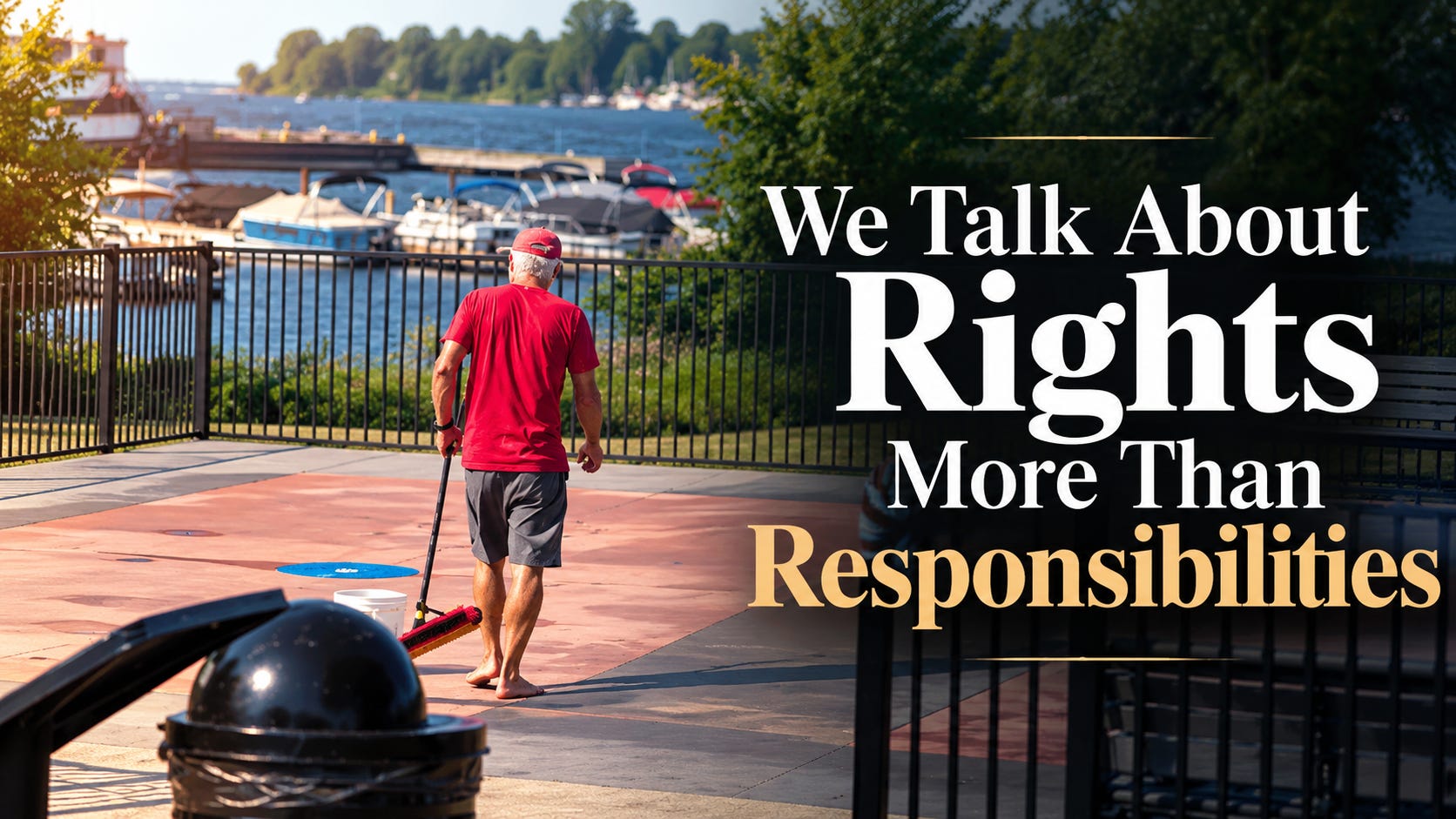
Not long ago, I watched a friend of mine sweeping a public area near the waterfront.
It was a beautiful day. Boats were sitting in the marina, people were enjoying the surroundings, and my friend was quietly doing his part to keep the area looking nice.
There was nothing particularly remarkable about the task itself. He wasn’t making a speech about community pride or looking for recognition. He was simply doing something that made a shared space better for everyone.
But the moment stuck with me.
I have always appreciated people who take pride in their communities. People who see something that needs to be done and do it, often without being asked or expecting anything in return.
Watching my friend that day reminded me that community pride is demonstrated through actions far more often than words.
We all appreciate clean parks, safe neighborhoods, good schools, maintained roads, and attractive public spaces. We expect people to respect our property, follow the rules, and treat one another with consideration.
And those are reasonable expectations.
But how often do we stop to consider our own role in creating the kind of community we want to live in?
It is easy to complain about litter in a park. It takes a little more effort to pick something up.
It is easy to criticize the decisions made by a school board or city council. It takes more effort to understand the issues, attend a meeting, or participate constructively.
It is easy to talk about the importance of community. It takes something more to volunteer, support a neighbor, or contribute when there is nothing obvious to gain personally.
Having served in several community organizations over the years, I have developed a real appreciation for the people who quietly make things work.
The volunteer who shows up early to prepare for an event. The neighbor who checks on someone who needs help. The parent who gives up an evening to support a school activity.
And sometimes, it is simply a friend sweeping a waterfront walkway.
These are the people who help turn a collection of individuals into a community.
Yet I sometimes wonder whether we have become so focused on what we are entitled to receive that we have lost sight of what we should be willing to give.
We talk a great deal about our rights. We spend considerably less time talking about our responsibilities.
Rights Are Essential, but They Are Not the Whole Story
Rights matter. They protect our freedoms, establish boundaries, and help ensure that individuals are treated with dignity.
We should defend them.
But there is a difference between having a right and exercising that right responsibly.
You may have the right to express your opinion. That does not mean every disagreement needs to become a personal attack.
You may have the right to criticize an elected official. That does not mean you should ignore the facts or dismiss the complexity of the decisions being made.
You may have the right to make a decision that benefits you personally. That does not mean you should disregard how it affects others.
The question is not simply whether we are allowed to do something.
It is whether doing it reflects the kind of person we want to be and the kind of society we want to live in.
I think we have become very good at identifying when someone else has failed to meet our expectations.
We are not always as willing to examine whether we are meeting the expectations others should reasonably have of us.
A parent expects a school to provide a quality education but may be reluctant to reinforce the habits that make learning possible.
An employee expects to be treated professionally but may resist the accountability that professionalism requires.
A leader expects loyalty and trust but sometimes overlooks the obligation to earn both.
A citizen expects effective government but may have little interest in understanding the issues or participating in the process.
The problem is not that these expectations are unreasonable.
It is that expectations cannot flow in only one direction.
Freedom Depends on More Than Rules
I think we sometimes misunderstand the relationship between freedom and responsibility.
We tend to view freedom as the absence of restrictions. The fewer rules, the better.
But consider what happens when people consistently disregard their obligations to others.
When drivers ignore traffic laws, communities respond with greater enforcement.
When employees repeatedly fail to meet commitments, organizations introduce additional oversight and processes.
When people misuse public spaces, communities adopt restrictions intended to protect those spaces.
In each case, the irresponsible behavior of some can reduce the freedom of everyone.
This is one reason personal responsibility matters beyond the individual.
Our choices influence the environment in which other people live and work.
A community where people generally act with consideration requires fewer rules to manage everyday behavior.
A workplace where people follow through on commitments can provide greater autonomy.
A relationship built on trust requires less monitoring and fewer demands for reassurance.
Freedom is easier to preserve when people can reasonably trust one another to act responsibly.
What Are We Teaching Young People?
This issue becomes especially important when I think about education and preparing young people for adulthood.
We should absolutely teach young people about their rights.
They need to understand their freedoms, recognize unfair treatment, and have the confidence to speak up when something is wrong.
But knowing your rights is only part of becoming a capable adult.
Young people also need to understand that commitments matter, even when fulfilling them is inconvenient.
That being part of a team sometimes means doing things that are not personally rewarding.
That disagreements do not excuse disrespect.
That mistakes are inevitable, but refusing to acknowledge them makes things worse.
And that other people have needs, priorities, and perspectives that deserve consideration.
These lessons do not discourage independence. They help young people exercise independence wisely.
I have always believed that education should prepare students for more than passing tests or finding employment.
It should help them become capable, thoughtful adults who can contribute meaningfully to their families, workplaces, and communities.
Understanding the relationship between personal freedom and responsibility is an important part of that preparation.
Responsibility Starts With Those Who Lead
There is an important distinction I want to make.
Conversations about personal responsibility can easily become lectures directed at people with less authority.
Business owners tell employees to work harder. Public officials tell citizens to be more patient. Parents tell children to be more disciplined.
But those messages mean very little when the people delivering them refuse to hold themselves to the same standards.
If anything, responsibility should increase with authority.
As a business owner and someone who has served in community leadership, I have made decisions that affected other people.
Some were difficult. Some were unpopular. And some, looking back, could have been handled better.
Having the authority to make those decisions did not eliminate my obligation to consider their consequences.
It increased it.
I cannot reasonably expect accountability from a teammate while making excuses for my own mistakes.
I cannot expect people to trust my judgment if I am unwilling to explain my decisions or listen to legitimate concerns.
And I cannot expect others to accept responsibility for their actions if I consistently shift blame for mine.
Leadership comes with privileges, but those privileges are accompanied by obligations.
The credibility to ask more of others begins with a willingness to expect more of ourselves.
Responsibility Is Not the Same as Submission
I also think it is important to recognize what responsibility does not mean.
It does not mean accepting mistreatment, remaining silent in the face of wrongdoing, or excusing people in positions of authority.
An employee should not feel obligated to remain loyal to an employer who consistently mistreats them.
A citizen should not be expected to support every decision made by government.
A student should not be taught that questioning authority is inherently disrespectful.
In fact, there are times when exercising our rights is one of the most responsible things we can do.
Speaking up against unethical conduct, challenging an unfair policy, or defending someone who is being mistreated may require courage and personal sacrifice.
Rights are not rewards for good behavior. They are protections that belong to people regardless of whether others approve of their choices.
The goal is not to choose between rights and responsibilities.
It is to understand that both are necessary.
Rights protect individuals from abuses of power.
Responsibilities help us use our freedom in ways that respect the freedom and dignity of others.
The Communities We Create
One of the things I have learned through community service is that many of the people who make the greatest difference receive the least recognition.
They are not necessarily the loudest voices at public meetings or the people offering the most criticism on social media.
They are often the people setting up chairs before an event, serving on a volunteer committee, coaching a youth team, supporting a fundraiser, or checking on a neighbor.
They understand that being part of a community involves more than enjoying its benefits.
And they usually do not spend much time explaining that philosophy.
They simply live it.
That is what I appreciate about the picture of my friend sweeping near the waterfront.
It captures something that is easy to overlook in our conversations about society.
Communities do not become better places merely because people demand better conditions.
They improve when people are willing to help create those conditions.
Of course, we should expect our institutions and leaders to fulfill their obligations. We should insist on fairness, transparency, and accountability.
But there is a limit to what any institution can accomplish without the active participation of the people it serves.
A good community is not something we simply receive.
It is something we help build.
A Better Question to Ask
I do not think we need fewer conversations about rights.
I think we need more balanced conversations about what it means to live alongside other people.
We should defend our freedoms while recognizing that our actions have consequences beyond ourselves.
We should expect accountability from leaders while being willing to examine our own conduct.
We should teach young people to stand up for themselves while also helping them understand the value of serving others.
And we should appreciate the people whose quiet contributions make our communities better.
The next time I see someone taking care of a public space, volunteering their time, or helping a neighbor, I hope I remember what my friend demonstrated that day.
It is easy to enjoy the benefits of a good community without thinking about the effort required to maintain one.
But somebody has to do the work.
And the quality of our communities depends, in no small part, on how many people are willing to be that somebody.
We have become very comfortable asking, “What am I owed?”
Maybe we should spend a little more time asking, “What do I owe others?”