


I recently posted something online that I didn’t think was controversial. It wasn’t aimed at a specific party, person, or policy. It wasn’t a call to action or a critique of anyone in particular. It was simply a reflection on tribalism. How we label one another. How quickly disagreement turns into dismissal. How name calling has become a substitute for thinking.
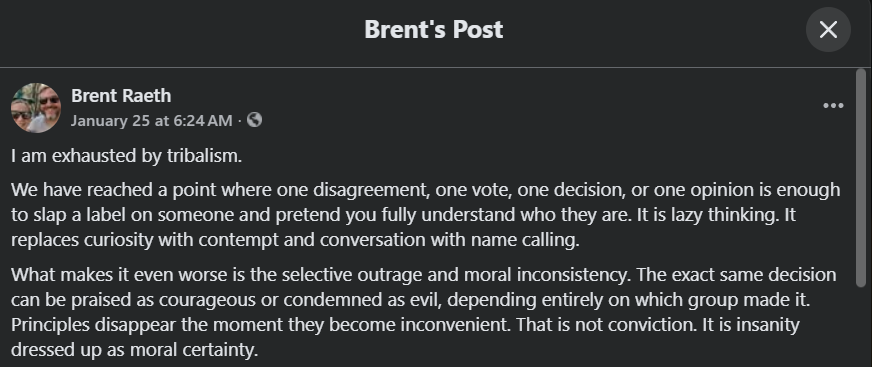
The response proved the point almost immediately.

Within hours, people were reading intent into the post that wasn’t there. Assumptions were made. Lines were drawn. Some agreed. Some bristled. A few responded defensively, as if naming the problem itself was an attack. Simply talking about tribalism caused it to surface in real time.


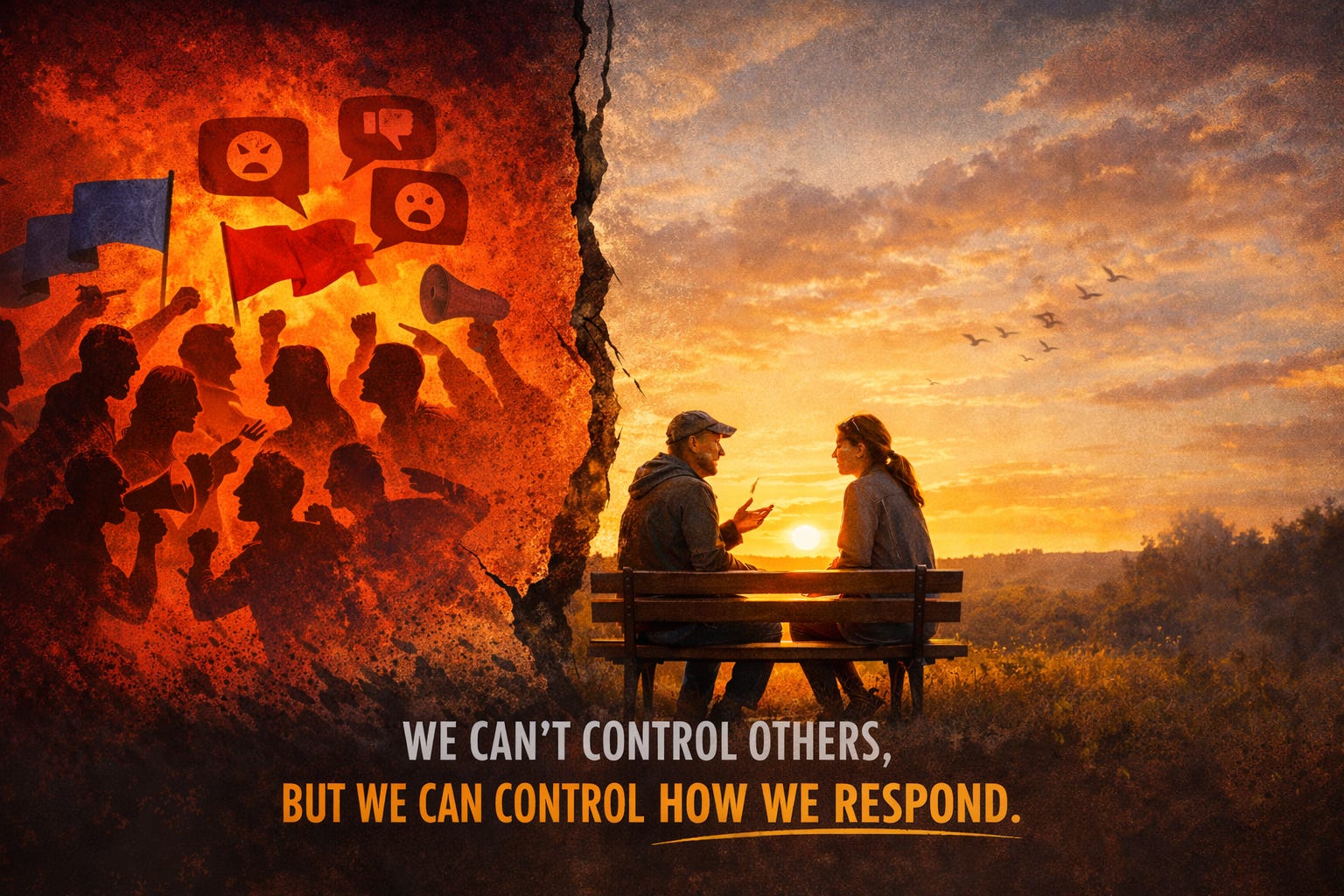
That experience reinforced something I have come to believe more strongly over the years. The only thing any of us truly control is how we act or react, and the choices we make.
We do not control the noise. We do not control the labels others place on us. We do not control how someone else behaves, responds, or interprets our words. But we do control whether we contribute to the cycle or refuse to add fuel to it.
Tribalism thrives on shortcuts. It encourages us to sort people into categories instead of engaging with ideas. It rewards loyalty to a group over curiosity, nuance, or humility. Once someone is labeled, it becomes easy to dismiss them entirely. Their motives are suspect. Their arguments are irrelevant. Their humanity is secondary.
What makes this so corrosive is that it rarely starts with cruelty. It often starts with fear, frustration, or exhaustion. People feel unheard. They feel attacked. They feel backed into a corner. And when that happens, the instinct is to strike back, to defend the tribe, to protect identity at all costs.
But every time we do that, we give up a piece of our agency.
Choosing how we respond is not weakness. It is discipline. It is deciding that our character is not determined by the behavior of others. It is recognizing that disagreement does not require contempt, and that conviction does not require cruelty.
At the end of the day, how we treat people, especially those we disagree with, says far more about us than it does about them.
This does not mean avoiding hard conversations. It does not mean pretending differences do not exist. It does not mean silence. It means speaking with intention. Listening with curiosity. Pausing before reacting. Refusing to reduce a complex human being to a slogan, a label, or a caricature.
The irony is that many of us say we want less division, but we often participate in it reflexively. We share posts that mock. We respond in ways that score points instead of build understanding. We assume the worst before asking questions. And then we wonder why nothing ever changes.
Tribalism is not defeated by winning arguments. It is weakened when individuals decide, quietly and consistently, to act differently.
That choice is available to all of us. Every post. Every comment. Every conversation. We may not control the world around us, but we always control the part we play in it.
And that is where real change begins
.