


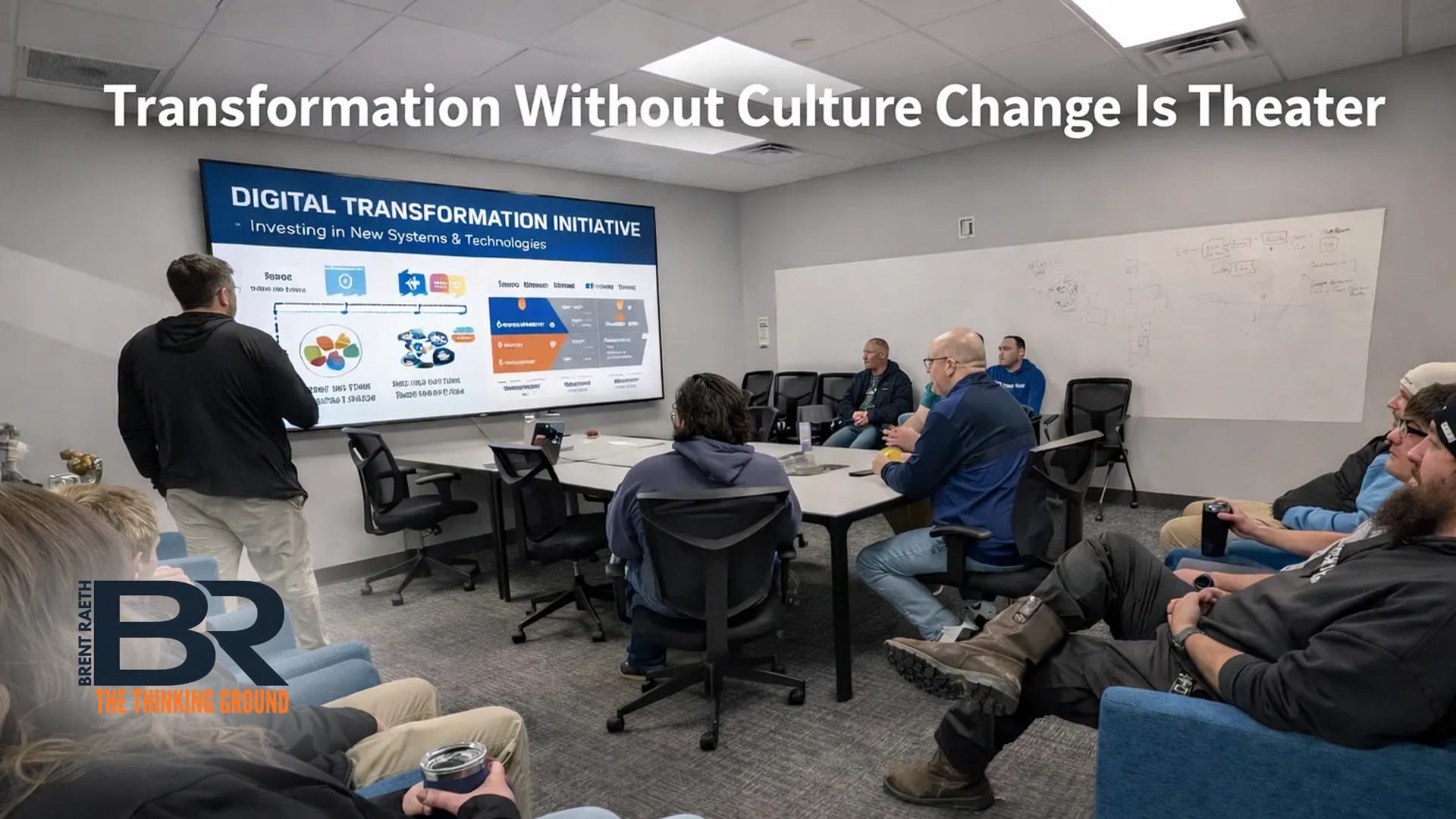
A few years ago I sat in a boardroom listening to a customer leadership team present their “digital transformation” initiative.
The slide deck was impressive. There were polished diagrams showing new platforms, automated workflows, cybersecurity tools, and dashboards filled with data. Millions of dollars had been allocated. Consultants had been hired. A multi year roadmap had been approved.
On paper, it looked like transformation.
But during the discussion I asked a simple question that derailed the meeting almost immediately.
“Who is responsible for owning the process changes that go with these new systems?”
The room got quiet.
Someone finally responded, “Well, the new platform should handle most of that.”
In that moment it became clear. The organization was not transforming anything. They were installing software.
And those are two very different things.
Technology can enable change. It cannot create it. Without culture change, transformation is just theater.
The Illusion of Change
Organizations love the language of transformation.
Digital transformation. Security transformation. AI transformation. Operational transformation.
The word suggests something dramatic. A shift from one state to another. A reinvention.
But most initiatives labeled “transformation” are simply modernization projects. New tools layered on top of old behaviors.
The same decision making habits remain.
The same accountability gaps remain.
The same resistance to discipline remains.
What changes is the technology. What does not change is the culture.
And culture always wins.
You can install the most advanced systems in the world, but if the people using them do not think differently, behave differently, and take responsibility differently, the results will look remarkably similar to what existed before.
The tools become more expensive. The outcomes stay the same.
Culture Is the Operating System
Culture is not posters on a wall or a set of corporate values printed in the employee handbook.
Culture is how people behave when no one is watching.
It is the collection of norms that answer questions like:
• Do we take ownership or pass blame?
• Do we solve problems or avoid them?
• Do we pursue excellence or settle for acceptable?
• Do we hold each other accountable or tolerate mediocrity?
These behaviors form the operating system of the organization.
Technology runs on top of that operating system. It does not replace it.
If the underlying culture tolerates shortcuts, weak accountability, and shallow thinking, even the best systems will be used poorly.
Controls get bypassed.
Processes get ignored.
Dashboards get gamed.
The technology works exactly as designed.
The organization does not.
Why Leaders Avoid the Real Work
Culture change is hard.
It requires leaders to confront uncomfortable truths about how the organization actually operates. It requires challenging long standing habits. It requires holding people accountable in ways that may create friction.
Most importantly, it requires leaders to change themselves.
That is why many organizations choose the easier path.
Buying technology feels like action.
Launching initiatives creates excitement.
Announcing transformation generates positive headlines.
But none of those things require altering behavior.
Real culture change does.
And culture change cannot be outsourced to consultants, delegated to a committee, or installed through software.
Transformation Starts With Behavior
If an organization truly wants to transform, the starting point is not technology. It is behavior.
Leaders must define the standards of ownership, accountability, and excellence that the organization expects. Those standards must be reinforced consistently, even when it is uncomfortable.
Processes must be redesigned around responsibility rather than convenience.
People must be expected to think critically rather than simply follow instructions.
When those behaviors begin to change, technology suddenly becomes powerful.
Automation works because people trust the process.
Data becomes valuable because people act on it.
Security improves because individuals take ownership of risk.
The technology amplifies the culture.
But it cannot create it.
The Difference Between Installation and Transformation
Installing technology changes systems. Transforming an organization changes people. One is primarily a purchasing decision. The other is a leadership decision.
That distinction explains why so many transformation initiatives disappoint. Organizations invest heavily in platforms but lightly in culture. They assume capability will produce discipline.
It rarely does. Discipline produces capability. And discipline is cultural.
The Quiet Truth
The uncomfortable truth is that transformation is not primarily a technology challenge. It is a human one.
It requires people to think differently, take responsibility differently, and operate with higher standards than they have in the past. That kind of change cannot be purchased. It has to be built.
Until it is, every transformation initiative risks becoming what so many already are. An expensive performance on a well lit stage.
Impressive to watch.
But ultimately just theater.