


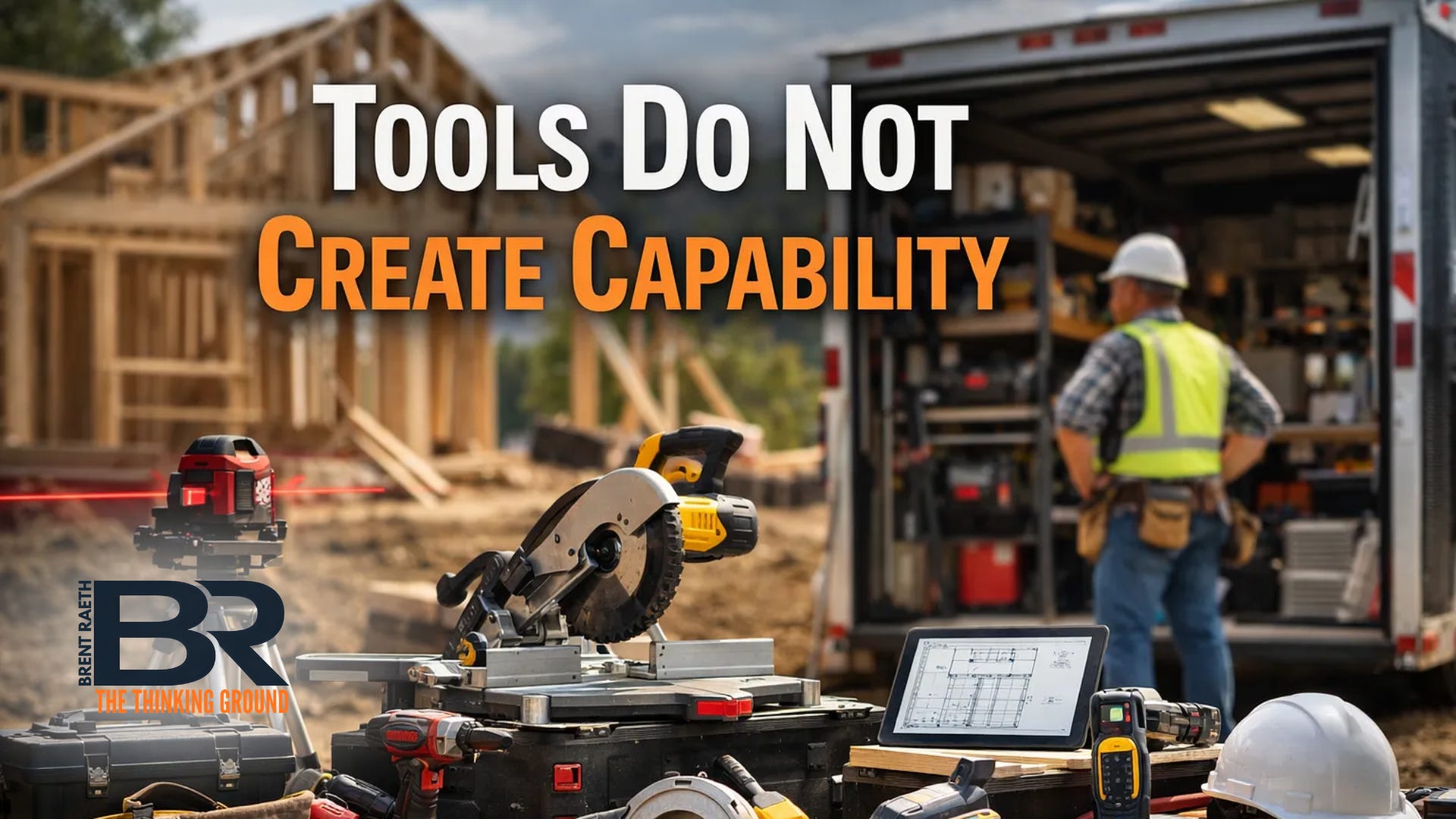
Not long ago I watched a contractor unload a truck full of expensive equipment at a job site. There were laser levels, high end saws, specialized measuring tools, and a trailer that looked like a mobile showroom for a construction supply catalog.
The tools were impressive.
But within a few hours it became clear that the results were not.
Measurements were off. Cuts were sloppy. Simple layout mistakes forced rework. The tools themselves were excellent. The issue was something far more fundamental.
The person using them did not possess the capability the tools assumed.
This dynamic exists everywhere today. In construction. In technology. In business. In leadership. And increasingly in the world of artificial intelligence.
We are surrounded by powerful tools. But tools do not create capability.
They only amplify the capability that already exists.
The Illusion Created by Powerful Tools
Modern tools are extraordinary. Software can automate complex workflows. AI can generate analysis in seconds. Advanced platforms can manage infrastructure, marketing, finance, or cybersecurity with only a few inputs.
Because of this, many people begin to believe the tool itself is what creates the outcome.
It is an understandable mistake. When the interface is simple and the results appear quickly, it can feel like the tool is doing the thinking.
But tools do not replace understanding. They simply execute instructions faster and at greater scale.
If the thinking behind the instruction is weak, the outcome will still be weak. The only difference is that the failure may happen faster and affect more things at once.
A powerful tool in the hands of someone who does not understand the underlying work does not create excellence.
It creates the illusion of competence.
The Gap Between Access and Ability
One of the defining characteristics of the modern era is the collapse of barriers to access.
Anyone can access professional grade software. Anyone can deploy sophisticated technology. Anyone can generate reports, analysis, designs, or code with the help of AI.
Access has been democratized.
Capability has not.
Capability still requires something tools cannot provide. It requires experience, judgment, context, discipline, and pattern recognition built over time.
A seasoned carpenter can build a precise cabinet with modest tools because they understand the material, the tolerances, and the process.
A novice with the most advanced tools available will still struggle because they lack the underlying skill.
The same principle applies in every knowledge field.
A security platform does not make someone a cybersecurity professional. An AI writing tool does not make someone a thinker. A data dashboard does not make someone an analyst.
The tool removes friction. It does not replace mastery.
Automation Exposes What Is Missing
As automation becomes more powerful, this gap becomes more visible.
When routine work is automated, the remaining work requires higher levels of thinking. You must ask better questions, interpret results carefully, detect when something is wrong, and understand the system well enough to guide the tool effectively.
This is where real capability reveals itself.
A skilled professional uses powerful tools to multiply their effectiveness.
An unskilled operator hides behind the tool and hopes the output is correct.
When something breaks, the difference becomes obvious. One person quickly diagnoses the issue because they understand the system. The other blames the software because they never truly understood what the tool was doing.
Why Capability Still Matters
There is a quiet temptation in every generation to believe that technology has eliminated the need for deep skill.
History repeatedly proves the opposite.
Technology changes the tools, but it does not remove the need for competence. In fact, the more powerful the tools become, the more important judgment becomes.
A person who understands their craft will use new tools to produce extraordinary results.
A person who does not will simply produce mediocre work faster.
Sometimes they will produce disastrous work at scale.
The tool simply amplifies what is already there.
Build Capability First
This is why the most valuable investment anyone can make is not in tools.
It is in capability.
Learn the fundamentals. Develop judgment. Understand the systems you work within. Build pattern recognition through experience.
Once that foundation exists, tools become incredibly powerful because they accelerate what you already know how to do.
But without that foundation, tools become little more than expensive decorations.
They may look impressive. They may promise efficiency.
But they cannot create the one thing that actually matters.
Capability.