


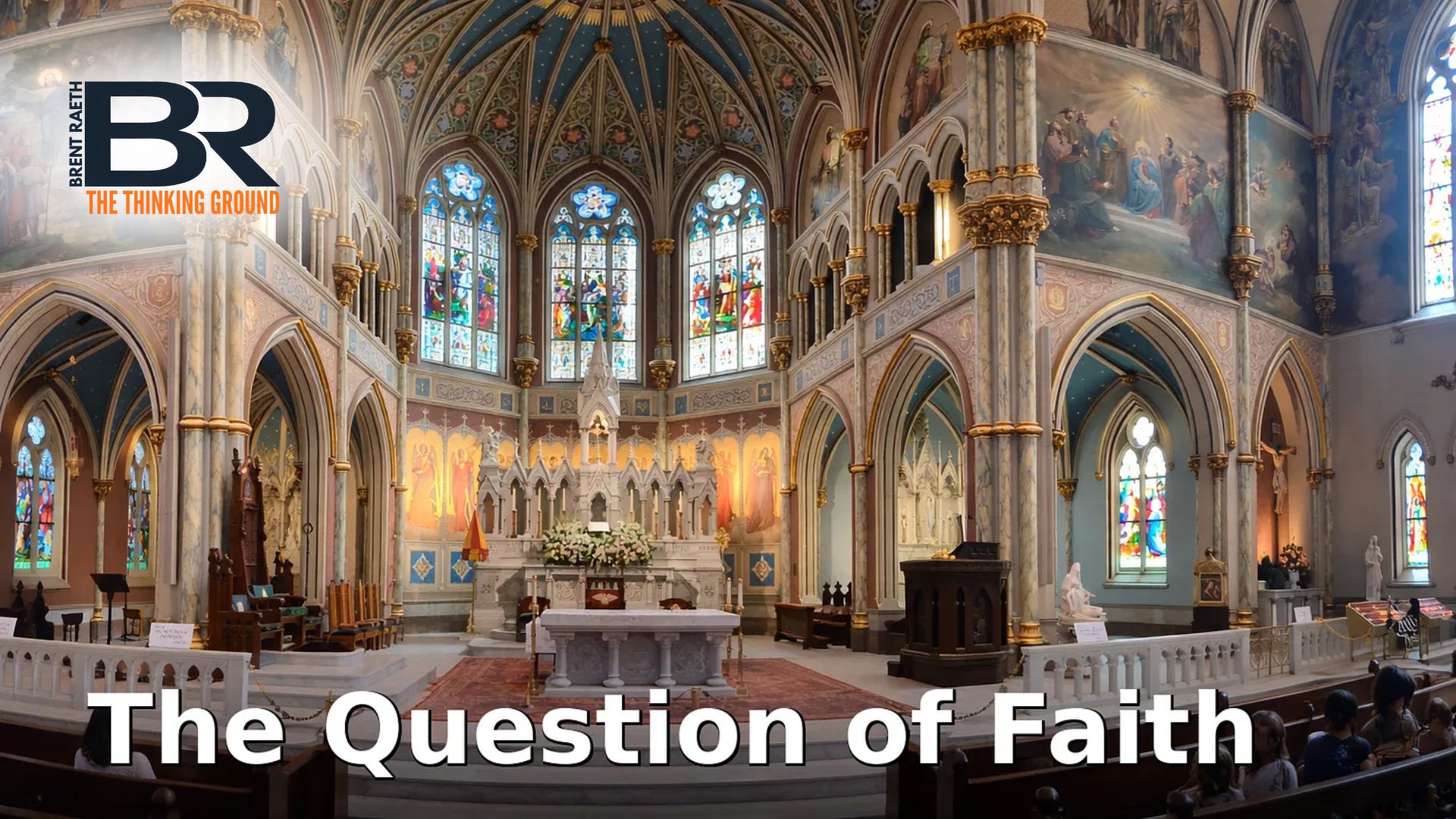
I am going to veer off my normal topics for a moment. This one is less practical, less cultural, and more philosophical. It is about faith. Not in the preachy, polished sense. In the real sense. The kind you wrestle with when you are alone, when the noise is gone, and you are stuck staring at questions you cannot outwork.
I grew up in a wonderful Christian church. The kind of place where the people were not perfect, but they were good. They showed up. They served. They cared. They modeled something steady. It did not feel performative. It felt sincere. If you have ever had that kind of environment, you know how formative it is. It becomes your baseline for what community can look like when it is oriented around something higher than itself.
Because of that upbringing, belief in God has never been foreign to me. It has always been there, in the background if not always in the foreground. But right alongside belief have been lingering questions. Not small ones. The kind that do not go away because you get older. The kind that do not dissolve just because you learn more Bible verses or sit through more sermons. Questions about suffering, about human nature, about why some people seem to get a clearer signal than others, about why the world looks both designed and broken at the same time.
And here is the part I do not love admitting, but it is true. I am often a hypocrite. I do plenty of things that do not align with what I say I believe. I fail at consistency. I fail at discipline. I fail at humility. If you have been around church long enough, you know that hypocrisy is often used as a reason to dismiss faith entirely. But Christianity, at least as I understand it, does not claim that believers are perfect. It claims they are human. It claims they are in need of grace. It claims the entire project begins with the premise that we cannot fully fix ourselves.
That does not excuse inconsistency. It just frames it honestly. To be a Christian is to be imperfect and human, in public. That can feel uncomfortable because it removes the illusion of arrival. It forces you to admit you are still in process.
And if most people are honest with themselves, periods of doubt happen to everyone. Doubt is not always rebellion. Sometimes it is the mind doing what it was designed to do, testing the integrity of what you claim is true. Sometimes it is grief. Sometimes it is exhaustion. Sometimes it is disappointment in people who represented God poorly. Sometimes it is simply the collision between a finite brain and an infinite concept.
This article is not an argument for what I believe. It is a logic exploration of the word faith, and why no matter how many answers you collect, you eventually arrive at a point where you have to trust something you cannot fully prove.
What faith actually means
Most people treat faith like a synonym for wishful thinking. As if faith is what you use when you do not have evidence.
That is not how faith operates in real life.
Faith is closer to a commitment made under uncertainty. It is the bridge between what you know and what you cannot know. It is not the absence of reason. It is what you do after reason takes you as far as it can go.
Every meaningful decision you have ever made required this.
You chose a spouse without being able to guarantee the future.
You started a business without certainty.
You trusted a friend.
You had kids.
You moved to a new place.
You took a job.
In each case, you had information. You had signals. You had patterns. But you did not have proof. You had to move forward anyway. That is not irrational. That is human.
Faith is not unique to religion. Religion just makes the stakes bigger.
The limits of certainty
One of the most underappreciated facts of being alive is that certainty is scarce.
Even in the sciences, which I respect deeply, the language is probabilistic. Models. Theories. Hypotheses. Peer review. Updated understandings. Science is a disciplined way of reducing uncertainty, not eliminating it.
That matters because many people subconsciously hold religion to a standard they do not apply anywhere else. They want courtroom certainty for metaphysical questions while living the rest of their life on reasonable trust.
That is not a critique. It is just a description of how we are wired. We want solid ground. We want to know. But the deeper the question, the more you realize how little of reality is available to direct measurement.
And that leads us to the unavoidable wall.
The wall you eventually hit: something from nothing
No matter what worldview you adopt, at some point you have to wrestle with the fact that something came from nothing.
That statement alone should stop us in our tracks, because it is incomprehensible.
Our entire experience of reality is built on the principle that things come from other things. Cause and effect. Inputs and outputs. Nothing in your daily life begins without a prior source. Even your ideas are recombinations of experience.
So when we ask the ultimate question, why is there anything at all, we are not asking a simple question. We are asking about the origin of causality itself.
And here is the logic problem.
If there was ever truly “nothing,” then nothing could produce something.
Yet there is clearly “something.”
Therefore, either “nothing” never existed, or something outside our normal categories initiated reality.
You can label that initiating reality “God.” You can label it “a necessary first cause.” You can label it “a brute fact.” You can label it “an eternal universe.” You can label it “a multiverse.” You can label it whatever you want.
But the structure of the problem remains. Existence is here. It had to come from somewhere, or it had to always have been. Both options are strange. Both options are beyond intuition. Both options involve accepting something you cannot fully visualize.
That is the point.
Faith is not exclusive to belief in God. Faith is required by every worldview because every worldview must make a claim at the edge of human comprehension.
Two doors, same requirement
When you reach this wall, you usually end up walking through one of two doors.
Door one: Reality is ultimately self existent or eternal in some form. Matter, energy, laws, the universe, the multiverse. Something has always been.
Door two: Reality was initiated by something outside the physical system. A mind, a creator, a necessary being. Something that is not bound by the constraints inside the universe.
Neither door gives you a complete mental picture.
If you choose an eternal universe, you still have to accept an eternal chain or an eternal substrate, which is just as difficult to conceptualize as anything else. If you choose a creator, you still have to accept an uncaused cause, which is also difficult to conceptualize.
This is why the cheap framing of faith, as if only religious people make leaps, does not hold up under scrutiny. Everybody makes a leap. The only question is where you place it.
Why answers do not eliminate faith
A common assumption is that if you had enough answers, you would not need faith.
That sounds reasonable until you test it.
Let us say you explain the Big Bang. Great. What caused the conditions that produced it.
Let us say you explain quantum fields. Great. Why do those fields exist.
Let us say you explain physical laws. Great. Why those laws, and why anything obeys them at all.
Let us say you explain consciousness as emergent. Great. Why emergence is possible.
Let us say you explain morality as evolutionary. Great. Why people still experience moral obligation as more than preference.
Every answer creates a new question, and eventually you arrive at a foundational assumption. A stopping point. A first premise you cannot prove without using itself.
That is where faith lives.
Faith is not the refusal to think. Faith is the decision you make when thinking brings you to the end of the trail.
Faith is not the enemy of doubt
If faith is a commitment under uncertainty, doubt is not automatically a threat. Doubt can be part of intellectual integrity. Doubt can be the sharpening stone that turns vague belief into considered belief.
The danger is not doubt. The danger is pretending doubt is unique to one side.
Believers doubt.
Skeptics doubt.
Everyone doubts.
The difference is what you do with it. Some people use doubt as an excuse to disengage from the question entirely. Others use it as fuel to go deeper. The second group, in my experience, tends to end up more grounded, whether they land in belief or not.
The honest conclusion
Here is the conclusion I keep coming back to.
No matter how many answers you gather, you eventually have to have faith in the belief you hold. Because you will always arrive at the edge where existence itself becomes incomprehensible. Where the question is no longer about data but about metaphysics. Where you must decide which foundational assumption you think is most reasonable.
Faith is not childish. It is unavoidable.
You can place your faith in a personal God.
You can place your faith in an eternal universe.
You can place your faith in brute fact.
You can place your faith in mathematics as ultimate reality.
You can place your faith in something else entirely.
But you will place it somewhere, because the alternative is to pretend the question does not exist.
And for me, the older I get, the more I think the most honest posture is not arrogance but humility.
I grew up around people of faith who were deeply good. I still carry belief, along with questions. I still fall short, often. I still have moments where conviction feels strong and moments where doubt whispers loudly. That does not make the faith fake. It makes it human.
If anything, the question of faith is not, “Do you have doubts.”
The question is, “When you reach the edge of what can be known, what will you trust, and why.” I know where I land, do you?