


A few months ago, a teammate missed a deadline.
It was not catastrophic. No client was lost. No major contract fell apart. But it mattered.
When I followed up, the response came quickly. There were several reasons. Competing priorities. A vendor delay. An unexpected meeting. A technology hiccup. Each explanation had a sliver of truth. Each one was understandable on its own.
But taken together, they formed something familiar.
An excuse.
I remember responding in a way that is consistent with our culture. I said, “I am less concerned with what happened and more concerned with what you are going to do about it. Own it. Fix it. Then tell me how we prevent it next time.”
The conversation shifted immediately. The energy changed from justification to responsibility.
That moment illustrates something I have observed over two decades of leadership.
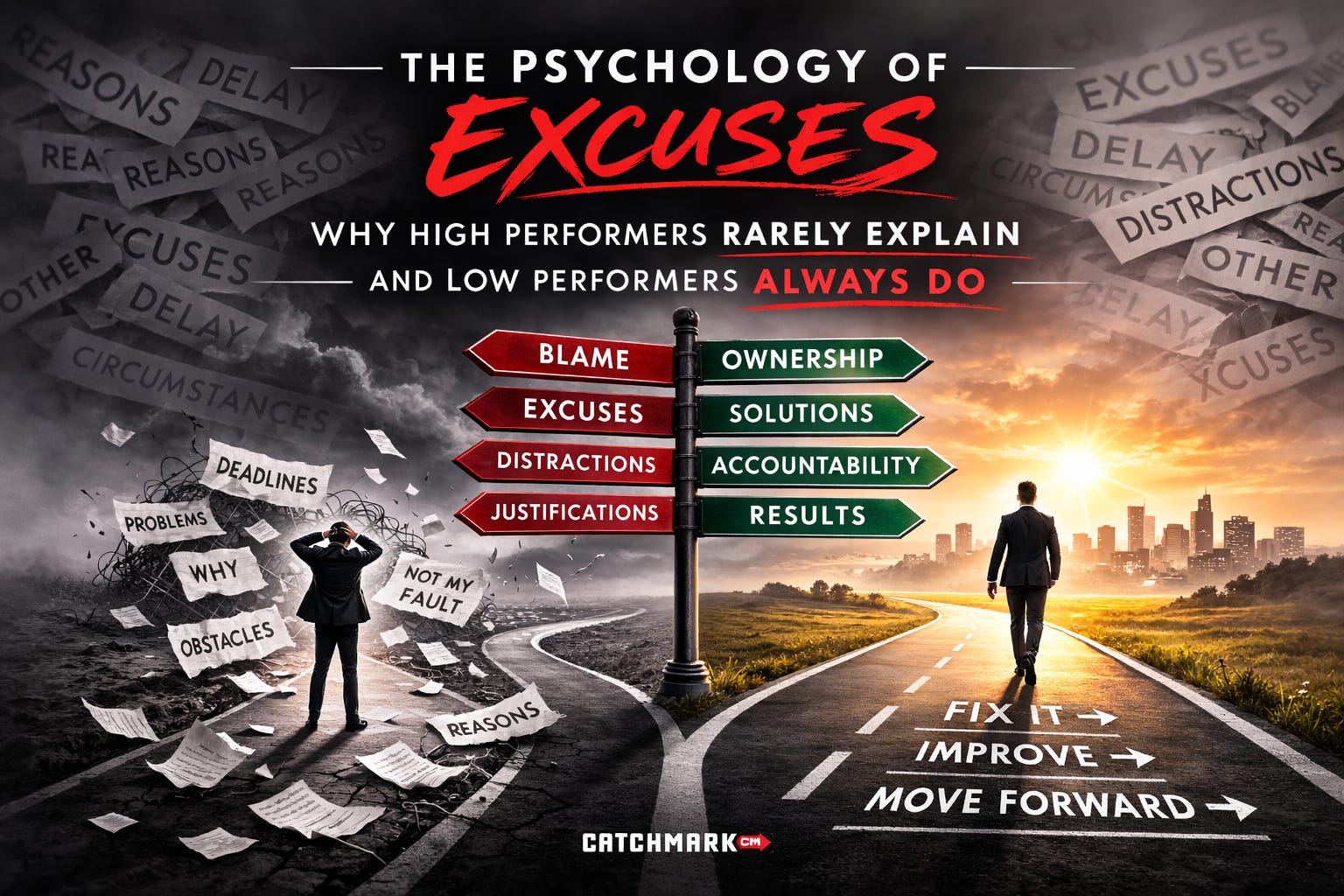
High performers rarely explain.
Low performers almost always do.
The Reflex to Protect the Ego
Excuses are rarely about the facts. They are about identity.
When performance falls short, it threatens how we see ourselves. We want to believe we are competent, responsible, capable. An unmet commitment creates tension between that belief and reality.
Psychologists call this cognitive dissonance. We resolve it one of two ways:
• Adjust our behavior
• Adjust our narrative
Low performers adjust the narrative.
They point to circumstances. They highlight obstacles. They distribute blame across time, tools, or other people. The goal is not always manipulation. It is often self preservation.
If the story can be framed as “This happened to me,” then the ego remains intact.
High performers adjust behavior.
They say, “That is on me.”
They say, “I misjudged that.”
They say, “I will fix it.”
They feel the same internal discomfort. The difference is they channel it into correction rather than explanation.
The Accountability Gap
In organizations, this dynamic compounds quickly.
A culture of excuses sounds like this:
• “I did not have enough time.”
• “No one told me.”
• “That is not my department.”
• “The client changed their mind.”
• “We have always done it this way.”
Each statement shifts responsibility outward.
Over time, teams that tolerate this language become reactive. Deadlines slip. Standards erode. Frustration rises. Meetings become longer because energy is spent dissecting why something happened instead of ensuring it does not happen again.
Contrast that with an accountability culture.
It sounds different:
• “I should have clarified expectations.”
• “I underestimated the timeline.”
• “I failed to follow up.”
• “Here is how I will correct it.”
Notice the pattern. Ownership is internal. Correction is forward focused.
High performance environments do not eliminate mistakes. They eliminate hiding.
Why High Performers Do Not Over Explain
There are three consistent traits I see in top performers.
They Separate Identity from Outcome
Their self worth is not shattered by a mistake. Because of that, they do not need to defend it. They can evaluate performance objectively.They Focus on Control
They instinctively ask, “What part of this was within my control?” Even when external factors are real, they hunt for the lever they could have pulled differently.They Value Results Over Optics
Explaining feels productive. It gives the illusion of engagement. But results are what move organizations forward. High performers care more about impact than image.
Low performers, in contrast, are often image managers. They want to be seen as competent more than they want to become competent.
That distinction changes everything.
The Leader’s Role in Shaping the Culture
Leaders either reward excuses or extinguish them.
When leaders respond to every failure by dissecting external causes, they reinforce a victim mindset. When leaders accept elaborate explanations without requiring ownership, they lower the bar for everyone watching.
But when leaders calmly redirect the conversation to responsibility, something powerful happens.
The standard becomes clear.
At CatchMark, we have worked hard to build this into our rhythm. When something breaks, the first question is not “Who can we blame?” It is “What will we do differently next time?”
That small shift creates psychological safety without sacrificing accountability. People know they can admit mistakes. They also know they cannot hide behind them.
Accountability is not harshness. It is clarity.
The Freedom in Ownership
Here is the irony.
Excuses feel protective, but they are limiting.
If every outcome is the result of external forces, then you are at the mercy of those forces. You become dependent on better circumstances, better leadership, better tools.
Ownership, on the other hand, is empowering.
If part of every outcome belongs to you, then improvement also belongs to you.
High performers understand this intuitively. They are not perfect. They miss deadlines. They misjudge priorities. They drop balls.
But they do not linger in explanation.
They move quickly to responsibility.
In a culture where accountability is the norm, excuses become uncomfortable. Not because people are shamed. But because they simply do not work.
And over time, something interesting happens.
People either rise to that standard or remove themselves from it.
The psychology of excuses is not complicated. It is human. We all feel the pull to defend ourselves.
The difference between high and low performance is not talent.
It is the willingness to say, without qualification:
That one is on me.