


A few years ago, I sat in a quarterly planning session with a leadership team that was both capable and committed.
They cared about the business. They were working hard. They had clear priorities for growth, customer experience, and operational improvement.
On the surface, everything looked aligned.
As the conversation unfolded, each leader shared their priorities for the upcoming quarter.
Sales prioritized accelerating pipeline and closing new business.
Operations prioritized stabilizing delivery and reducing errors.
Finance prioritized margin and cost control.
Technology prioritized modernizing systems and reducing risk.
Each priority made sense on its own.
Each was important.
And each was being pursued with urgency.
But as the discussion continued, something became clear.
These priorities were not just different.
They were competing.
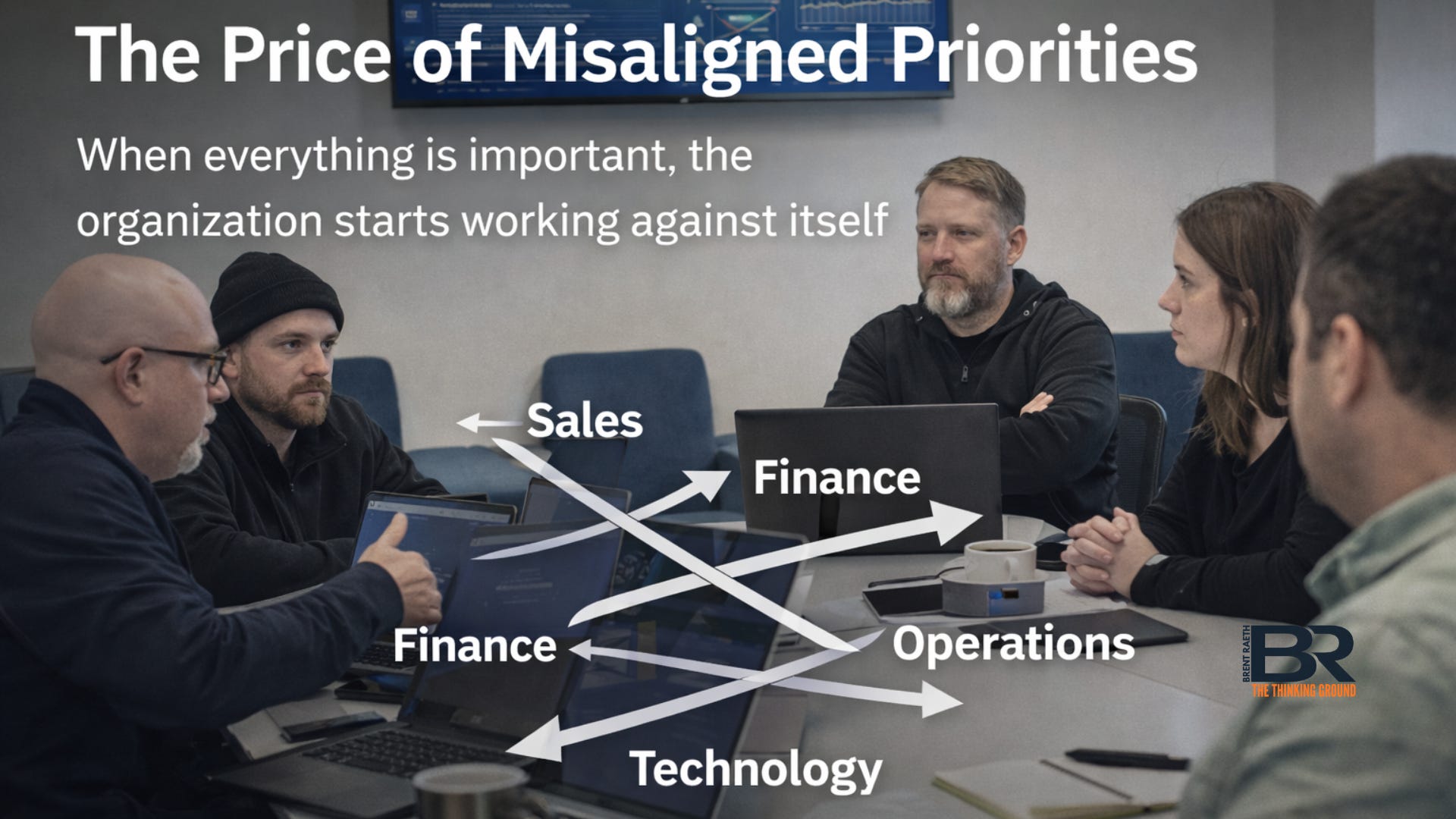
Sales priorities were increasing complexity for operations.
Operational priorities were slowing down sales.
Financial priorities were limiting technology investment.
Technology priorities were disrupting established workflows.
No one was wrong.
But the organization was not aligned in its priorities.
And that misalignment was creating friction that no amount of effort could overcome.
This is one of the most expensive and least visible problems inside growing organizations.
The price of misaligned priorities.
The Illusion of Shared Priorities
Most leadership teams believe they are aligned.
They define strategic priorities. They communicate them across the organization. They reinforce them in meetings and planning sessions.
On paper, everything connects.
But alignment at a high level does not guarantee alignment in execution.
What often happens is that each leader interprets organizational priorities through the lens of their own function.
Sales hears growth as the top priority.
Operations hears efficiency as the top priority.
Finance hears cost control as the top priority.
Technology hears modernization as the top priority.
All of those interpretations are valid.
But without deliberate alignment, they do not converge.
They compete.
And that competition shows up in how work actually gets done.
Where Misaligned Priorities Become Visible
Misaligned priorities rarely announce themselves directly.
They show up as tension between teams.
Projects that should move quickly get stuck in back-and-forth conversations. Decisions take longer because different leaders are optimizing for different priorities. Teams begin to feel like they are working against each other instead of with each other.
You hear it in the language:
“Why is this taking so long?”
“Why are we doing it this way?”
“This should be the priority.”
From each perspective, those statements are reasonable.
But they are not pointing to a people problem.
They are pointing to a priority problem.
The Hidden Cost
The cost of misaligned priorities is not just disagreement.
It is inefficiency.
Work gets duplicated as teams act on different priorities. Effort is wasted as initiatives are started, slowed, redirected, or abandoned based on shifting emphasis. Energy is consumed in internal negotiation over what should matter most.
Perhaps most importantly, speed is lost.
Not because the organization lacks capability, but because it lacks alignment on priorities.
People begin to spend more time defending their priorities than executing against shared ones.
And over time, that becomes normal.
Why It Happens
Misalignment does not typically come from bad intentions.
It comes from incomplete conversations about priorities.
Leadership teams often align on a list of priorities, but not on how those priorities rank against each other.
Growth versus efficiency.
Speed versus quality.
Innovation versus stability.
These tensions exist in every business.
But when they are not explicitly resolved, each leader elevates the priorities that matter most within their own area.
That is where misalignment begins.
Another contributing factor is how success is measured.
If leaders are evaluated against different priorities, they will act accordingly.
Even well-intentioned leaders will prioritize what they are held accountable for.
Without shared prioritization, alignment becomes fragile.
The Compounding Effect
Like many hidden costs, misaligned priorities compound over time.
Small conflicts become larger ones. Minor inefficiencies become systemic. Competing priorities become embedded in how the organization operates.
New initiatives are layered on top of unresolved tension. Teams begin to anticipate resistance and adjust their behavior accordingly.
Collaboration becomes more cautious. Decisions become more political. Progress becomes slower.
And because work is still happening, it is easy to miss what is being lost.
What Alignment Actually Requires
True alignment is not agreement on a list of priorities.
It requires clarity on which priorities matter most.
It requires shared understanding of:
What the top priorities are right now
How those priorities rank against each other
What tradeoffs will be made when priorities conflict
Who has the authority to resolve priority conflicts
Without that clarity, priorities compete.
And when priorities compete, the organization slows down.
A Simple Test
There is a simple way to assess whether priorities are truly aligned.
Ask each leader to list the top three priorities for the organization.
Then ask them which of those they would deprioritize if necessary.
The first answer is usually consistent.
The second is where the differences emerge.
Alignment is not proven by what you say is a priority.
It is revealed by what you are willing to move down the list.
Closing Thought
Most organizations do not struggle because they lack good ideas or capable people.
They struggle because those people are not aligned on priorities.
Misaligned priorities create friction that effort alone cannot overcome.
And the most challenging part is this.
From the inside, it often feels like progress.
Work is happening. Initiatives are moving. People are busy.
But beneath the surface, the organization is pulling in different directions.
And that is a cost few leaders see clearly until it is already slowing them down.