


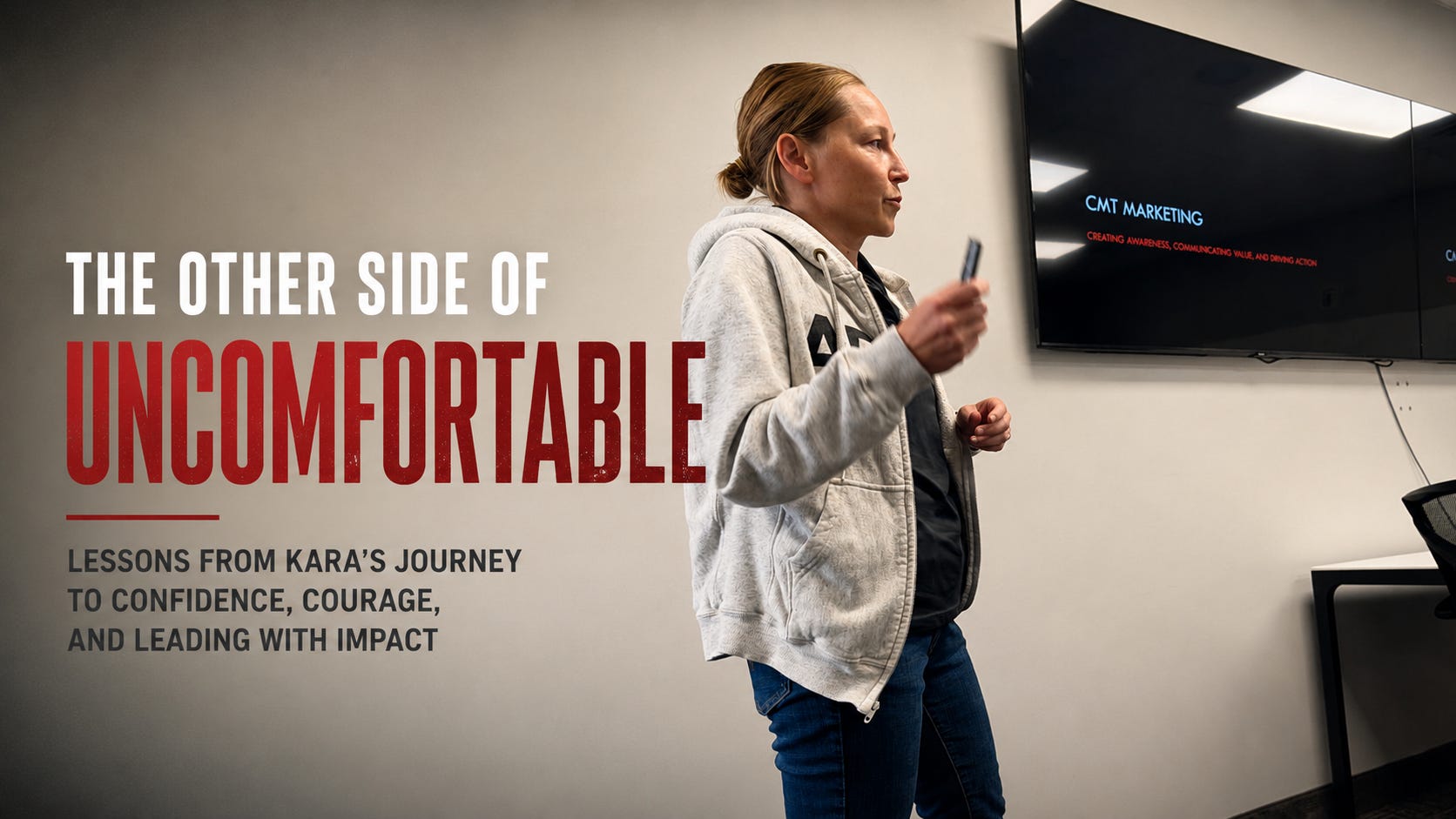
A few years ago, you would have had a hard time convincing my wife Kara to stand in front of a room and speak.
It did not matter whether the audience was large or small. The moment attention shifted toward her, the physical signs of discomfort would appear. Her face would turn red. She would sweat. Her thoughts would race. She would become intensely aware of every person watching her and every word coming out of her mouth.
So, whenever possible, she avoided public speaking altogether.
That response was not unusual. Public speaking is one of the most common fears people carry. But for Kara, it was not simply a matter of being nervous before a presentation. It had become part of the story she told herself about who she was.
She was not a public speaker.
She was not someone who wanted to command a room.
She was more comfortable contributing behind the scenes, where her work could speak for her.
And for a while, that was enough.
But growth has a way of making our old definitions too small.
Over the years, I watched Kara become more confident, capable, and knowledgeable. Her understanding of the work deepened. Her perspective became more valuable. She had ideas people needed to hear, not eventually, not secondhand, but directly from her.
Her ability had grown.
The question was whether her willingness to be uncomfortable would grow with it.
The Next Level Was Not Going to Be Comfortable
Over the last couple of months, I challenged Kara to take another step.
Not because she was failing.
Because she was ready.
That distinction matters.
The best challenges are not punishments for where someone is falling short. They are invitations to become more of who that person is capable of being. They come from seeing potential that may still be difficult for the other person to recognize in themselves.
That does not mean the process feels encouraging every day.
There were hard conversations.
There were tears.
There was frustration and doubt.
There were moments when Kara questioned herself, the process, and probably me. There were moments when the easier choice would have been to pull back, to return to what was familiar and stop asking so much of herself.
Discomfort can be persuasive. It tells us that difficulty is evidence we are on the wrong path.
Sometimes it tells us we are not ready.
Sometimes it tells us we are not good enough.
Sometimes it disguises fear as certainty and says, “This just isn’t who you are.”
But discomfort is not always a warning to stop.
Sometimes it is evidence that an old version of us is being stretched beyond its limits.
The challenge for Kara was not simply to prepare a better presentation. It was to become more comfortable taking ownership of her voice, her knowledge, and her place in the room.
That kind of growth cannot be accomplished by changing a few slides.
It requires confronting the beliefs underneath the fear.
Then Came the Tactical Meeting
At our recent tactical meeting, Kara stood at the front of the room with the presentation on the screen behind her.
This was the kind of moment she once would have tried almost anything to avoid.
But this time, she did not retreat.
She presented.
And she absolutely delivered.
She was prepared. She understood the material. She communicated with clarity and purpose. More importantly, she brought the struggle of the previous months into the room, not as baggage, but as strength.
The hard conversations were there.
The tears were there.
The frustration, doubt, preparation, and repetition were all there.
They had simply been transformed.
What once felt like resistance had become resilience.
What once felt like pressure had become presence.
What once made her want to disappear had become an opportunity to lead.
The presentation was impressive because of what everyone in the room could see. But I was even more impressed by what most of them could not see: everything it had taken for her to stand there and do it.
People often see the breakthrough without seeing the breaking open that came before it.
They see confidence, but not the days of uncertainty.
They see the polished presentation, but not the difficult feedback.
They see someone performing at a higher level and assume the transformation happened in that moment.
It did not.
That presentation was the visible result of dozens of invisible decisions.
The decision to stay in a difficult conversation.
The decision to hear feedback without letting it become a verdict.
The decision to prepare again.
The decision to return after frustration.
The decision to stand in front of the room despite remembering every uncomfortable experience that came before.
Growth did not happen when Kara stopped feeling discomfort.
Growth happened when discomfort stopped making her decisions.
Confidence Is Often the Result, Not the Requirement
We tend to think confidence must come first.
We tell ourselves that we will speak when we feel confident. We will lead when we feel ready. We will take the opportunity when the fear has passed.
But confidence is rarely something we find while waiting.
It is built through evidence.
Every difficult conversation we survive becomes evidence.
Every attempt we make becomes evidence.
Every moment when we feel afraid and act anyway becomes evidence.
Eventually, we have enough evidence to begin seeing ourselves differently.
Kara did not need to become fearless before giving a great presentation. She needed to be willing to walk into the room with whatever fear remained and refuse to let it have the final word.
That is courage in its most practical form.
Not the absence of discomfort.
The willingness to move through it.
A Lesson for Leaders
There is also a leadership lesson in Kara’s story.
Caring about someone does not always mean making things easier for them.
Sometimes it means having the conversation they would rather avoid.
Sometimes it means refusing to let them settle for a version of themselves they have already outgrown.
Sometimes it means holding a standard while also holding space for the very human emotions that come with reaching for it.
Challenge without support can become cruelty. Support without challenge can become stagnation.
Good leadership requires both.
We have to recognize when discomfort is doing damage, and when it is doing developmental work. We have to know the difference between pushing someone toward our expectations and calling forward something we genuinely see within them.
Most of all, we have to remain present during the messy middle.
It is easy to celebrate people once they succeed. Leadership matters more when they are frustrated, uncertain, and unable to see the outcome yet.
What Kara Proved
Kara’s presentation was more than a successful moment at a tactical meeting.
It was proof.
Proof that the person who once avoided public speaking could stand in front of a room and deliver.
Proof that an old fear does not have to become a permanent identity.
Proof that tears do not mean weakness, frustration does not mean failure, and doubt does not mean we are incapable.
Sometimes those things are simply part of the price of becoming better.
Kara still has room to grow. We all do. One great presentation is not the end of the journey.
But it changes the journey.
She now has evidence she did not have before.
The next time discomfort tells her, “You cannot do this,” she can point to a moment when she already did.
That may be the most important lesson in all of this:
The other side of uncomfortable is not always comfort. Sometimes it is capability.
Sometimes it is discovering that the thing we were convinced we could not do was simply something we had not yet been willing to struggle through.
And sometimes, after the hard conversations, the frustration, the tears, and the doubt, we find ourselves standing at the front of the room, remote in hand, message on the screen, and a new understanding of who we are capable of becoming.