


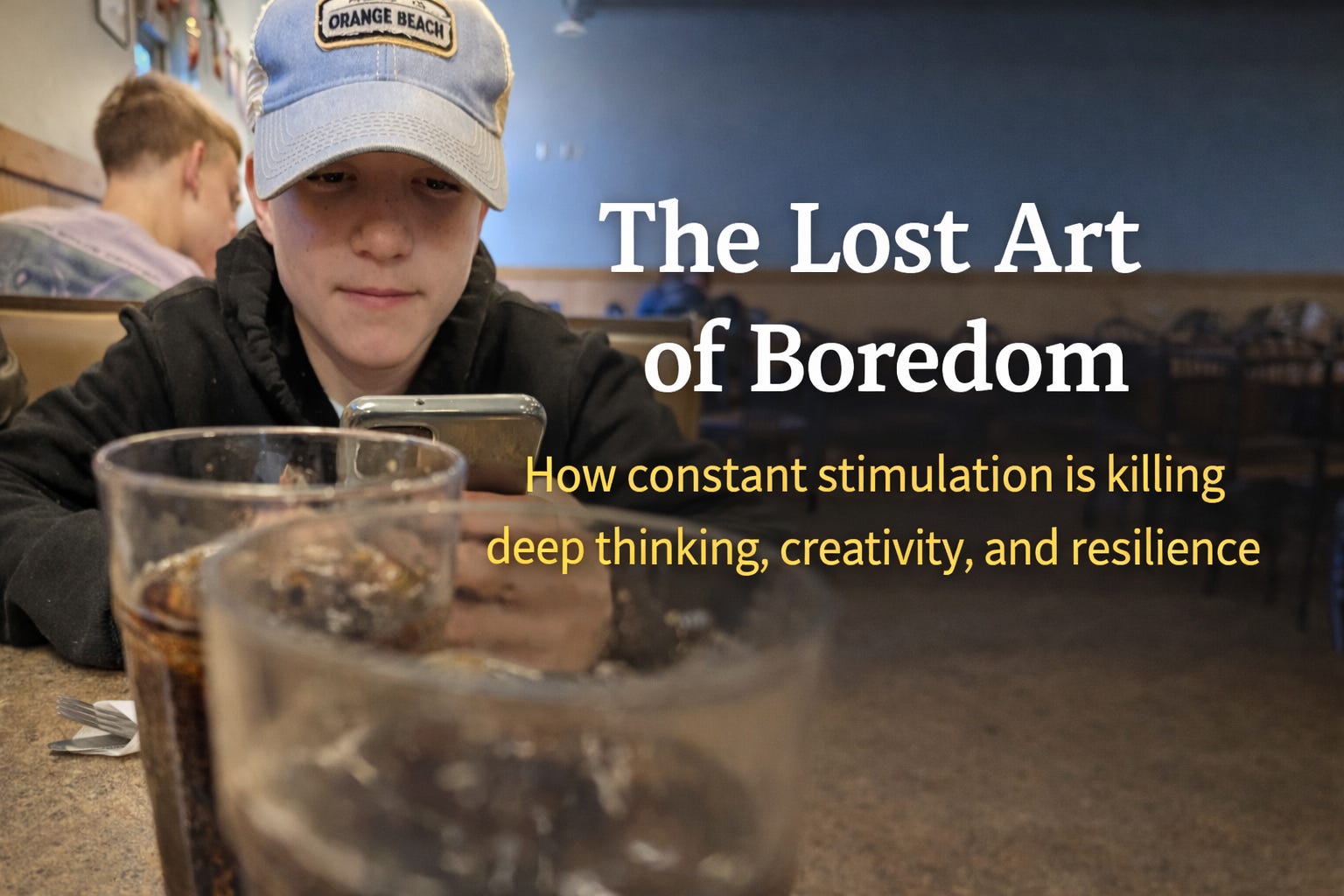
Not long ago I found myself standing in line at a restaurant with my youngest son.
We had nothing urgent to do. No crisis to solve. No call to return. Just a few quiet minutes between commitments.
Within seconds, nearly everyone in line had reached for their phone. Scroll. Tap. Swipe. Micro hits of novelty. My son instinctively looked up at me, almost unsure what to do with the empty space.
That moment struck me.
We no longer tolerate boredom. We eliminate it.
And in doing so, we may be eliminating something far more valuable.
Boredom used to be normal. It was the space between activity. The gap between inputs. The quiet room where your mind wandered and made connections. Today, those gaps are filled instantly. Notifications. Podcasts. Social feeds. Streaming. Even our workouts and drives are saturated with content.
We have engineered boredom out of existence.
But boredom was never the enemy. It was the incubator.
Boredom and Deep Thinking
Deep thinking requires space. It requires sitting with a problem longer than is comfortable. It requires resisting the urge to check something, consume something, react to something.
Innovation rarely happens in the middle of noise. It happens after prolonged wrestling. After staring at a wall. After taking a long walk without headphones. After letting your mind drift.
When every spare second is filled, your brain never gets to wander. And wandering is where pattern recognition lives. It is where unrelated ideas collide. It is where strategy is born.
Leaders who cannot be alone with their thoughts become reactive. They manage inputs instead of shaping outcomes. They consume more than they create.
The best strategic decisions I have made did not come from a Slack thread or a rapid fire meeting. They came from quiet reflection. From asking better questions. From thinking longer than everyone else was willing to think.
That requires boredom.
Parenting in a World That Fears Quiet
We see this most clearly with our kids.
The moment a child says, “I’m bored,” many parents feel an obligation to fix it. We provide a device. We schedule an activity. We entertain.
But boredom is not a problem to solve. It is a muscle to build.
When a child is bored, something powerful is happening. Their brain is searching. It is learning to self initiate. It is wrestling with the discomfort of stillness. If we rush to remove that discomfort, we rob them of the opportunity to develop creativity and resilience.
Unstructured time forces imagination. It forces problem solving. It forces ownership of one’s internal world.
A child who never learns to sit in boredom becomes an adult who cannot sit in discomfort. And leadership requires discomfort. So does entrepreneurship. So does innovation.
We cannot pave every quiet road for our children and expect them to know how to navigate a wilderness later.
Leadership Without Space Is Management
In business, constant stimulation masquerades as productivity.
Endless meetings. Constant emails. Real time dashboards. Immediate responses. We feel busy. We feel informed. We feel engaged.
But are we thinking?
The meeting is not the work. The notifications are not the strategy. The updates are not the vision.
Great leaders carve out time to think. They protect white space on their calendars. They step away from noise to evaluate trends, risks, and long term direction.
If you are always responding, you are rarely leading.
Innovation requires boredom because boredom creates margin. Margin creates reflection. Reflection creates insight.
Organizations that never slow down become operationally efficient but strategically fragile. They execute well on yesterday’s ideas while missing tomorrow’s shifts.
Creativity Is Born in the Gap
Some of the best ideas in history were not born in hyper connected environments. They were born in solitude. In long walks. In quiet labs. In deep focus without interruption.
Today we attempt to brainstorm between notifications.
We expect breakthrough thinking while multitasking.
We want creativity without stillness.
That is not how the human brain works.
Your mind needs idle time to consolidate information. To replay experiences. To test scenarios. To make connections. When you deny it that time, you trade depth for volume.
You know a lot. You just do not think about it long enough to produce something original.
Resilience Requires Discomfort
There is another cost to eliminating boredom.
When we remove every minor discomfort, we weaken our tolerance for major ones.
Boredom is mild discomfort. It is the itch of inactivity. It is the unease of silence. Learning to sit in it builds patience. It builds self control. It builds emotional regulation.
If you cannot tolerate five quiet minutes, how will you tolerate five difficult months?
Resilient leaders and resilient kids share a common trait. They can endure internal discomfort without immediate relief. They do not require constant stimulation to feel steady.
That capacity begins with something as simple as letting a mind be quiet.
Reclaiming the Lost Art
This is not an argument against technology. I build businesses in the digital age. I value speed and information.
But tools should serve us. They should not eliminate the conditions required for depth.
Reclaiming boredom is a discipline.
• Leave your phone in another room for an hour.
• Drive without a podcast.
• Take a walk without music.
• Let your child figure out what to do next.
• Block thinking time on your calendar and defend it.
You may feel restless at first. That is the point.
On the other side of that restlessness is clarity.
On the other side is creativity.
On the other side is resilience.
We do not need more input. We need more integration.
Boredom is not wasted time. It is processing time.
In a world addicted to stimulation, the ability to sit quietly and think may become one of the greatest competitive advantages a parent, a leader, or an innovator can develop.
The art is not lost.
But it is waiting to be practiced again.