


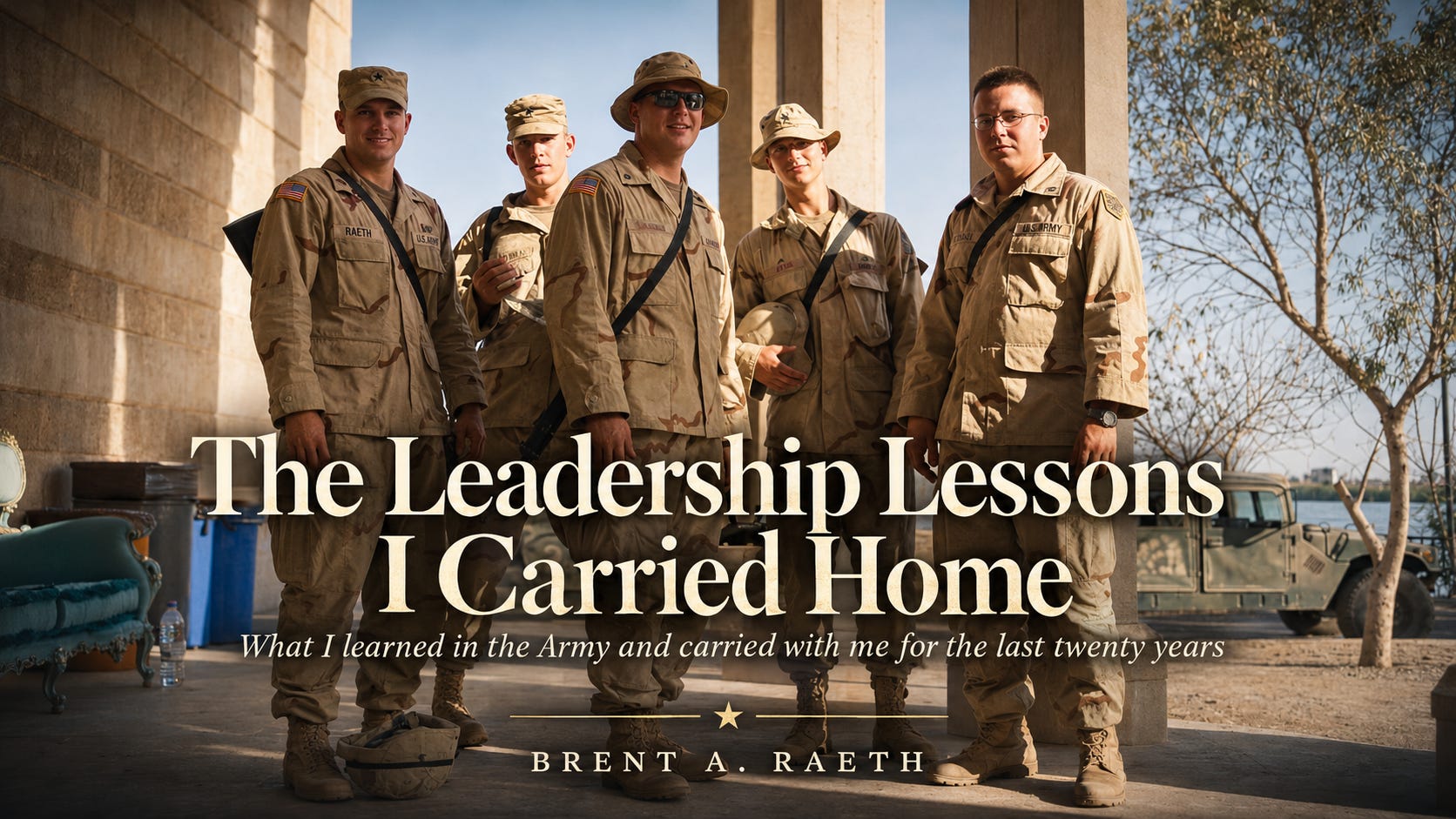
I left the United States Army in 2004. Twenty-two years have passed since I last wore the uniform, but there are days when something happens in my professional or personal life that immediately takes me back to a lesson I learned as a young soldier.
Some of those lessons came from formal training. Others came from mistakes, difficult assignments, long days, and the people I had the privilege of serving alongside. A few came from getting my ass chewed by someone who understood leadership better than I did at the time.
I have spent much of the last two decades leading people, building teams, managing organizations, and working through problems that rarely have simple answers. I have served in business, on community boards, and in positions where the decisions I made affected other people’s livelihoods and well-being. Through all of it, I have repeatedly returned to principles that were introduced, challenged, and reinforced during my military service.
The Army did not make me a perfect leader. It did, however, give me a foundation that I continue to build upon.
And perhaps the most important thing I learned is that leadership is not something you achieve. It is something you practice, often imperfectly, for the rest of your life.
Your Squad Wasn’t Late. You Failed to Get Them There on Time.
One of the most important leadership lessons I learned in the Army was that responsibility changes when you become a leader. You are no longer accountable for just your own actions and performance. You become responsible for the preparation, performance, and readiness of the people entrusted to you.
The military has a rather direct way of teaching this lesson.
If your squad was late to formation, the explanation wasn’t that your soldiers failed to show up on time. The explanation was that you, as their leader, failed to ensure they were there on time.
If your platoon failed to accomplish its mission, the first question wasn’t which soldier made a mistake. It was whether the platoon’s leadership had properly trained, prepared, equipped, and organized the team to succeed.
That distinction may seem unfair to someone who has never led people in that environment. After all, shouldn’t individuals be responsible for their own actions?
Of course they should. Individual accountability never disappears. But leadership introduces another layer of responsibility that cannot simply be delegated away.
As a leader, you own the performance of your team, including the failures you did not personally cause.
That is a difficult concept to embrace because it requires looking at problems differently. When someone fails to meet an expectation, it is easy to focus on what that person did wrong. It is much harder to ask whether you communicated the expectation clearly, provided the necessary training, identified potential obstacles, and followed through to ensure they were prepared.
The Army taught me that a leader’s responsibility begins long before the outcome is known.
If your soldiers aren’t prepared, you should be asking what you failed to do to prepare them. If they don’t understand the mission, you should be examining how you communicated it. If they repeatedly fall short of expectations, you should be evaluating whether you have established the right standards, provided appropriate guidance, and held people accountable along the way.
This principle has shaped how I approach leadership in business for more than two decades.
When a project goes poorly, a customer is disappointed, or a team fails to deliver on a commitment, my first responsibility is not to identify someone to blame. It is to understand what happened and what role leadership played in creating the conditions that led to the outcome.
Did we establish clear expectations? Did we assign responsibility appropriately? Did we provide the resources necessary to succeed? Did we recognize problems early enough to intervene?
Sometimes the answer is that an individual simply failed to meet a reasonable expectation, and that must be addressed. But even then, the leader is responsible for ensuring accountability occurs and that the organization learns from the experience.
I have not always lived up to this standard. There have been plenty of occasions when I have been frustrated with someone’s performance before taking the time to examine my own contribution to the situation.
But the lesson remains.
Leadership is not about taking credit when your team succeeds and assigning blame when it fails. It is about accepting ownership of both outcomes.
More than twenty years after leaving the Army, I still believe this is one of the most important distinctions between someone who holds a leadership position and someone who actually leads.
Standards Are Not the Enemy of People
Military life introduces you to an extraordinary number of standards, procedures, inspections, and expectations. To someone looking in from the outside, some of them probably seem unnecessarily rigid.
I remember the packing-list inspections we went through during military schools. You were expected to have exactly what was required, properly organized and ready for inspection. Missing items were a problem, but so were extra items that weren’t on the list.
Early in your military career, it is easy to view these exercises as little more than an opportunity for someone to find something wrong.
With experience, you begin to understand the larger purpose.
Standards create consistency. Consistency supports readiness. Readiness allows a team to function when circumstances become difficult, unpredictable, or dangerous.
The point was not simply to have the correct equipment in your bag. The point was to develop the discipline to prepare, pay attention, follow through, and take responsibility for your work.
In civilian leadership, I have carried that same belief into how I approach organizational expectations and accountability.
I believe people deserve clear expectations, consistent standards, and honest feedback. Nothing frustrates a team faster than a leader who changes the rules based on the individual involved, the circumstances of the day, or their personal mood.
But I have also learned something important about standards over the years.
Standards must serve a purpose. They should not exist simply because someone in authority likes having rules.
Good leaders explain the reasons behind expectations, apply them consistently, and remain willing to change them when circumstances warrant. They also recognize that accountability without support is not leadership. It is simply enforcement.
The goal is not to create an organization where everyone is afraid of making a mistake. The goal is to create one where people understand what is expected, have the resources to succeed, and take ownership of their responsibilities.
Clarity Matters More Than Control
The military taught me the importance of understanding the mission, communicating intent, and establishing clear responsibilities.
When a team understands what it is trying to accomplish, why it matters, and the boundaries within which it can operate, people can make decisions without constantly seeking permission.
That is a powerful concept, and one I believe many civilian organizations struggle to implement.
Too often, leaders confuse control with effectiveness. They want to approve every decision, review every action, and remain involved in every detail. Then they become frustrated when their employees lack initiative or fail to demonstrate independent judgment.
We cannot reasonably expect people to take ownership while refusing to give them the authority necessary to exercise it.
I have always believed that good leadership requires setting a clear direction and then allowing capable people to determine how best to reach the objective. That does not mean abandoning oversight or accountability. It means understanding the difference between providing direction and dictating every movement.
Of course, this approach requires trust, and trust is not something that magically appears because someone has been assigned a position on an organizational chart.
It is built through competence, honesty, consistency, and repeated experiences of following through on commitments.
Over the years, I have come to appreciate that clarity is one of the greatest gifts a leader can give a team. When people know what success looks like, what authority they have, and where to turn when they need help, an enormous amount of unnecessary friction disappears.
Your Rank Doesn’t Make You Right
There is something interesting about leadership in a military environment. Rank establishes authority, but it does not automatically establish wisdom.
As a young soldier, I served with leaders who earned extraordinary respect because of their competence, character, and willingness to take responsibility. I also encountered people who appeared to believe that the insignia on their uniform meant their judgment should never be questioned.
Those experiences helped shape a distinction that I believe is just as important in business today.
Authority gives you the responsibility to make decisions. It does not guarantee that your decisions are correct.
One of the most dangerous things that can happen to a leader is becoming so attached to their position that they stop listening to the people around them.
I have written frequently about the importance of being willing to reconsider our beliefs, acknowledge mistakes, and separate our identity from our opinions. Those ideas are not disconnected from my military experience. They are an extension of lessons I began learning there.
The best leaders I have known were confident enough to make difficult decisions while remaining humble enough to recognize that someone else might have a better idea.
That balance is harder than it sounds.
Leadership often requires making decisions with incomplete information, competing priorities, and people who disagree about the proper course of action. In those moments, it can be tempting to interpret disagreement as disrespect or questions as challenges to your authority.
But disagreement is not necessarily disloyalty, and being questioned does not make someone a weak leader.
I would much rather work with someone who challenges my thinking in good faith than someone who agrees with me simply because I am in charge.
The Army taught me to respect the chain of command. Experience has taught me that respecting authority and thinking critically are not mutually exclusive.
Take Responsibility, Especially When Things Go Wrong
Accepting ownership of a team’s performance is one thing. Responding constructively when something goes wrong is another.
The Army taught me that there is a significant difference between holding people accountable and simply looking for someone to blame. One builds stronger teams. The other often creates an environment where people become more concerned with protecting themselves than solving problems.
I see this struggle in civilian organizations all the time.
When things go well, everyone wants to share in the credit. When things go poorly, the conversation quickly turns toward who failed, who should have known better, and who deserves the blame.
I have never found that approach particularly productive.
Accountability is necessary, but blame and accountability are not the same thing. Accountability is concerned with understanding what happened, accepting responsibility, learning from the experience, and improving future performance.
Blame is frequently concerned with protecting ourselves.
Throughout my career, I have tried to approach mistakes by asking what we can learn, what needs to change, and what my own role was in the outcome. I have not always succeeded. There have been times when frustration got the better of me or when I was too quick to focus on someone else’s failure before considering my own contribution.
Those moments matter because they remind me that leadership principles are easy to discuss and considerably harder to practice.
It is easy to believe in accountability when you are evaluating someone else’s behavior. The real test comes when accountability requires you to admit that you were wrong.
The Mission Matters, but So Do the People
My military service included time in Iraq, an experience that reinforced just how important teamwork, trust, and shared responsibility become when the stakes are high.
One of the things I remember most about military life is not any particular procedure or training exercise. It is the relationships built through shared experiences, difficult circumstances, and the knowledge that the people around you were depending on you to do your part.
There is a level of trust that develops when people consistently demonstrate that they will show up, do their jobs, and look out for one another.
That trust cannot be created through a motivational speech, a company values statement, or an annual team-building exercise.
It develops through behavior.
In the years since leaving the Army, I have come to believe that one of the most important responsibilities of leadership is creating an environment where people understand that they are part of something larger than themselves.
The mission gives a team direction, but the people give it the ability to accomplish that mission.
I have seen organizations become so focused on metrics, financial performance, and operational results that they forget the people responsible for producing them. I have also seen organizations use the language of caring for people as an excuse to avoid difficult decisions and meaningful accountability.
Neither approach works particularly well.
A leader must be willing to hold people to high standards while also caring about their development, circumstances, and long-term success. Those responsibilities are not in conflict. They reinforce each other.
I have always liked the idea that leadership is about solving problems, helping people, and being a great teammate on better teams. It is a simple way of describing something that can become unnecessarily complicated.
It also captures much of what I valued about military service.
Twenty-Two Years Later, I Am Still Learning
There is a temptation, particularly on Veterans Day, to reflect on military service through a lens of nostalgia. We remember the people, the experiences, the challenges, and the moments that shaped us.
I certainly do.
My wife, my father and both of my grandfathers served in the Army, making military service part of my family’s history long before I put on a uniform. I am proud to have continued that tradition, and I remain grateful for the people I served alongside and the experiences we shared.
But when I reflect on my service today, I am increasingly interested in what I have done with the lessons it gave me.
Did I become more accountable, or did I simply become more comfortable expecting accountability from others?
Did I learn to take ownership of my team’s performance, or did I become better at explaining why someone else was responsible when things went wrong?
Did I become better at listening, or did years of experience make me more convinced that I already had the answers?
Did I consistently demonstrate the principles I claimed to believe in, especially when doing so became inconvenient?
Those are uncomfortable questions, but I believe they are necessary ones.
The Army provided me with an early foundation in discipline, responsibility, teamwork, preparation, and leadership. Civilian life has provided more than two decades of opportunities to test whether I actually understood those lessons.
Some days I have done well. Other days have reminded me just how much I still have to learn.
And that may be the greatest leadership lesson of all.
Experience does not automatically make us wiser. Rank does not automatically make us better leaders. Time does not guarantee growth. What matters is whether we are willing to learn from our experiences and change our behavior accordingly.
I took off the uniform in 2004, but I never stopped carrying the responsibility to lead well, serve others, and hold myself accountable to the standards I expect from those around me.
On this Veterans Day, I am grateful not only for the opportunity to have served, but for the people who challenged me, corrected me, trusted me, and helped shape the person and leader I continue trying to become.
Twenty-two years later, their lessons are still with me.
And I hope they always will.