


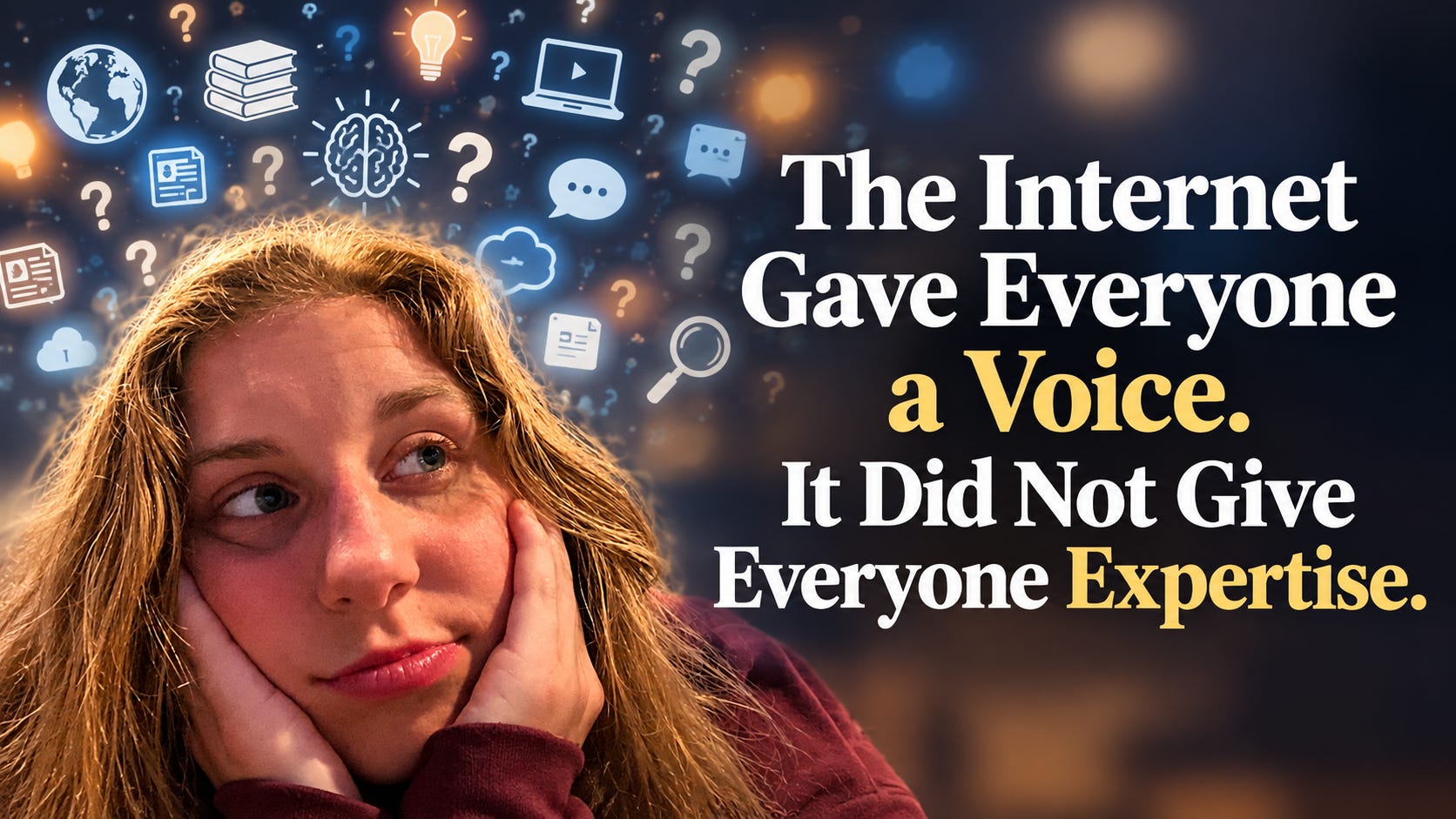
There was a time when not knowing something was relatively easy to admit. You either knew it or you didn’t, and if the subject mattered enough, you went looking for someone who did. If your car made a strange noise, you asked a mechanic. If you had a legal question, you called an attorney. If you were sick, you went to a doctor. If you wanted to understand an obscure historical event, you found a book written by someone who had spent years studying it. Experts were certainly not always right, and credentials have never guaranteed wisdom, but there was at least a general recognition that knowing something required more than simply having an opinion about it.
The internet fundamentally changed that relationship.
Today, nearly all of us carry access to more information in our pockets than previous generations could have imagined. Within seconds, we can search medical symptoms, read court decisions, watch someone repair an engine, study an economic theory, learn about a war happening on the other side of the world, or ask artificial intelligence to explain an unfamiliar subject to us. This is an extraordinary achievement. Access to information has never been easier, cheaper, or more democratic.
You would think that would make us extraordinarily knowledgeable.
Instead, it has created a new problem: we have started confusing access to information with possession of knowledge.
Information Is Not Knowledge
Finding information and understanding information are not the same thing. I can search for symptoms of an illness, but that does not make me a physician. I can read about network architecture, but that does not make me a network engineer. I can read a court ruling, but that does not make me an attorney. I can watch videos about investing without understanding markets, risk, taxation, or the financial circumstances of the person whose advice I am repeating.
Information gives us pieces. Expertise teaches us how those pieces fit together.
I see this regularly in technology. A customer can search an error message and find a proposed solution in thirty seconds. Sometimes that solution is exactly right. Sometimes implementing it will make the problem considerably worse. The difference is rarely whether the information exists. The difference is whether the person using it understands the context surrounding it.
What caused the problem? What changed immediately before it occurred? What other systems depend on this one? What happens if we make the suggested change? What are the security implications? Can we reverse it? Have we seen problems that looked exactly like this but actually had completely different causes?
Those questions are where expertise lives.
Experience isn’t simply the accumulation of answers. It is the accumulation of patterns, failures, exceptions, consequences, and judgment. Someone who has worked in a field for twenty years has probably been wrong many times. That isn’t evidence against their expertise; in many cases, those mistakes are part of how the expertise was developed. They have seen seemingly obvious solutions fail. They have watched one change create three unintended consequences. They have learned that problems that look identical on the surface can have completely different causes underneath.
Google can give you an answer. Experience helps you understand whether it is the right answer.
The Internet Flattened the Appearance of Authority
The internet has created another strange phenomenon: it flattened the appearance of authority. A researcher who has spent thirty years studying a subject can write a post online. Someone who learned about the subject yesterday can write one too. Both appear on the same screen. Both can build professional-looking websites, create polished graphics, record convincing videos, cite studies, and attract thousands of followers. Now, with artificial intelligence, both can produce exceptionally well-written arguments.
That creates a difficult environment because confidence is much easier to recognize than competence.
In fact, genuine expertise often sounds less confident than superficial knowledge. The longer you spend working in a complicated field, the more exceptions you discover. Beginners tend to see rules. Experts see conditions. Beginners are often comfortable saying, “This is how it works.” Someone with deeper experience is more likely to say, “Usually, but it depends.”
That qualification can sound like uncertainty, but often it is exactly the opposite. It is the result of understanding the subject well enough to know that reality rarely fits perfectly inside a slogan.
Unfortunately, the modern internet does not reward that kind of nuance particularly well. “It depends” isn’t a great headline. “There are several factors we should consider” isn’t likely to go viral. “I don’t have enough information to know” doesn’t generate much engagement. Certainty does. Outrage does. Simple explanations do. The person willing to make the strongest claim can therefore appear more knowledgeable than the person who actually understands the complexity.
Social Media Made Opinion Look Like Evidence
Social media intensified this problem by giving nearly everyone not only access to information, but access to an audience. There is tremendous value in that. People who once had no platform can share experiences, teach skills, expose wrongdoing, challenge institutions, build businesses, and connect with people around the world. I would not want to reverse that democratization.
But democratizing speech did not democratize expertise.
Having an audience does not make someone correct. Going viral does not validate an argument. Ten thousand people agreeing with something does not transform it into fact. A million views are evidence of distribution, not accuracy. Yet we increasingly use popularity as a shortcut for credibility.
We count followers, likes, shares, and views because those numbers are easy to see. We rarely see the years of study, practical experience, failed attempts, peer scrutiny, or demonstrated results behind the person making the claim.
The internet has become extraordinarily good at measuring attention. We should be careful not to confuse attention with authority.
The Internet Lets Us Find the Answer We Already Wanted
Perhaps the most dangerous feature of unlimited access to information is that we can almost always find evidence supporting whatever we already want to believe. Pick nearly any controversial subject and search long enough and you will find an article, video, podcast, chart, study, expert, social media account, or online community confirming your position. You can then send the link to someone else and say, “See? I told you.”
That feels like research. Sometimes it is. Other times, it is simply confirmation bias with a search engine.
Real learning requires something much more uncomfortable. It requires actively looking for information that might prove us wrong. It means reading people with whom we disagree and trying to understand their argument rather than immediately searching for its weakest point. It means distinguishing evidence from interpretation and being willing to change our minds when the evidence demands it.
The internet makes finding information easy. It does not make intellectual honesty easy.
AI Is About to Magnify the Problem
Artificial intelligence is going to make this distinction even more important. AI dramatically lowers the cost of producing intelligent-sounding material. Someone with very little knowledge of a subject can now create a polished article, presentation, proposal, analysis, or argument in minutes.
I use AI regularly and believe it is an extraordinary tool, but we need to understand what has changed. The ability to produce the appearance of expertise is becoming universally available.
Good grammar no longer demonstrates knowledge. A professional-looking presentation does not demonstrate mastery. A well-structured argument does not necessarily mean the person presenting it understands the subject. AI can help all of us communicate beyond our expertise, which is incredibly useful, but it also means the traditional signals we used to associate with expertise are becoming less reliable.
That means our responsibility as readers and consumers of information has to increase.
Questioning Experts Is Healthy. Pretending Expertise Doesn’t Exist Is Not.
The answer is not to return to a world where only people with certain credentials are allowed to speak. Experts can be wrong. Institutions can become insulated. Credentials can create their own form of arrogance. Outsiders sometimes see things insiders miss, and some of history’s most important innovations came from people willing to challenge conventional wisdom.
Questioning experts is healthy.
Pretending expertise doesn’t exist is not.
We need to get better at asking how someone knows what they claim to know. What experience do they have? What evidence supports their conclusion? What evidence contradicts it? Are they explaining complexity or hiding it? Are they separating facts from opinions? What would cause them to change their mind? What incentives might influence their argument? Perhaps most importantly, am I accepting what they are saying because the evidence is strong, or because I desperately want it to be true?
Those questions require something that may be even harder than evaluating other people’s expertise: recognizing the limits of our own.
Knowing What You Don’t Know
There are subjects I know deeply because I have spent decades working with them. There are others I understand reasonably well because I have studied them. There are subjects where I know just enough to ask decent questions. And there are countless subjects where I am completely dependent upon people who know considerably more than I do.
The dangerous part is forgetting which category I’m in.
The internet makes that remarkably easy because an answer is always seconds away. We can go from knowing almost nothing about a subject to reading five articles about it before breakfast, and suddenly we feel informed enough to argue with someone who has spent twenty years working in the field.
We may have acquired information, but we have not acquired their experience. We haven’t made their mistakes, encountered their exceptions, developed their pattern recognition, or lived with the consequences of decisions made in that field.
Perhaps one of the greatest signs of intelligence in the information age will be becoming comfortable again with three simple words:
I don’t know.
Those words are not an admission of intellectual weakness. They are the beginning of intellectual honesty. They create room for curiosity, questions, learning, and eventually knowledge.
Everyone Has a Voice. Not Everyone Has Expertise.
The internet accomplished something extraordinary by removing many of the gatekeepers standing between ordinary people and information. That was, on balance, a remarkable advancement. But removing the gatekeepers did not remove the need for judgment. If anything, it made judgment more important.
We once lived with a scarcity problem. Information was difficult to find.
Now we have an abundance problem. Information is everywhere, and much of it arrives with someone confidently telling us exactly what it means.
The next evolution of literacy isn’t learning how to find information. We have largely solved that problem. It is learning how to evaluate information, challenge it, contextualize it, understand where it came from, recognize genuine expertise, and remain aware of the limits of our own understanding.
Everyone deserves a voice. Everyone should have access to information. Everyone should be free to question experts.
But none of those things magically creates expertise.
The internet put the world’s knowledge at our fingertips. It did not put the world’s experience in our heads.
Understanding the difference may be one of the most important skills of the information age.