


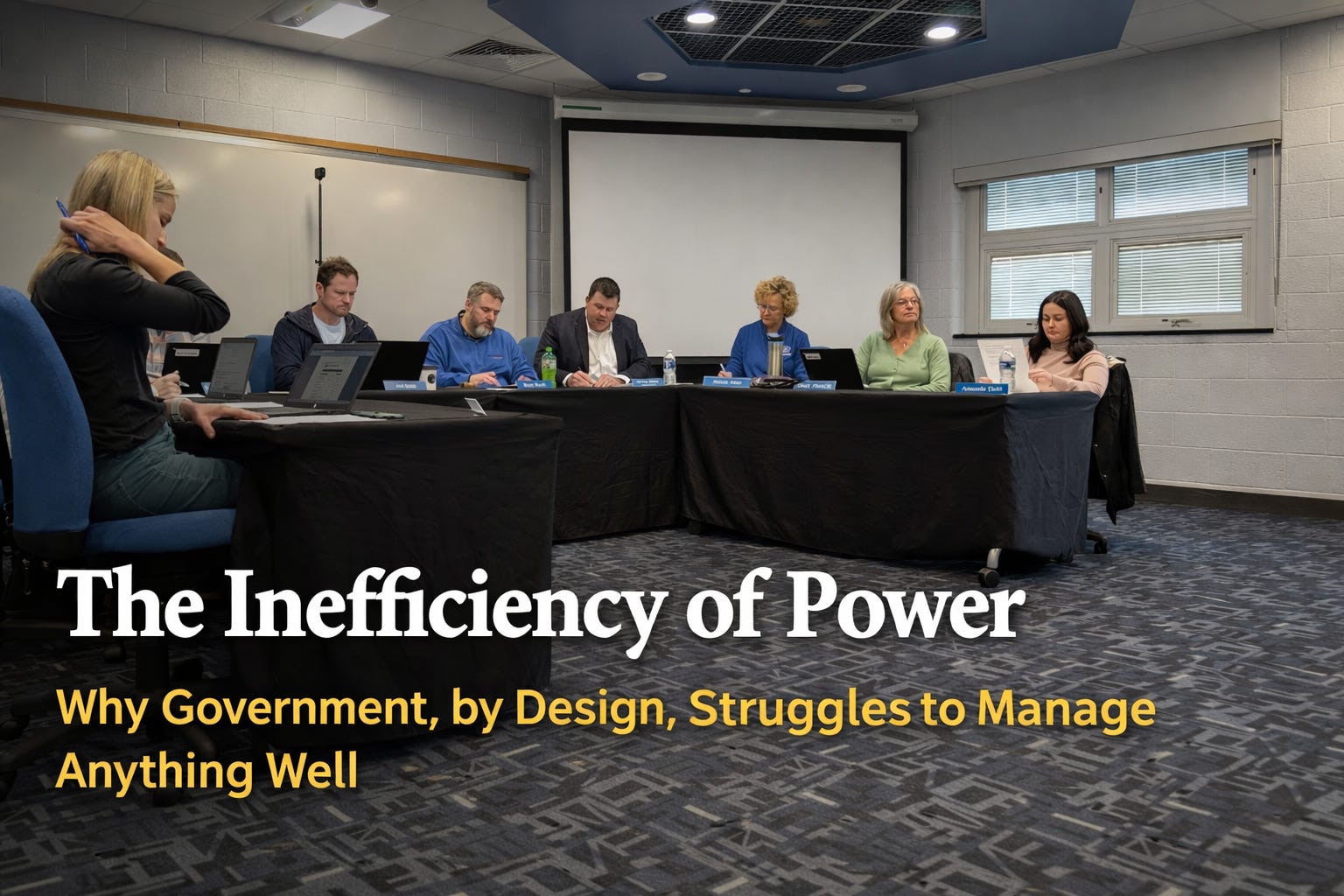
I have spent more than two decades inside structured environments. Corporate governance. Cybersecurity frameworks. Regulatory oversight. Policy design.
But my exposure to organized decision making did not begin there. It began in board rooms that most people would consider small and local. A Church Deacon Board. A Public School Board. A Chamber of Commerce Board. A Rotary Board.
Different missions. Different personalities. Different stakes.
Yet the same pattern kept emerging.
The further decision making moved away from direct ownership and personal consequences, the less effective it became.
That is the fundamental problem with government management.
Government, in any form, is structurally disconnected from the incentives that drive excellence.
That is not a partisan statement. It is an organizational reality.
The Incentive Problem
In the private sector, incentives are direct and immediate.
If you mismanage capital, you lose money.
If you treat customers poorly, they leave.
If you fail to innovate, competitors replace you.
The feedback loop is tight.
Government operates on a different loop entirely.
If a program fails, funding often increases.
If costs overrun, taxpayers absorb the difference.
If outcomes disappoint, the solution is typically more regulation, not less.
There is no natural correction mechanism.
This is not about intelligence. It is about incentives.
When there is no personal ownership of loss and no direct reward for efficiency, performance inevitably drifts.
Bureaucracy Multiplies Itself
Every system has friction. Government institutionalizes it.
In business, complexity is punished. In government, complexity is preserved.
Layers of approval.
Committees to review committees.
Regulations that require entire departments to interpret other regulations.
Bureaucracies do not shrink organically. They expand to justify their existence.
The result is predictable.
Slower decisions.
Higher costs.
Lower accountability.
The Information Gap
Centralized management assumes centralized knowledge.
But information is always local.
The small business owner knows his customers better than a federal agency.
A parent understands their child better than a school board.
A community understands its needs better than a distant capital.
When decisions are pushed upward, nuance disappears. Policy becomes broad and blunt.
Markets adjust in real time. Government adjusts in election cycles.
That lag alone creates inefficiency.
The Scale Illusion
There is a common belief that large centralized systems are more efficient because of scale.
In reality, scale without accountability magnifies waste.
A mistake in a small company affects dozens.
A mistake in federal policy affects millions.
The larger the system, the harder it is to reverse course. Pride, politics, and public optics get in the way of correction.
In smaller systems, survival forces adaptation.
In government systems, survival is guaranteed by taxation.
The Myth of Neutral Management
Government is often presented as a neutral administrator.
It is not.
Every decision is influenced by political pressure, special interests, reelection concerns, and public perception.
Short term optics frequently outweigh long term outcomes.
A business can take a five year view.
An elected official often thinks in two year cycles.
That misalignment distorts priorities.
Where Government Excels
To be fair, government has a role.
It establishes rule of law.
It protects property rights.
It provides national defense.
Those are boundary functions.
They define the playing field. They do not attempt to run the players.
The problem begins when government shifts from referee to operator.
The Freedom Principle
There is a deeper philosophical issue underneath all of this.
Freedom produces responsibility. Responsibility produces ownership. Ownership produces effectiveness.
When government absorbs responsibility, it reduces ownership at the individual and community level.
People adjust accordingly.
Innovation slows.
Dependence increases.
Initiative declines.
The more centralized the management, the more diluted the accountability.
History Is Consistent
Across time and geography, centralized control has repeatedly struggled with efficiency.
From state run industries in the Soviet Union to modern public infrastructure projects that exceed budgets by multiples, the pattern is not random.
When no one personally owns the outcome, outcomes deteriorate.
This does not mean government is unnecessary. It means it is ill suited for management beyond its core functions.
A Better Model
The most effective systems tend to share three characteristics.
Clear ownership.
Direct incentives.
Immediate consequences.
Families operate this way.
Entrepreneurs operate this way.
High performance teams operate this way.
Government, by design, does not.
Conclusion
The question is not whether government officials are capable or well intentioned. Many are.
The question is structural.
Is a centralized system funded by compulsory taxation, shielded from competition, and influenced by political cycles the most effective way to manage dynamic human systems?
History, economics, and organizational experience suggest it is not.
Government has a role.
But management is rarely where it performs best.
The closer responsibility sits to the individual bearing the consequences, the better things tend to run.
I didn’t intend to imply that citizen demands were the main cause of government inefficiency. I would add, though that another factor is being necessity of government being “fair“ to everyone. Once a standard is put in place there will be people who will find ways to exploit it and benefit in ways they should not.
Having spent over 46 years in government I think that government inefficiency is more complex than looking at the leaders. Constituents (voters) often demand specific services of the government that leads to the inefficiencies. We need to look at our expectations of government and ourselves. We might find that if we stop asking the government to lessen our "suffering" that we might suffer less.