


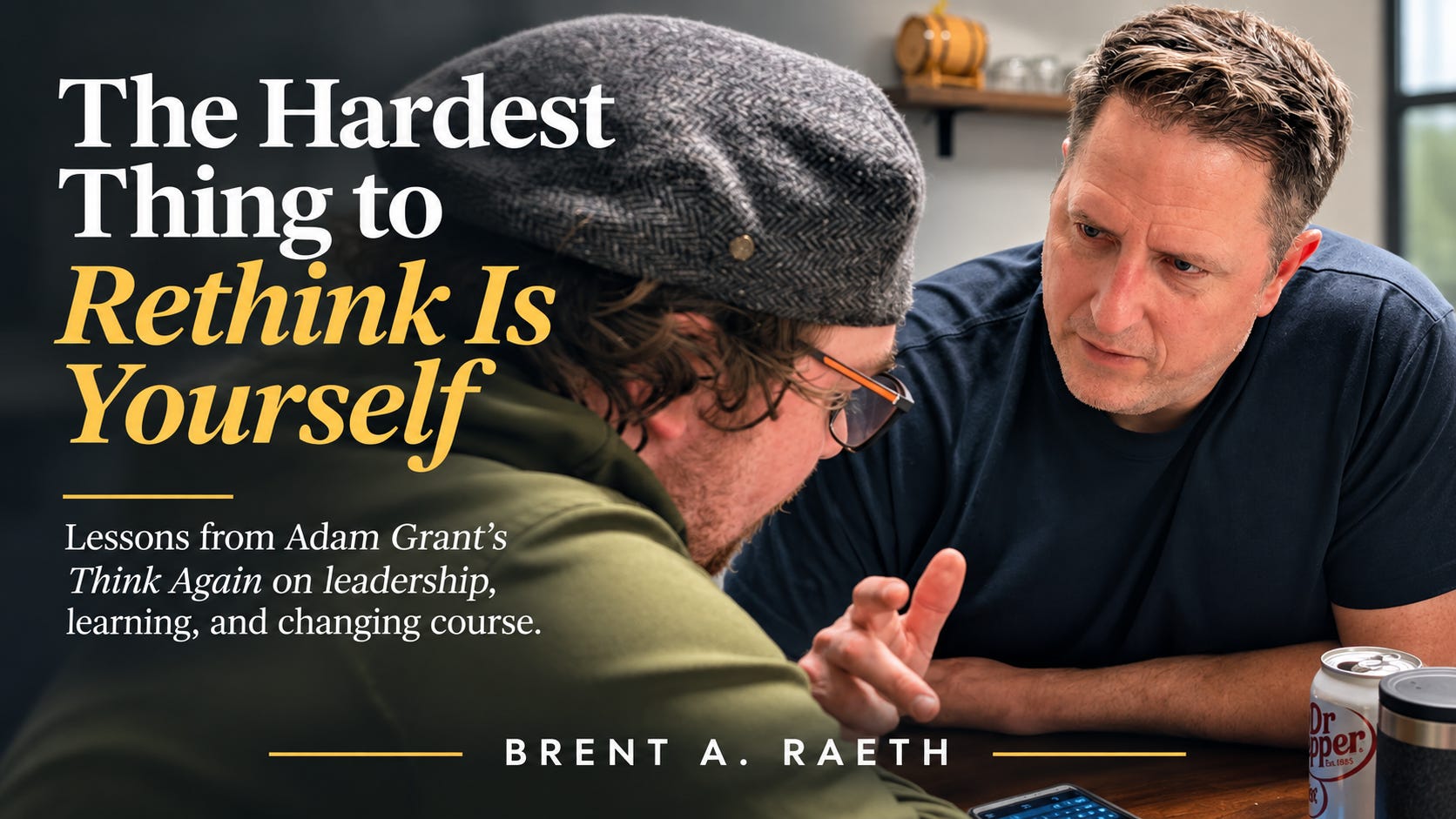
Our leadership team at CatchMark recently finished reading Adam Grant’s Think Again.
I have always believed that one of the best reasons for a leadership team to read a book together is not necessarily to learn the same lessons. It is to give everyone a common set of ideas to argue with, test, apply, and reconsider.
Think Again gave us plenty of those.
The premise of the book is straightforward: we spend a great deal of our lives learning how to think, but not nearly enough time learning how to rethink.
That sounds simple until you begin applying it to yourself.
It is easy to identify stubbornness in someone else. It is easy to see when another person is defending a bad idea, ignoring evidence, or allowing pride to keep them from changing direction.
It is much harder to recognize when we are doing the same thing.
And that may be the most useful lesson I took from the book.
Rethinking is not primarily about becoming better at changing other people’s minds.
It is about becoming less attached to our own.
Intelligence Does Not Protect Us From Being Wrong
One of the more uncomfortable ideas in Think Again is that intelligence does not necessarily make us better at recognizing when we are wrong.
Sometimes it simply makes us better at defending ourselves.
Smart people are often very good at constructing arguments. We can gather facts, explain context, challenge opposing evidence, and build a perfectly reasonable case for why our position makes sense.
That sounds like a strength.
And it is.
Until the position we are defending happens to be wrong.
Then intelligence can become a very effective defense mechanism for ego.
I have seen this in leadership meetings, customer conversations, political discussions, and certainly in myself. Once we become invested in a conclusion, our thinking can quietly shift.
We stop asking:
Is this true?
And begin asking:
How do I prove this is true?
Those are very different questions.
The first is an investigation.
The second is a defense.
Good leaders have to know the difference.
We Become Prosecutors Without Realizing It
Grant describes several different mindsets we tend to adopt when confronting ideas.
One of the most recognizable is the prosecutor.
The prosecutor’s job is not to discover what happened. The prosecutor already has a theory of the case. The job is to assemble the strongest argument possible in support of it.
We do this all the time.
We decide an employee has a bad attitude and begin noticing every example that confirms it.
We decide a customer is difficult and reinterpret every interaction through that assumption.
We decide a strategy is working and explain away every piece of evidence suggesting that it is not.
We decide someone is wrong before the conversation begins and then spend the conversation looking for ammunition.
This is one of the great dangers of experience.
The longer we have been doing something, the easier it becomes to believe that we already know what we are looking at.
Sometimes we do.
Sometimes we are simply seeing what we expected to see.
Experience Should Produce Better Questions, Not Permanent Answers
I place a lot of value on experience.
I think it matters.
I also think experience is valuable only when we remain willing to learn from it.
There is a subtle difference between saying:
“I have seen this before.”
And saying:
“I already know how this ends.”
The first is experience.
The second can become arrogance.
In technology, this becomes obvious very quickly. The industry changes too fast to become permanently attached to yesterday’s answers. Tools change. Threats change. Customer expectations change. Business models change. What was considered best practice five years ago may be a poor recommendation today.
But technology is not unique in this regard.
Leadership changes.
Organizations change.
People change.
Markets change.
Our own priorities change.
Experience should give us pattern recognition, but it should also give us humility.
The more situations we encounter, the more we should understand how often circumstances matter.
Wisdom is not knowing exactly what will happen because you have seen something similar before.
Wisdom is knowing which questions to ask before deciding that the situations are actually the same.
Confidence and Certainty Are Not the Same Thing
Leadership requires confidence.
Eventually someone has to decide.
You cannot run an organization by endlessly discussing every possibility, qualifying every statement, and refusing to move until perfect information arrives.
Perfect information rarely arrives.
We make decisions with what we know.
But confidence is different from certainty.
Confidence says:
Based on what we know, I believe this is the best decision.
Certainty says:
There is no possibility that I am wrong.
I trust the first kind of leader far more than the second.
A leader can be decisive and still curious.
You can make a call while remaining open to new information.
You can strongly believe something while acknowledging that evidence might change your mind.
You can say, “This is where we are going,” while still listening when someone on the team says, “I think we are missing something.”
That does not weaken authority.
Done correctly, it strengthens credibility.
The strongest person in the room is rarely the person most desperate to appear certain.
Changing Your Mind Is Not Inconsistency
We have created a strange cultural expectation around consistency.
We expect people to maintain the same opinions indefinitely, and when they change their minds we sometimes treat it like evidence of dishonesty or weakness.
“You used to say something different.”
Yes.
Perhaps they learned something.
Maybe the facts changed.
Maybe their experience changed.
Maybe they were wrong.
There is nothing admirable about maintaining the same opinion forever if the evidence underneath that opinion has changed.
Consistency is valuable when it describes our principles.
It is far less valuable when it describes our conclusions.
I hope my values remain relatively stable.
I hope my opinions continue changing.
If I am learning, some of them should.
The alternative would suggest that twenty years of additional experience, reading, mistakes, conversations, successes, and failures had somehow taught me nothing.
That would be a far greater problem than changing my mind.
The Best Teams Make It Safe to Say, “I Was Wrong”
This may be where Think Again matters most for leadership teams.
Rethinking cannot simply be an individual discipline. It has to become culturally acceptable.
Teams quickly learn what behavior gets rewarded.
If admitting a mistake gets punished, people will hide mistakes.
If questioning an established decision is interpreted as disloyalty, people will stop questioning decisions.
If leaders defend every previous choice because changing direction might make them look bad, everyone else will learn to do the same.
Eventually the organization becomes filled with people protecting old decisions.
That is expensive.
Sometimes financially.
Sometimes culturally.
Sometimes strategically.
One of the healthiest things a leader can say is:
I was wrong about that.
Another is:
You were right.
And perhaps an even better one:
I had not considered that. Tell me more.
None of those statements surrender leadership.
They demonstrate it.
Disagreement Should Be Useful
Another idea I appreciated in the book is the distinction between productive disagreement and disagreement for the sake of winning.
We need people around us who challenge us.
But challenge is valuable only when the goal is better thinking.
Once disagreement becomes personal, tribal, or performative, very little learning happens.
You can see this everywhere today.
People are often not discussing ideas. They are defending identities.
Once an opinion becomes part of who we believe we are, changing the opinion feels like surrendering part of ourselves.
That makes honest discussion extremely difficult.
Instead of hearing an argument, we hear an attack.
Instead of considering evidence, we evaluate whose side it supports.
Instead of asking whether something might be true, we ask what accepting it would mean about us.
That is when thinking stops.
The challenge is learning to separate our identity from our ideas.
I can be wrong about an idea without being an idiot.
You can disagree with me without becoming my enemy.
And neither of us has to lose simply because one of us changes our mind.
Ask What Would Change Your Mind
There is one question I kept returning to while reading the book:
What evidence would change my mind?
It is a deceptively powerful question.
If the honest answer is “nothing,” then we probably are not reasoning anymore.
We are believing.
There may be things in life that appropriately fall into that category. Deeply held values, moral principles, or matters of faith may not operate like scientific hypotheses.
But a surprising number of our everyday opinions should be open to evidence.
Business strategies should be.
Management decisions should be.
Technology recommendations should be.
Assumptions about people should be.
Political opinions should be.
Predictions should be.
Theories about why something happened should be.
Before arguing harder, it is worth asking:
What would I need to see to conclude that I am wrong?
Then comes the more difficult question:
Am I willing to look for it?
The Goal Cannot Be to Win
Perhaps the biggest idea I took from Think Again is one I have been circling around for years.
The goal of thinking cannot simply be to be right.
That sounds contradictory.
Of course we want to be right.
But there is a difference between wanting the correct answer and wanting our answer to be correct.
The first creates curiosity.
The second creates ego.
When the goal is truth, discovering that someone else has a better answer is progress.
When the goal is winning, discovering that someone else has a better answer feels like defeat.
That distinction affects everything.
Leadership.
Marriage.
Friendship.
Business.
Politics.
Teams.
If every conversation creates winners and losers, people eventually become afraid to reconsider anything.
But if the objective is to get closer to the truth, changing our minds becomes part of the process.
Rethinking Ourselves
We finished Think Again, but I am not sure books like this are ever really finished.
The point is not remembering every concept.
The point is noticing yourself differently afterward.
I want to notice when I become defensive too quickly.
I want to notice when I am gathering evidence to protect an opinion rather than test it.
I want to notice when experience turns into certainty.
I want to notice when being right becomes more important than solving the problem.
And I want the people around me to feel comfortable enough to tell me when they see it before I do.
Because the hardest ideas to rethink are rarely abstract ideas.
They are the ones we have repeated for years.
The decisions we have defended.
The assumptions that have become comfortable.
The stories we tell ourselves about other people.
And perhaps most importantly, the stories we tell ourselves about ourselves.
Being willing to rethink those things does not mean we lack conviction.
It means our conviction is strong enough to survive examination.
There is a tremendous amount of pressure in leadership to know.
To have the answer.
To be decisive.
To be right.
But perhaps mature leadership looks a little different.
Make the best decision you can.
Act on it.
Pay attention.
Remain curious.
And when the evidence changes, have enough humility to say:
I need to think again.