


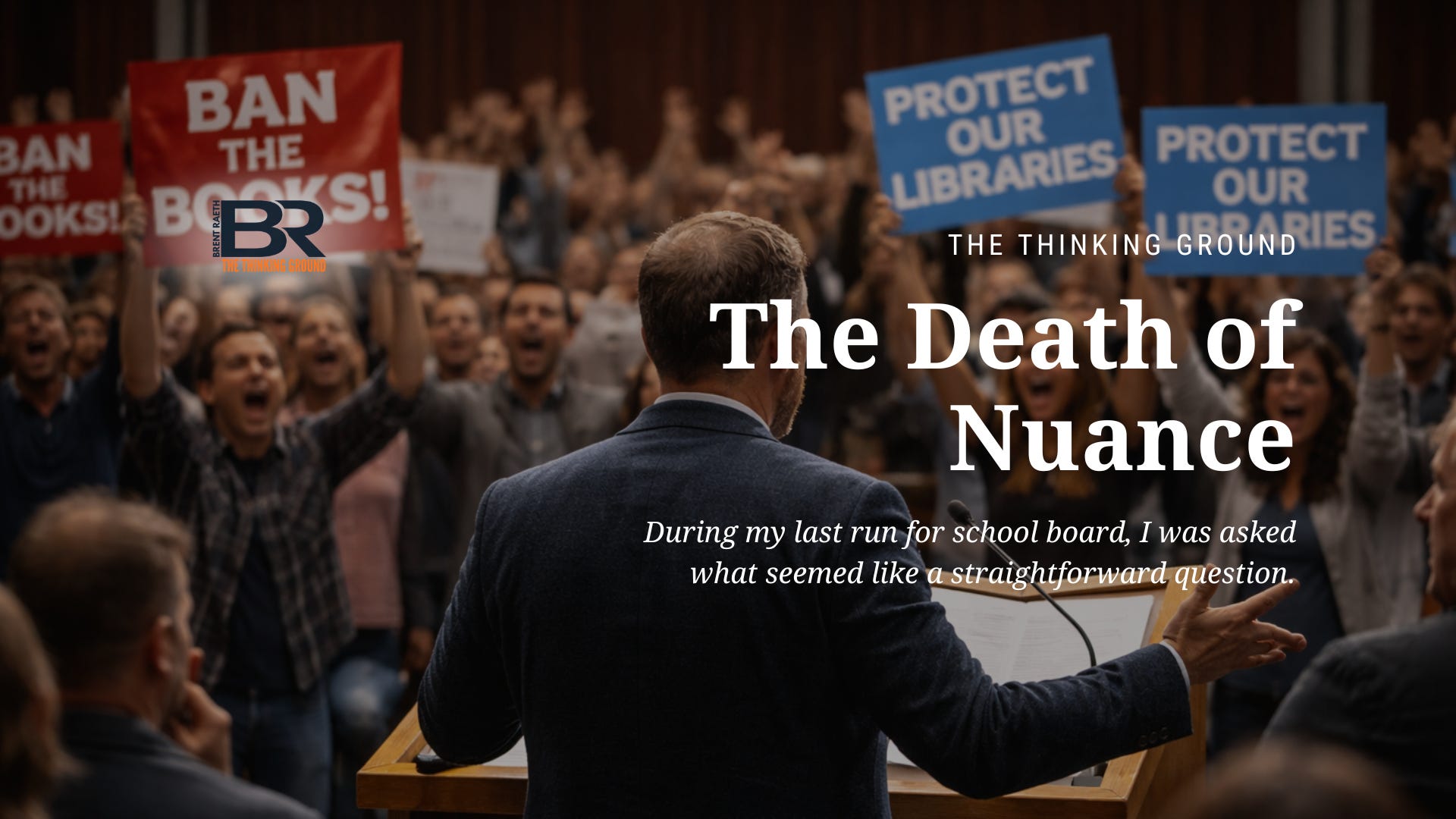
During my last run for school board, I was asked what seemed like a straightforward question.
“What is your position on book banning?”
My answer, at least in my mind, was practical and balanced.
I said I am fundamentally against banning books outright. At the same time, I believe there should be clear criteria for what is allowed in a public school library that is meant for children.
That answer reflects how I approach most decisions. Not absolute. Not reactionary. Grounded in both principle and responsibility.
Then came the follow-up.
“What would you do if a non-approved book ended up in the library?”
Again, I walked through it logically.
First, confirm whether the book was actually non-approved and whether it had gone through the proper process. If it had not, remove it until it did and figure out how it got there. Then look at improving the process if needed.
If it had gone through the process, I would review the book against our standards. From there, determine whether the issue was the book itself or whether our standards needed to be adjusted.
To me, this was not controversial. It was structured thinking. Evaluate the situation, follow the process, and adjust where necessary.
But that is not how it was received.
On one side, people stopped listening the moment I said I was against outright banning books. That alone was enough to label me as someone who did not care about what was in schools.
On the other side, I was criticized for the idea that there should be any standard at all for what is allowed in a school library.
Both reactions had something in common.
They ignored the full answer.
Each side heard the part they disagreed with, filtered out the rest, and responded as if the position was absolute.
That is the problem.
Why everything is now extreme, and nothing is thoughtful
Somewhere along the way, we lost the ability to hold two ideas at the same time.
Everything now has to be absolute. You are either for something or against it. You are either aligned or opposed. There is very little space left for anything in between.
And when that space disappears, so does thoughtful thinking.
The Pressure to Choose a Side
Most complex issues are exactly that. Complex.
They involve tradeoffs, unintended consequences, competing priorities, and incomplete information. In leadership, this is understood. Decisions are rarely perfect. They are made by weighing risks, considering impacts, and choosing the best path forward with what is known.
But in public discourse, that complexity is often stripped away.
Issues are reduced to simple, binary choices. Nuanced positions are reframed as weak or indecisive. If you acknowledge both sides of a problem, you are accused of not taking a stand.
So people adapt.
They simplify their views, not because the issue is simple, but because complexity is no longer well received.
When Everything Becomes Extreme
Once nuance is removed, everything starts to drift toward extremes.
Moderate positions get pulled apart. Balanced perspectives are criticized from both directions. Over time, the loudest and most rigid viewpoints begin to dominate the conversation.
Not because they are the most accurate, but because they are the easiest to communicate.
Clear. Certain. Confident.
Even when they are incomplete.
This creates an environment where the most thoughtful voices are often the least heard.
A Familiar Breakdown in Decision-Making
In business, removing nuance would be considered a failure of leadership.
Imagine evaluating a major decision without acknowledging tradeoffs. Ignoring risk. Dismissing alternative perspectives. Forcing a binary answer to a problem that requires a layered approach.
It would not take long before the quality of decisions declined.
Yet this is exactly what happens in broader conversations every day.
Complex issues are forced into oversimplified frameworks. And once that happens, the ability to make good decisions starts to erode.
Because good decisions require clarity, not certainty.
The Cost of Oversimplification
When everything is framed as all-or-nothing, we lose more than just accuracy.
We lose understanding.
People stop listening to learn. They listen to confirm. Conversations become predictable. Positions harden. And progress slows because no one is willing to engage with the full picture.
It also creates unnecessary division.
Two people can agree on 80 percent of an issue and still find themselves in conflict because the remaining 20 percent is framed as a deal-breaker. The common ground is ignored, and the difference is amplified.
That is not a disagreement problem. That is a framing problem.
Why Nuance Feels Uncomfortable
Nuance requires effort.
It forces you to sit in tension. To acknowledge that a position can have both strengths and weaknesses. To accept that your current understanding may be incomplete.
That is not easy.
It is far more comfortable to adopt a clean, simple position and defend it. It removes ambiguity. It provides clarity. It aligns you with a group.
But comfort and clarity are not the same as accuracy.
And over time, choosing comfort over accuracy weakens thinking.
Relearning How to Think Clearly
If we want to improve the quality of our conversations and decisions, we have to bring nuance back into the process.
That starts with a few simple shifts.
Be willing to say, “This part makes sense, and this part does not.”
Recognize that disagreement does not require total opposition.
Ask better questions instead of rushing to conclusions.
Accept that understanding an issue fully may take time.
None of this is complicated.
But it does require discipline.
A Better Standard for Thinking
Strong thinking is not about having a quick answer.
It is about having a complete one.
It is the ability to evaluate ideas from multiple angles, to understand tradeoffs, and to make decisions that reflect reality, not just preference.
That kind of thinking does not fit well into a world that rewards speed and certainty.
But it is the kind of thinking that leads to better outcomes.
And right now, it is in short supply.
The more we move away from nuance, the more confident we become in incomplete ideas.
And the more confident we become, the harder it is to recognize when we are wrong.
That is not progress.
That is erosion.