


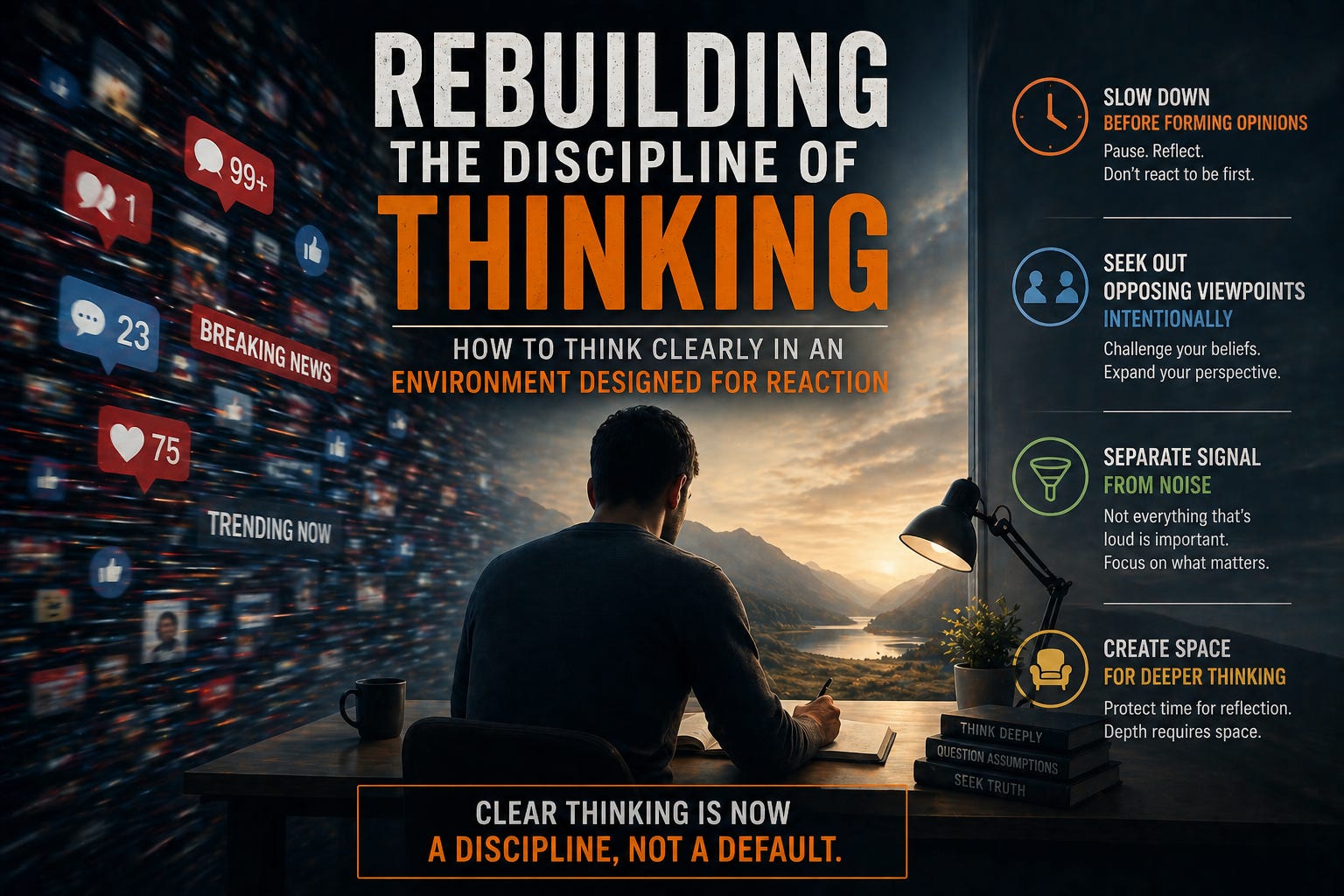
There was a time when clear thinking required effort.
That is still true.
But the nature of that effort has changed.
Today, the challenge is not access to information. It is resisting the way that information is presented, consumed, and reinforced. The environment is built for speed, reaction, and constant engagement.
Clear thinking runs against all three.
It is slower. It is quieter. It requires space that the current environment does not naturally provide.
Which means it is no longer a default.
It is a discipline.
Slowing Down Before Forming Opinions
The first step is deceptively simple.
Pause.
In a fast-moving environment, the instinct is to respond quickly. To form an opinion as soon as possible. To keep pace with the conversation.
But most situations do not require an immediate conclusion.
They require understanding.
Slowing down creates space for that understanding to develop. It allows time for additional context to emerge, for initial narratives to be tested, and for assumptions to be questioned.
Without that pause, you are often reacting to the first version of the story, not the most accurate one.
And early versions are frequently incomplete.
Seeking Out Opposition
Left to its own, the environment will reinforce what you already believe.
That makes intentional exposure to opposing viewpoints essential.
Not for the purpose of arguing against them, but for understanding them.
Strong thinking is shaped by tension. It improves when it is challenged. It becomes more precise when it is forced to account for perspectives that do not align easily.
Avoiding opposition may feel comfortable, but it comes at a cost.
It creates blind spots. It weakens reasoning. It builds confidence without testing its foundation.
Seeking out opposing views reintroduces friction.
And friction is where clarity is refined.
Separating Signal from Noise
Not all information carries equal weight.
Some is relevant. Some is incomplete. Some is misleading. Some is designed primarily to provoke a reaction.
In a high-volume environment, the ability to distinguish between them becomes critical.
Signal is often less visible. It is not always the most shared or the most emotionally charged. It requires more effort to identify.
Noise, on the other hand, is easy to find. It is loud, immediate, and persistent.
Without discipline, noise dominates.
Separating the two requires asking better questions.
Is this information complete?
What is the source?
What might be missing?
Is this designed to inform, or to provoke?
Those questions slow the process, but they also improve the outcome.
Creating Space to Think
Clear thinking does not happen in constant motion.
It requires space.
Time without input. Time without interruption. Time to process, connect ideas, and reflect without the pressure to respond.
That space is increasingly rare.
But it is also increasingly valuable.
Without it, thinking becomes reactive. You move from one input to the next without ever fully processing any of them. Conclusions are formed quickly, but they are rarely examined.
Creating space is not passive.
It is a deliberate choice to step away from the flow long enough to think independently of it.
The Discipline of Clarity
None of this happens automatically.
It requires intention.
It requires choosing to pause when speed is rewarded. Choosing to engage with opposition when agreement is easier. Choosing depth when simplicity is more appealing. Choosing reflection when reaction is expected.
These choices are not always efficient.
They do not always feel natural.
But they are necessary.
Because the environment is not neutral. It is shaping how people think, often without their awareness.
Rebuilding the discipline of thinking means recognizing that influence and deciding not to follow it blindly.
The Real Advantage
Clear thinking has always been valuable.
Now it is becoming rare.
In an environment filled with constant noise, those who can slow down, filter effectively, and think independently will separate themselves.
Their decisions will be better. Their judgment will be sharper. Their ability to navigate complexity will improve.
Not because they have more information.
But because they use it differently.
The Real Cost, and the Opportunity
The cost of this environment is not just distraction.
It is the gradual erosion of how people think.
But the opportunity is just as real.
Because discipline can be developed.
Clear thinking can be rebuilt.
And those who are willing to do the work will find themselves operating with an advantage that is becoming less common by the day.
In a world designed for reaction, the ability to think clearly is no longer automatic.
It is earned.