


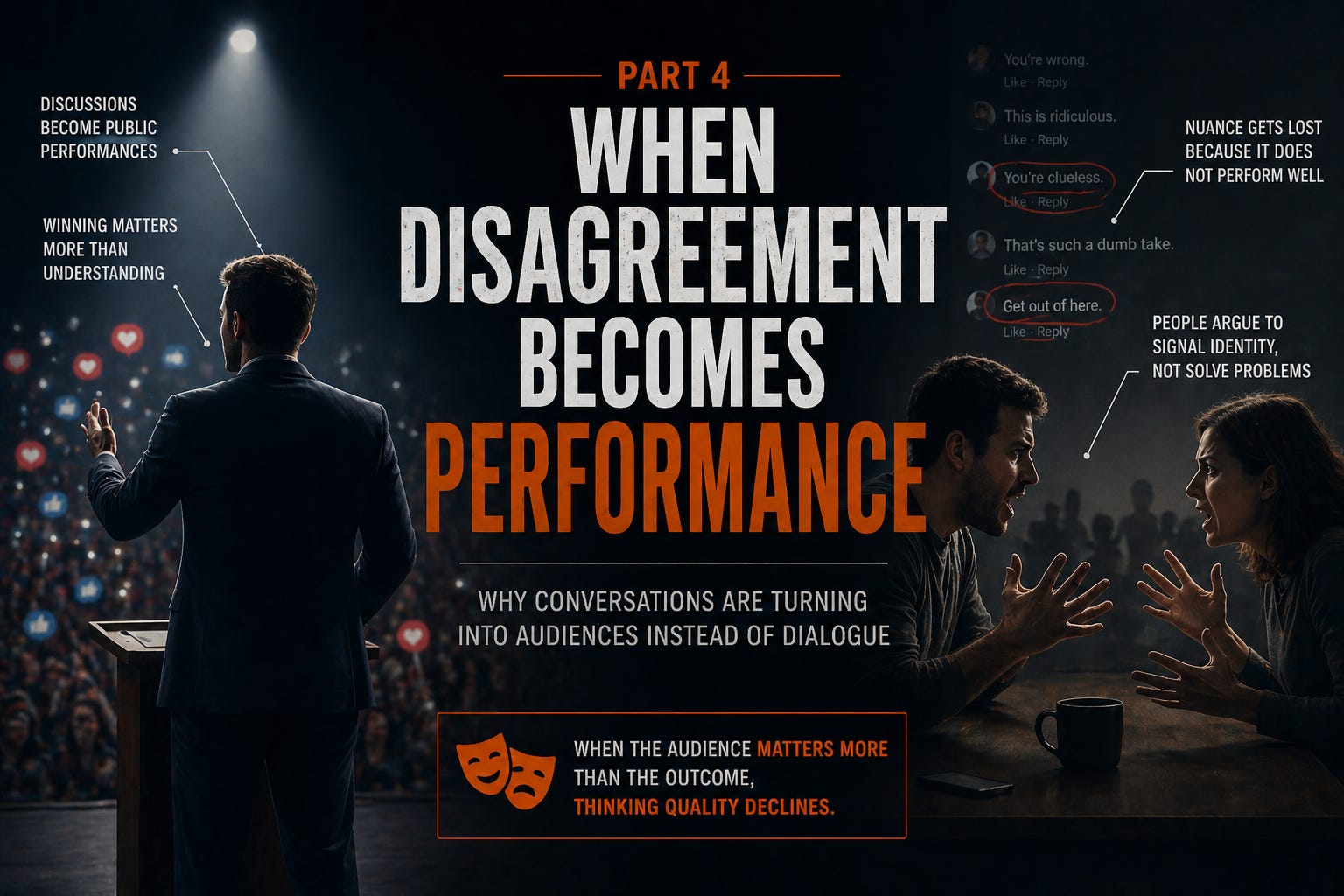
There was a time when disagreement served a clear purpose.
It was a way to test ideas. To challenge assumptions. To refine thinking through tension and exchange. The goal was not always agreement, but it was understanding.
That purpose is changing.
Increasingly, disagreement is no longer a conversation.
It is a performance.
From Dialogue to Audience
Social media has altered the structure of how we communicate.
Conversations that once happened privately or within small groups are now public by default. They are visible, shareable, and often permanent. What used to be an exchange between two people is now observed by many.
That shift matters.
Because when a conversation has an audience, the incentives change.
You are no longer speaking only to understand or to be understood. You are speaking to be seen. To be recognized. To be affirmed by those watching.
The conversation becomes something else.
It becomes a stage.
Winning Over Understanding
In a performance environment, the goal subtly shifts.
It is no longer to explore the issue. It is to present your position in the strongest possible light. To defend it. To make it persuasive, memorable, and, ideally, applauded.
Winning begins to matter more than understanding.
Points are made, not explored. Responses are crafted to land, not to learn. Opposing views are engaged selectively, often in their weakest form.
This is not always intentional.
It is simply what the environment rewards.
Clear, confident, and emotionally charged statements travel further than careful, nuanced ones. The more definitive the position, the more attention it receives.
Over time, that shapes how people communicate.
The Disappearance of Nuance
Nuance does not perform well.
It requires context. It introduces uncertainty. It acknowledges complexity. It often resists clean conclusions.
In a fast, public environment, those qualities are disadvantages.
They slow things down. They dilute the clarity of the message. They make it harder to take a definitive stance.
So nuance begins to disappear.
Complex issues are reduced to simple positions. Tradeoffs are minimized or ignored. Middle ground becomes less visible, and sometimes less acceptable.
What remains is a set of sharpened, simplified views that are easier to present and easier to defend.
But also less complete.
Arguing as Identity
As performance increases, something deeper begins to take hold.
Arguments become tied to identity.
Positions are no longer just ideas. They become signals. Indicators of what you believe, who you align with, and where you stand.
Disagreement, then, is not just about the issue.
It is about alignment.
To concede a point can feel like conceding position. To adjust a view can feel like stepping away from a group. The cost of changing your mind becomes higher, not because of the idea itself, but because of what it represents.
So positions harden.
Not necessarily because they are correct, but because they are connected to something beyond the argument.
The Impact on Thinking
When conversations become performances, thinking begins to change.
You prepare responses instead of considering alternatives. You listen for openings instead of understanding. You prioritize how something will be received over whether it is accurate.
The feedback loop reinforces this.
Strong reactions are rewarded. Engagement increases visibility. Visibility encourages repetition.
Over time, the goal of the conversation drifts.
It is no longer about solving the problem.
It is about sustaining the performance.
The Cost in Leadership and Decision Making
In leadership environments, this dynamic creates real challenges.
If disagreement becomes performative, honest dialogue becomes harder to sustain. People become more cautious about expressing uncertainty. They are less willing to explore ideas that may not be immediately well-received.
Conversations become safer, but also less useful.
Important perspectives remain unspoken. Weak ideas go unchallenged. Strong ideas are not fully developed because they are never tested under real scrutiny.
Decisions made in that environment reflect those limitations.
They may appear aligned on the surface, but lack the depth that comes from genuine debate.
Returning to Real Dialogue
The solution is not to eliminate disagreement.
It is to restore its purpose.
That begins with recognizing the difference between performing and thinking.
Are you responding to be understood, or to be seen?
Are you engaging the strongest version of the opposing view, or the easiest to dismiss?
Are you trying to resolve the issue, or win the exchange?
These questions create awareness.
From there, the shift requires intention.
Creating space for private, honest conversations where ideas can be explored without an audience. Valuing questions as much as statements. Rewarding clarity of thought over strength of delivery.
Most importantly, separating identity from position.
Because when ideas are allowed to stand on their own, they can be challenged, refined, or replaced without resistance tied to something deeper.
The Real Cost
Performance creates the appearance of engagement.
It looks active. It looks passionate. It looks like progress.
But when the audience becomes more important than the outcome, something essential is lost.
Thinking becomes secondary to presentation. Understanding gives way to positioning.
And over time, the quality of decisions reflects that shift.
In an environment where everything is visible, the discipline to think privately, to question openly, and to engage honestly becomes rare.
But it is also necessary.
Because when disagreement stops being a tool for understanding, it stops being useful at all.