


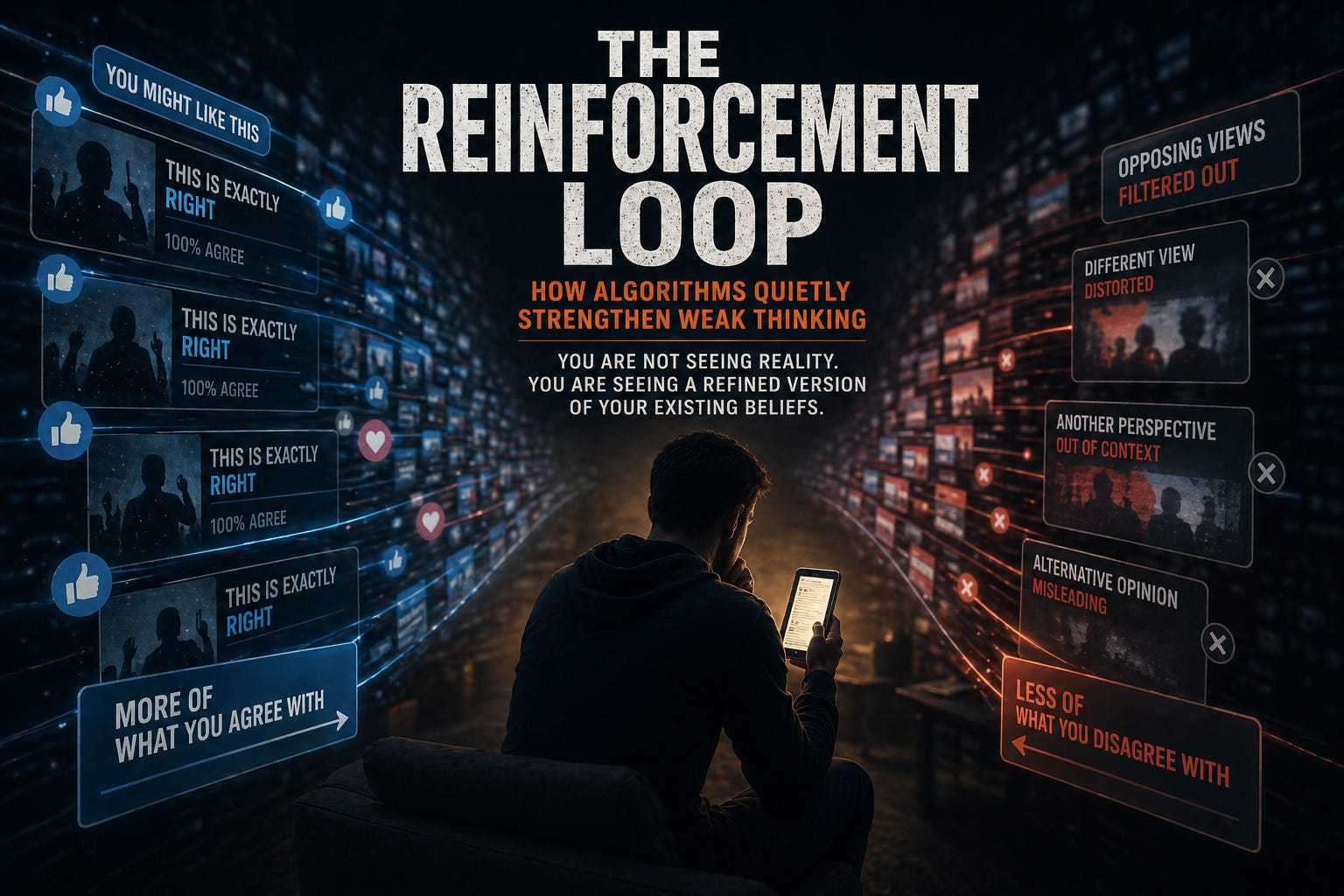
There is a common belief that access to more information leads to broader perspective.
That exposure to different viewpoints sharpens thinking. That seeing more of the world helps you understand it more clearly.
In theory, that should be true.
In practice, something very different is happening.
Because much of what you see is not expanding your perspective. It is reinforcing it.
The System Behind What You See
Social media does not present information randomly.
It is curated. Filtered. Refined.
Every interaction, what you click, what you pause on, what you like, what you share, becomes a signal. Over time, those signals are used to shape what you are shown next.
The goal is not to challenge you.
The goal is to keep your attention.
And the most effective way to do that is to show you more of what you already engage with.
More of what you agree with. More of what feels familiar. More of what confirms your existing views.
It feels like discovery.
But it is often repetition.
Agreement as a Feedback Loop
At first, the reinforcement is subtle.
You see content that aligns with your perspective. You engage with it. The system responds by showing you more of the same.
Over time, the pattern strengthens.
The range of viewpoints narrows. The frequency of agreement increases. The sense that your position is widely supported begins to grow.
It does not feel like bias.
It feels like validation.
But validation, when it is artificially amplified, can be misleading.
Because what you are seeing is not a balanced view of reality. It is a filtered version shaped by your past behavior.
The Disappearance of Opposition
As reinforcement increases, something else begins to fade.
Opposing viewpoints.
They do not disappear entirely, but they become less visible, less frequent, and often more distorted when they do appear.
Instead of engaging with the strongest version of a different perspective, you are more likely to encounter a simplified or exaggerated version of it. One that is easier to dismiss.
This creates a false sense of clarity.
Your position appears stronger, not because it has been tested, but because it has not been meaningfully challenged.
The Drift Toward Extremes
When ideas are reinforced without resistance, they tend to move.
Not always dramatically at first, but gradually.
What once felt like a moderate position becomes more defined. Then more certain. Then more rigid.
Without opposing pressure, there is nothing to slow that progression.
Each reinforcing signal pushes the belief slightly further. Each repeated message strengthens it. Each unchallenged assumption becomes more embedded.
Over time, the position evolves.
Not necessarily because it has become more accurate, but because it has become more reinforced.
Confidence Without Friction
One of the most significant consequences of this loop is the loss of friction.
Friction is what sharpens thinking.
It is what forces you to question assumptions, refine arguments, and consider alternatives. It is what exposes weaknesses before they become problems.
Without friction, thinking becomes easier.
And when thinking becomes easier, it often becomes weaker.
Confidence grows, but it is no longer tied to the strength of the reasoning behind it. It is tied to the consistency of reinforcement.
You believe it more because you see it more.
Not because it has been tested more.
The Impact on Decision Making
In leadership and decision making, this dynamic carries real risk.
When perspectives are shaped by reinforcement rather than challenge, blind spots expand.
You begin to assume alignment where it may not exist. You overestimate the strength of your position. You underestimate the validity of alternative views.
Decisions are made within a narrower frame.
And because that frame feels complete, it is rarely questioned.
The result is not just disagreement with others.
It is misalignment with reality.
Breaking the Loop
The reinforcement loop is not obvious while you are inside it.
It feels like clarity. It feels like confidence. It feels like being informed.
But it is often something else.
It is a narrowing of perspective that happens gradually, reinforced by design.
Breaking that loop requires intention.
It requires seeking out perspectives that do not align with your own. Engaging with arguments you disagree with, not to dismiss them, but to understand them. Questioning why certain views feel obvious, and whether they have actually been tested.
It requires reintroducing friction into your thinking.
Not because it is comfortable.
But because it is necessary.
The Real Cost
The danger is not that people have strong beliefs.
The danger is when those beliefs are built in environments that never challenge them.
Because in that environment, confidence becomes detached from accuracy.
And when that happens, decisions begin to drift.
You are not seeing the world as it is.
You are seeing a version of it shaped by what you have already chosen to believe.
Refined. Reinforced. Repeated.
But not necessarily true.