


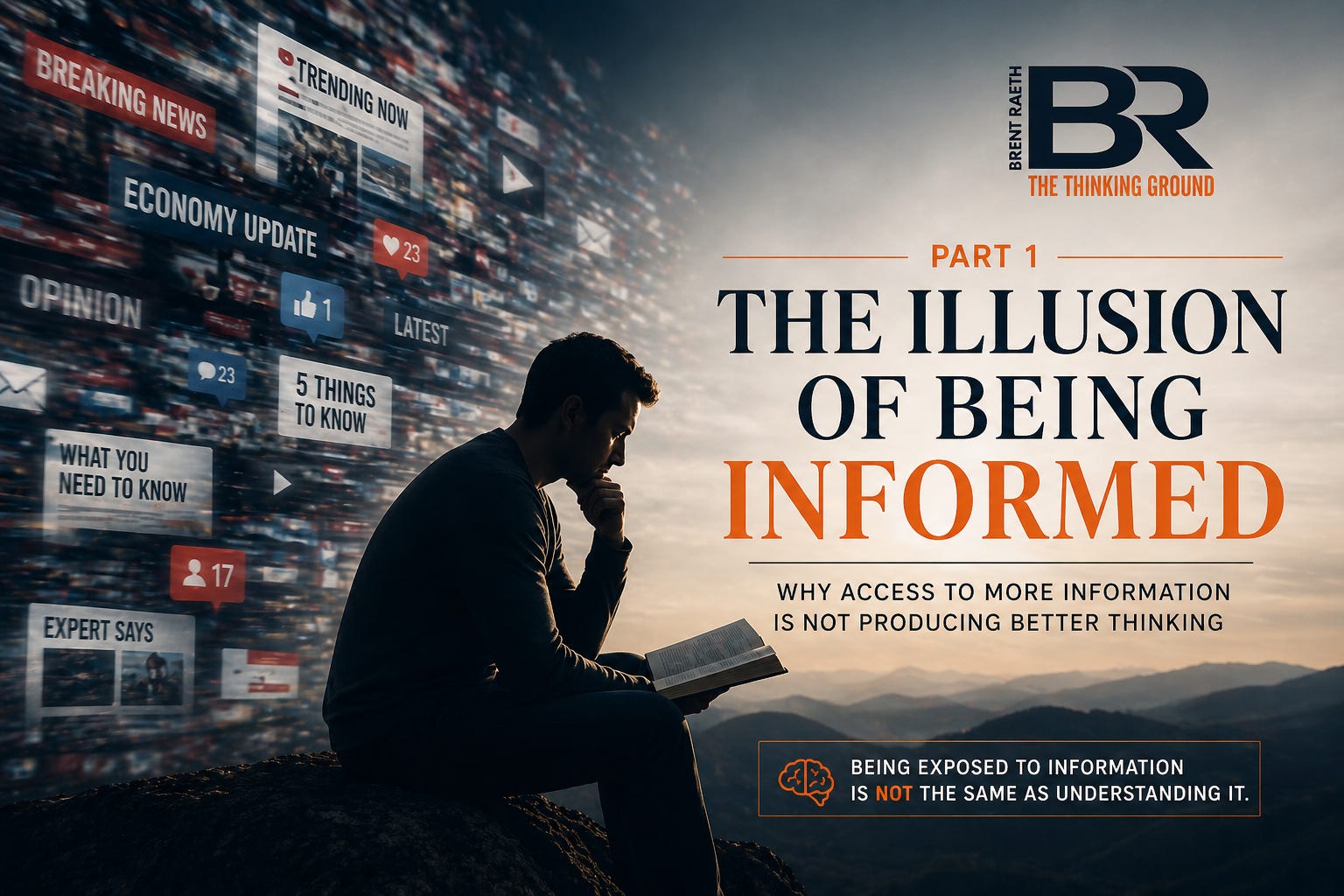
There is a quiet assumption that underlies much of modern life.
If you have access to more information, you will make better decisions.
It is a reasonable belief. More data should sharpen judgment. More perspectives should deepen understanding. More visibility should reduce blind spots.
And yet, something is off.
Because while access has increased, the quality of thinking has not kept pace. In many cases, it has declined.
The issue is not the presence of information. It is the way it is being absorbed.
The Illusion Begins with Exposure
We live in a state of constant exposure.
Information arrives in an unending stream. Headlines. Fragments. Commentary layered on commentary. A continuous flow of updates, each one quickly replaced by the next.
Over time, something subtle takes hold.
You begin to feel informed.
You recognize the topic. You have seen the key points. You can follow the conversation, even contribute to it. There is a sense of familiarity that feels, at first glance, like understanding.
But familiarity is not understanding.
Exposure creates recognition. It does not create depth.
When Headlines Replace Depth
To keep pace with the speed of consumption, information has been compressed.
Complex issues are reduced to headlines, summaries, and brief moments of explanation. They are shaped to be consumed quickly, understood easily, and shared immediately.
There is nothing inherently wrong with simplification. The problem arises when it becomes the primary lens through which we see.
A headline can tell you what happened. It rarely tells you why. It does not reveal the context, the tradeoffs, or the consequences that sit beneath the surface.
Without those elements, the picture remains incomplete.
And yet, it is often enough to form a conclusion.
Skimming as a Substitute for Thought
The pace encourages a particular kind of engagement.
We skim. We scan. We move quickly from one idea to the next, collecting impressions rather than building understanding.
It feels efficient. It feels like staying informed.
But something essential is lost in the process.
Understanding requires time. It requires holding competing ideas in tension, questioning assumptions, and working through complexity without the comfort of immediate resolution.
That kind of thinking cannot exist at scroll speed.
When skimming replaces analysis, what remains is not clarity, but a thinner version of it. One that feels sufficient, but rarely is.
Confidence Without Foundation
Perhaps the most concerning effect is not misinformation, but misplaced confidence.
As exposure increases, so too does certainty.
You have seen enough to feel assured. Enough repetition to believe something must be true. Enough agreement to reinforce your position.
And yet, much of what would challenge that confidence remains unseen or unexplored.
The result is a widening gap.
Confidence rises. Depth does not.
And decisions are made not on what is known, but on what is believed to be known.
The Cost in Leadership and Decision Making
In leadership, this gap carries weight.
Decisions are rarely simple. They involve uncertainty, incomplete information, and competing priorities. They require judgment, not just awareness.
When that judgment is built on partial understanding, the consequences begin to surface.
Teams align around ideas that feel well-supported, but are not fully examined. Assumptions pass without challenge because they are familiar. Risks go unnoticed because they were never fully considered.
The impact is not always immediate.
It shows up over time, in missed signals, flawed decisions, and outcomes that do not align with expectations.
The cost is cumulative. And it is often difficult to trace back to its source.
Relearning the Difference
The solution is not to step away from information.
It is to engage with it more deliberately.
To recognize that exposure is not understanding. That recognition is not knowledge. That confidence, on its own, is not proof of accuracy.
Clear thinking requires more than access.
It requires restraint. The willingness to pause. The discipline to question what feels obvious. The patience to sit with uncertainty long enough for understanding to take shape.
These are not natural responses in a fast environment.
They are choices.
The Real Cost
The illusion of being informed is difficult to detect.
It feels like awareness. It feels like engagement. It feels like keeping up.
But over time, it replaces depth with familiarity and analysis with reaction.
And when that happens, the quality of thinking begins to erode.
In a world defined by constant input, the challenge is no longer gaining access to information.
It is maintaining the discipline to think clearly about it.
Because being exposed to information is not the same as understanding it.
Not even close.