


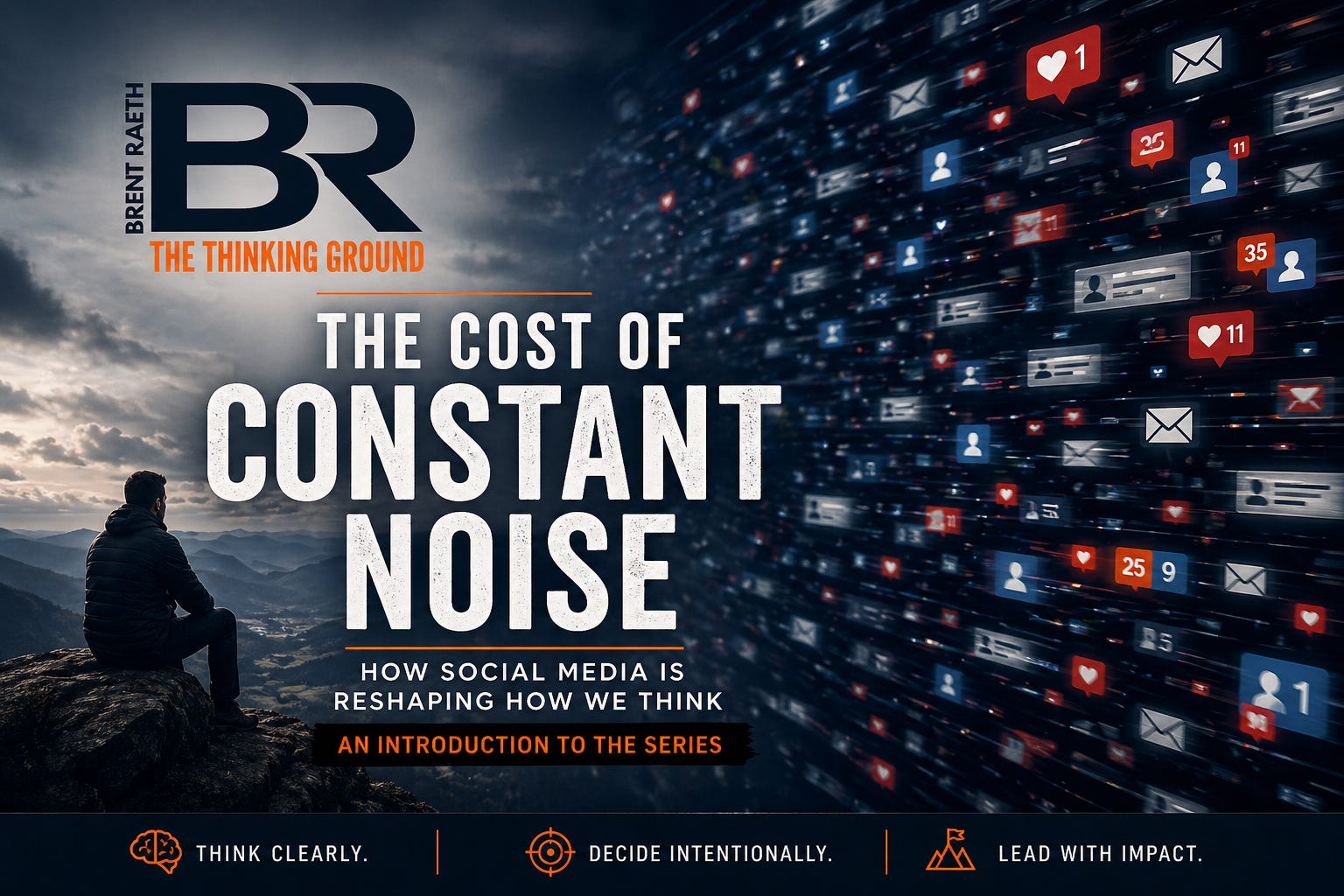
There is no shortage of information in the world today.
At any moment, you can reach into your pocket and access more perspectives, data, and opinions than any generation before you. News unfolds in real time. Analysis follows almost instantly. Reactions arrive faster still. By the time events fully take shape, most people have already decided what they think about them.
It feels, on the surface, like progress.
More access should lead to greater understanding. More perspectives should sharpen judgment. More information should improve outcomes.
But that is not what is happening.
In many cases, the opposite is unfolding quietly, almost imperceptibly.
More Information, Worse Thinking
The issue is not the presence of information. It is the environment in which it is consumed.
Social media has altered that environment in fundamental ways. It has increased the speed, volume, and visibility of information, but it has also reshaped the incentives that govern how we engage with it.
Quick reactions are rewarded. Strong opinions travel further than measured ones. Simplicity outperforms nuance. Certainty spreads more easily than doubt.
Over time, these incentives begin to shape behavior.
People respond before they understand. Complex issues are reduced to narrow narratives. Familiarity is mistaken for knowledge. Confidence grows, even when it rests on incomplete ground.
What emerges is not a communication problem alone. It is a degradation of thinking itself.
Why This Matters More Than It Appears
At an individual level, the effects can seem manageable. Misunderstandings arise. Judgments are formed too quickly. Conversations lose depth.
At a leadership level, the consequences are far more significant.
Leaders are responsible for interpreting information, making decisions, and guiding others through uncertainty. When the information they rely on is shaped by speed, bias, and missing context, the quality of those decisions begins to erode.
You begin to see patterns.
Teams align around incomplete understanding. Decisions carry more confidence than clarity. Disagreements become unproductive, not because of malice, but because the foundation beneath them is shallow. Organizations react to noise, mistaking it for signal.
These are not isolated failures. They are cumulative. And over time, they compound.
This Is Not About Blame
It is tempting to place responsibility on the platforms themselves.
That is too simple.
The platforms are environments. They shape behavior, but they do not determine it. The more important question is how we, within those environments, choose to think.
Awareness is the first step. Without it, the influence remains invisible. With it, the possibility of discipline returns.
What This Series Will Explore
This series is an attempt to examine how this environment is reshaping thought, often without our noticing.
We will look at how constant exposure creates the illusion of being informed. How speed begins to replace accuracy. How algorithms reinforce existing beliefs while narrowing perspective. How disagreement shifts from dialogue into performance. And, perhaps most importantly, how the discipline of clear thinking can be rebuilt.
The goal is not to reject information or withdraw from engagement.
It is to engage more deliberately, with greater awareness of what is being lost in the process.
The Real Opportunity
Most people are not adapting their thinking to this environment.
They are reacting to it.
That distinction matters.
Those who learn to slow down, to question more carefully, to hold uncertainty a little longer, will begin to separate themselves. Their decisions will improve. Their leadership will strengthen. Their understanding will deepen.
In a world filled with constant noise, clarity is no longer automatic.
It is earned.
And that may be the most important shift of all.
What Comes Next
This is not a one-time observation. It is a pattern worth examining more closely.
In the articles that follow, I will explore how this environment shapes thinking in specific, often subtle ways.
We will begin with The Illusion of Being Informed, and the growing gap between exposure and understanding. In a world of constant input, it is easy to feel knowledgeable without ever developing real depth. That gap is where poor judgment often begins.
From there, we will move into Speed Over Accuracy, where the pressure to respond quickly starts to replace the discipline of thinking clearly. When immediacy is rewarded, reflection becomes rare, and the quality of decisions suffers.
In The Reinforcement Loop, we will examine how algorithms quietly shape what we see and, over time, what we believe. The more our views go unchallenged, the more confident and, often, the more extreme they become.
Next, in When Disagreement Becomes Performance, we will look at how conversations have shifted. Dialogue gives way to audience-driven exchanges where winning matters more than understanding, and nuance is often lost in the process.
Finally, we will turn toward Rebuilding the Discipline of Thinking, focusing on what it takes to think clearly in an environment designed for reaction. Not in theory, but in practice.
None of this is abstract.
It shows up in leadership. It shows up in organizations. It shows up in everyday decisions.
And if it is left unexamined, it compounds.
The goal of this series is simple.
Not to reduce access to information, but to improve how we engage with it.
Because in an environment filled with constant noise, the ability to think clearly is no longer automatic.
It is a discipline.