


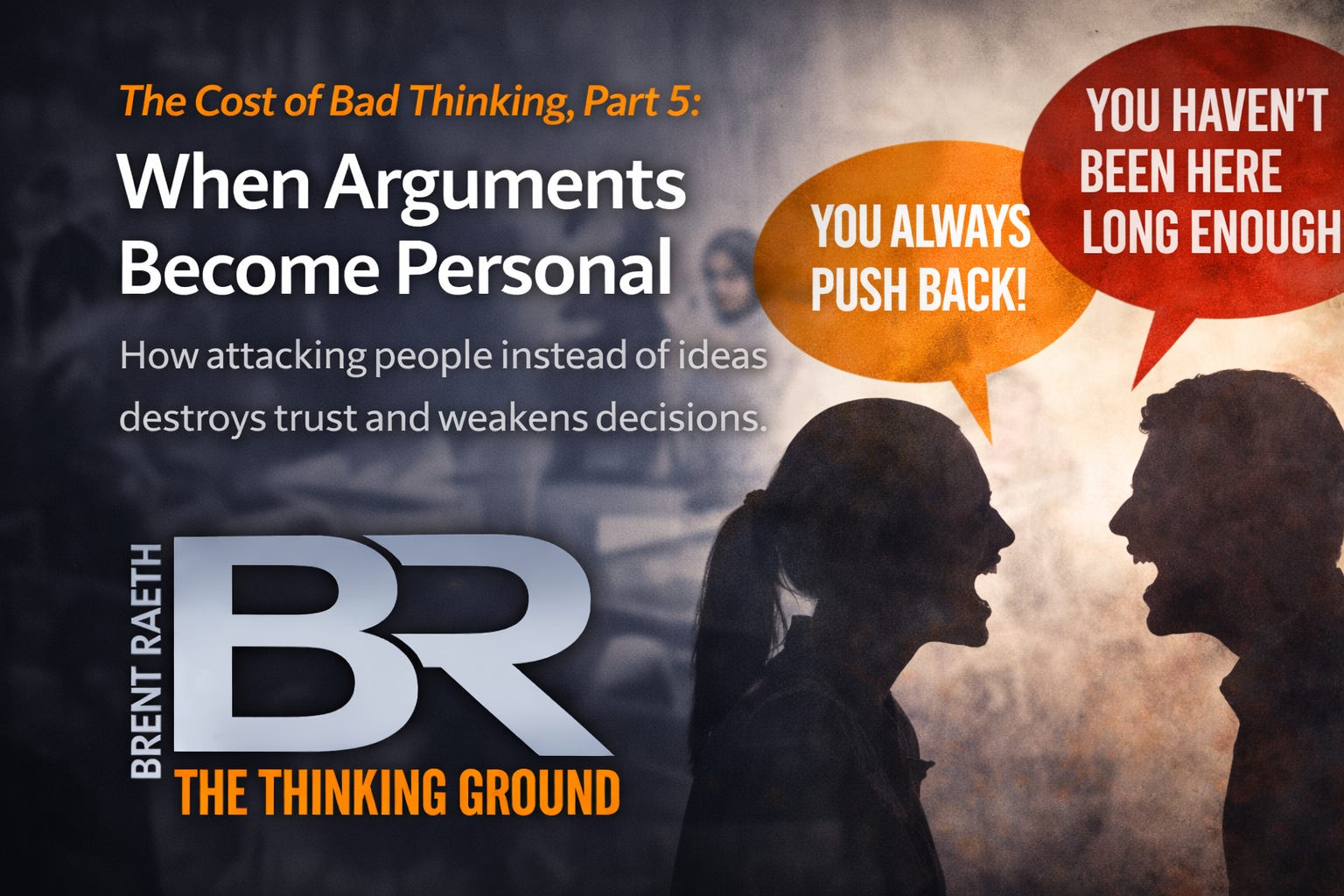
There is a moment in many conversations where the tone shifts.
It often starts as a disagreement. Different perspectives. Competing ideas. A healthy exchange that, at least initially, has the potential to lead to a better outcome. Then something changes.
The focus moves away from the idea and toward the person presenting it.
“He doesn’t really understand the business.”
“She always pushes back on everything.”
“That’s coming from someone who hasn’t been here long enough.”
At that point, the conversation is no longer about solving the problem. It becomes something else entirely.
What This Looks Like
This is the ad hominem fallacy. Instead of addressing the argument, the response targets the individual. Their experience, their motives, their credibility, or their character becomes the focal point.
In some cases, it is obvious. In others, it is more subtle. A dismissive comment. A shift in tone. A quiet undermining of the person rather than engaging the idea.
Either way, the outcome is the same. The conversation moves away from substance and toward distraction.
Why It Happens
This pattern shows up for a few predictable reasons.
Sometimes it is defensive. Challenging an idea can feel like challenging the person behind it, especially in environments where identity is closely tied to contribution.
Sometimes it is expedient. It is easier to discredit a person than to engage a strong argument.
And sometimes it is cultural. In organizations where disagreement is uncomfortable, people learn to avoid direct engagement with ideas and instead redirect the conversation.
Regardless of the reason, the shift is costly.
The Business Cost
When conversations become personal, the impact goes beyond a single discussion. Over time, it changes how people engage.
People become more cautious about speaking up. Ideas are filtered before they are shared. Risk-taking declines, not because people lack creativity, but because they do not want to become the target of the conversation.
It also lowers the quality of decisions. When ideas are evaluated based on who presents them instead of what they contain, good thinking gets overlooked and weak thinking gets protected.
Trust erodes as well. Teams begin to question whether discussions are fair, whether input is valued, and whether outcomes are based on merit or perception.
The result is an environment where progress slows, even if activity remains high.
A Better Standard
Strong teams separate ideas from individuals. They evaluate arguments on their merit, not on the person delivering them.
That sounds simple. In practice, it requires discipline. It requires leaders to model it consistently.
When a conversation starts to drift toward the person, it has to be redirected. Not aggressively. Not defensively. But clearly.
“Let’s stay focused on the idea.”
“Help me understand the concern with the approach.”
“What specifically about this do we disagree with?”
Those small interventions matter. They reinforce the standard.
What This Looks Like in Practice
In high-functioning teams, disagreement is expected. People challenge each other’s thinking directly, but respectfully. The goal is not to avoid tension. The goal is to make that tension productive.
This shows up in a few key ways. Feedback is specific and tied to the idea, not the individual. Questions are used to clarify, not to corner. Assumptions are surfaced and tested openly.
And perhaps most importantly, people are willing to change their position when presented with better reasoning. That is a sign that the conversation is working.
The Leadership Responsibility
Leaders set the tone for how disagreement happens.
If leaders engage in personal attacks, even subtly, the organization will follow. If leaders avoid addressing it when it happens, it becomes normalized.
But when leaders consistently bring conversations back to the substance of the issue, something different develops. People feel safer contributing. Ideas get tested more rigorously. Decisions improve.
This is not about creating a comfortable environment. It is about creating a productive one.
The Real Cost
Ad hominem thinking feels like winning in the moment. It can shut down opposition. It can create quick alignment. It can make a position feel stronger without actually strengthening it.
But over time, it weakens everything around it. Because once the focus shifts from ideas to people, progress becomes secondary.
And without progress, even the strongest teams will stall.
Bringing It Back to the Standard
Across this series, the pattern is consistent.
Strawman arguments distort the problem. False choices limit the solution. Confirmation bias narrows the view. Ad hominem attacks damage the environment.
Different fallacies. Same outcome.
They all degrade thinking.
And when thinking degrades, so do decisions, teams, and results.
If the goal is to help people, solve problems, and be a great teammate on better teams, then how we think matters. Not just what we think.
Because in the end, the quality of our thinking determines the quality of everything that follows.