


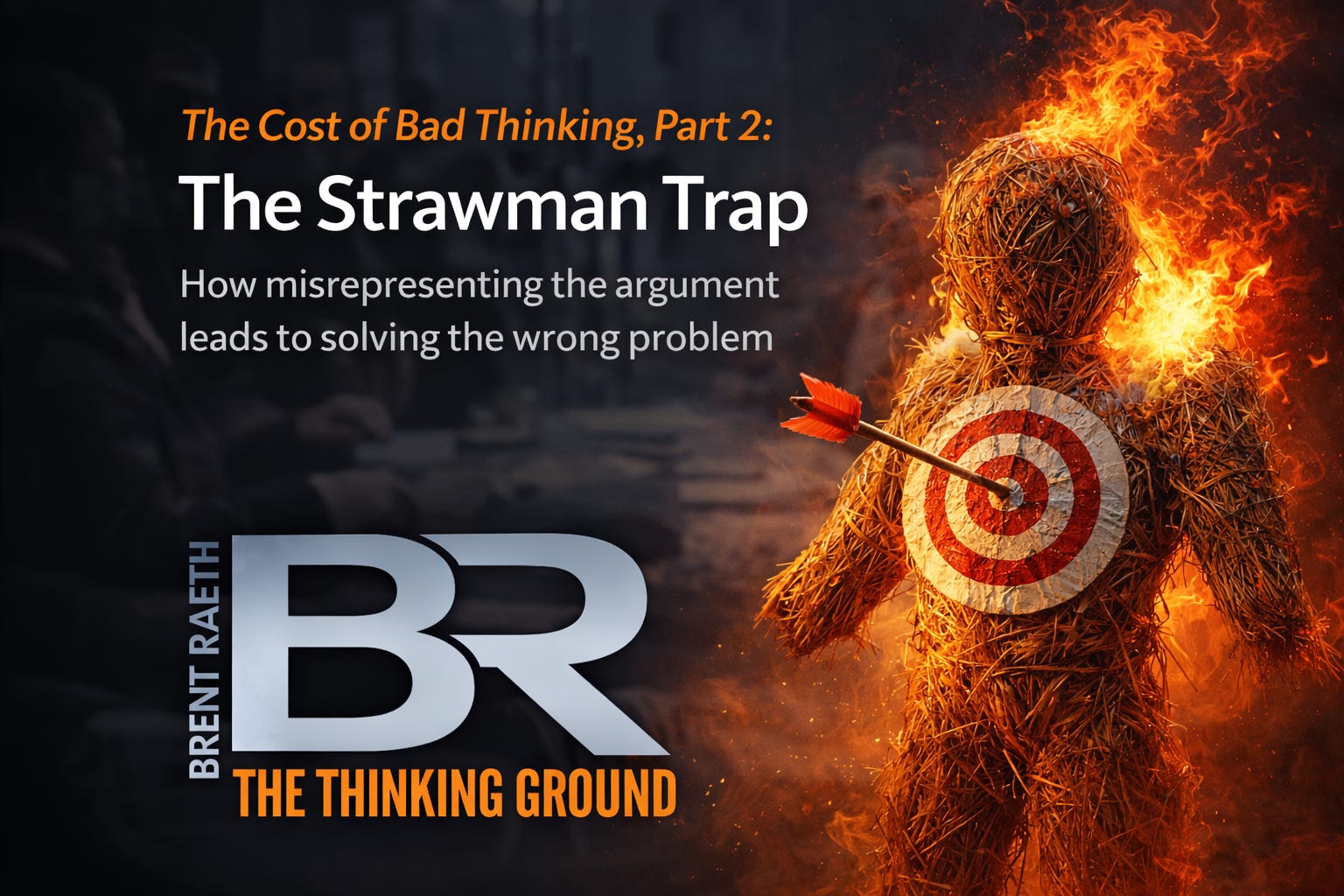
One of the fastest ways to derail a productive conversation is to argue against something that was never actually said. It happens more often than most people realize.
In a recent discussion, a team member raised a concern about risk in a proposed initiative. The point was thoughtful and specific. There were legitimate questions about timing, dependencies, and potential downstream impact.
The response came quickly. “So you just want to slow everything down.” That was not the argument. But from that point forward, that is the argument that got debated. The conversation shifted. Positions hardened. Progress stalled.
No one walked out of that meeting with a better solution, because the real issue was never fully addressed.
What a Strawman Looks Like
A strawman argument occurs when someone takes a position, simplifies or distorts it, and then argues against that weaker version instead of the original point. It is not always intentional.
In many cases, it is the result of:
Listening to respond instead of listening to understand
Filtering information through existing assumptions
Moving too quickly to form a conclusion
The problem is not just that it is inaccurate. The problem is that it creates the illusion of progress. It feels like the issue is being debated. In reality, the conversation has already gone off track.
Why It Shows Up in Leadership
Strawman arguments show up frequently in leadership environments because of pressure and pace. Leaders are expected to:
Make decisions quickly
Provide direction with confidence
Navigate competing priorities
Under those conditions, nuance often gets lost. A complex concern gets reduced to a simple label. A measured objection gets reframed as resistance. A request for clarity gets interpreted as a lack of alignment.
Once that shift happens, the discussion is no longer about the original idea. It becomes about defending positions that were never intended.
The Business Cost
At first glance, this might seem like a minor communication issue. It is not. When teams consistently argue against misrepresented ideas, several things begin to happen.
Problems go unsolved
The real issue never gets addressed because the wrong version is being debatedPeople disengage
Team members stop contributing when they feel like their input will be misunderstood or dismissedTrust erodes
Conversations become less about collaboration and more about protecting your positionDecision quality declines
Leaders make choices based on incomplete or distorted information
Over time, this creates a pattern where conversations feel productive, but outcomes do not improve.
A Better Standard
Avoiding strawman arguments does not require more intelligence. It requires more discipline. A simple shift can change the quality of an entire conversation. Before responding, make sure you can clearly restate the other person’s position in a way they would agree with.
Not your version of it. Their version. This does two things. First, it ensures that you actually understand the point being made. Second, it signals respect. It shows that the goal is to solve the problem, not win the argument.
What This Looks Like in Practice
Instead of: “So you just want to slow everything down”
Try: “If I understand you correctly, your concern is that moving too quickly here could create downstream issues. Is that right?”
That small shift keeps the conversation grounded in reality. It keeps the focus on the actual tradeoffs instead of a distorted version of them. And it creates space for better thinking on both sides.
The Real Goal
Strawman arguments are appealing because they make opposing positions easier to attack. But leadership is not about winning easier arguments.
It is about solving real problems. And real problems require engaging with the strongest version of the opposing view, not the weakest.
Because if you are not solving the real problem, you are not making progress. You are just getting better at arguing.