


I remember sitting across from a young man who had just graduated from college. Four years. Significant debt. A degree in hand. He was bright, capable, and motivated.
And unemployed.
Not because he lacked intelligence. Not because he lacked work ethic. But because the market did not value what he had purchased the way he was told it would.
It forced a question that many are quietly asking but few are willing to confront publicly:
Are college degrees still worth it?
In a world where nearly every piece of human knowledge sits in our pocket, what exactly are we paying for?
The Original Value of the University
For most of history, universities served as knowledge storehouses. If you wanted access to advanced learning, you had to go where the books were, where the experts were, where the lectures were. Information was scarce. Institutions were gatekeepers.
A degree signaled something meaningful. It meant you had access to rare knowledge. It meant you had endured intellectual rigor. It meant you had been credentialed by an authority structure that controlled access to opportunity.
But that world no longer exists.
We now carry more information in our smartphones than entire libraries once held. Lectures from MIT, Stanford, and Harvard are freely available online. You can learn coding, marketing, engineering theory, finance, philosophy, or entrepreneurship through platforms that cost a fraction of a semester’s tuition.
Information is no longer scarce. It is abundant.
And when scarcity disappears, value shifts.
The Digital Age Changes the Equation
The modern economy increasingly rewards skill, adaptability, execution, and results. Not seat time. Not credits accumulated. Not institutional brand names.
Employers care about whether you can solve problems.
Can you build the software?
Can you manage the project?
Can you close the sale?
Can you analyze the data?
Can you lead the team?
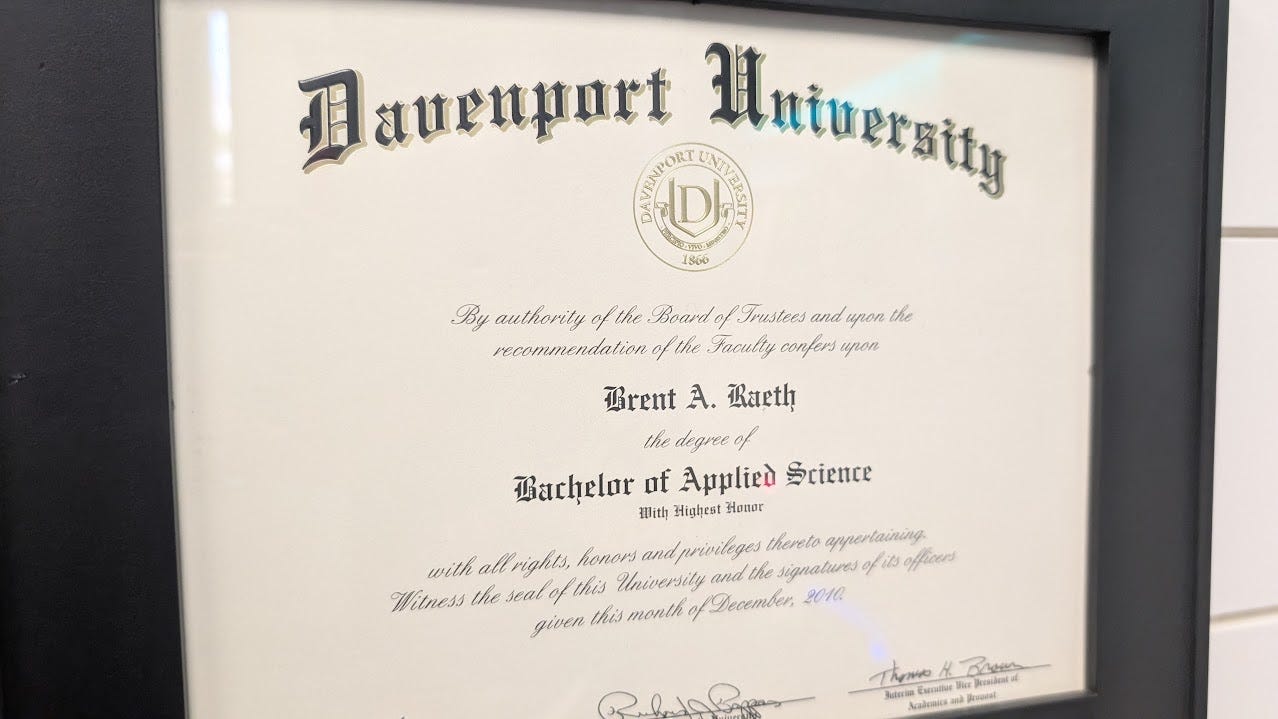
A framed diploma does not answer those questions. Demonstrated capability does.
In many industries, portfolios now matter more than transcripts. Certifications often move faster than degree programs. Apprenticeships, internships, and direct experience frequently outperform theoretical coursework.
We are watching the slow erosion of the university’s monopoly on validation.
The Debt Problem
The economic reality compounds the issue.
Tuition has risen at rates that far outpace inflation for decades. Student loan debt in the United States has climbed into the trillions. Young adults are delaying home ownership, marriage, and entrepreneurship under the weight of educational debt.
If the return on investment were consistent and predictable, the conversation would be different.
But it is not.
Some degrees yield high earnings and strong placement rates. Others produce underemployment and financial strain. Yet the cultural narrative often treats all degrees as equally valuable.
They are not.
What About the “College Experience”?
At this point, many will pivot.
“It’s not just about the degree. It’s about the experience.”
The friendships. The independence. The late night conversations. The growth. The self discovery.
I do not dismiss those things. But I do challenge the assumption that they require four years and six figures of structured campus life.
The idea that young adults need a prolonged, protected transition period before entering real adulthood is a very modern concept.
Fifty to eighty years ago, it was common for adults, yes I said it, adults, to begin working full time at 18, 19, or 20. Many started families. Bought homes. Took on responsibility. Built businesses. Served in the military. Contributed economically in meaningful ways almost immediately after high school.
They did not view themselves as extended adolescents. They viewed themselves as adults.
College, in many cases today, functions as a socially accepted delay of adulthood. It extends dependency. It postpones full responsibility. It creates a four year buffer between childhood and the demands of real life.
Is that always harmful? No.
Is it always necessary? Also no.
Growth does not require dorm rooms. Independence does not require a meal plan. Character is often forged faster through work, responsibility, risk, and accountability than through structured campus programming.
You can build community in the workforce. You can mature through entrepreneurship. You can learn resilience through starting at the bottom of an organization and climbing.
The “experience” argument deserves scrutiny, especially when it carries a five or six figure price tag.
Industries Where Degrees Still Matter
There are fields where formal education remains essential. Medicine, law, certain areas of engineering, and other highly regulated professions require standardized knowledge, licensure, and oversight. Society has a legitimate interest in ensuring surgeons and structural engineers meet rigorous benchmarks.
Even there, however, we can question structure.
Medical training, for example, already relies heavily on on the job training. Residency and clinical rotations are where competence is truly forged. The classroom builds foundation, but repetition under real conditions builds mastery.
It is not unreasonable to ask whether more industries could shift toward apprenticeship models that combine targeted education with immediate practical immersion.
Learning Versus Credentialing
We need to separate two concepts that have been bundled together for decades: learning and credentialing.
Learning is more accessible than ever.
Credentialing remains controlled.
Universities still function largely as credentialing institutions. They validate. They certify. They signal to employers that a candidate cleared a structured process.
But if employers increasingly value performance over pedigree, that signal weakens.
A self taught software developer with a strong portfolio may be more attractive than a computer science graduate who cannot build in the real world. A marketer who has grown real brands online may outperform someone who studied theory but never executed.
In the digital age, proof of work travels faster than paper credentials.
The Cultural Assumption
For decades, we told young people a simple formula:
Graduate high school.
Go to college.
Get a good job.
Build a stable life.
It was clean. Predictable. Reassuring.
But the economy no longer guarantees that path. Automation, globalization, remote work, artificial intelligence, and entrepreneurial platforms have disrupted the linear model.
We should be asking better questions of our young adults.
What are you wired to do?
What problems can you solve?
What skills are scarce and valuable?
How can you acquire them efficiently?
Are you ready to step fully into adulthood and responsibility?
For some, college will still be the best path.
For others, it may be an expensive detour disguised as a cultural expectation.
The Better Question
The real issue is not whether college is inherently good or bad.
The issue is whether we are evaluating it honestly.
Is the degree aligned with a clear vocational outcome?
Is the cost justified by realistic earning potential?
Could the same or better skills be acquired through targeted training, apprenticeships, certifications, or entrepreneurship?
Is the student using college to advance, or to delay?
Blind enrollment is not a strategy. It is a cultural reflex.
We live in an era where information is free, opportunity is decentralized, and skill acquisition can happen at speed. The old knowledge store model of the university is no longer indispensable in most industries.
That does not mean universities disappear.
It does mean they must evolve.
And it means families, students, and employers must rethink assumptions that were formed in a different century.
College degrees can still be worth it.
But they are no longer automatically worth it.
In the digital age, value belongs to those who can learn quickly, execute consistently, and accept adult responsibility early.
A diploma alone cannot guarantee that.
And perhaps it never truly did.