


The other night I was doing what most of us do more than we would like to admit. I was swiping through Facebook.
In between the noise, the ads, and the predictable arguments, I came across a thoughtful post from my friend, a teacher. It was not flippant. It was not angry. It was reflective and, frankly, a little heavy.
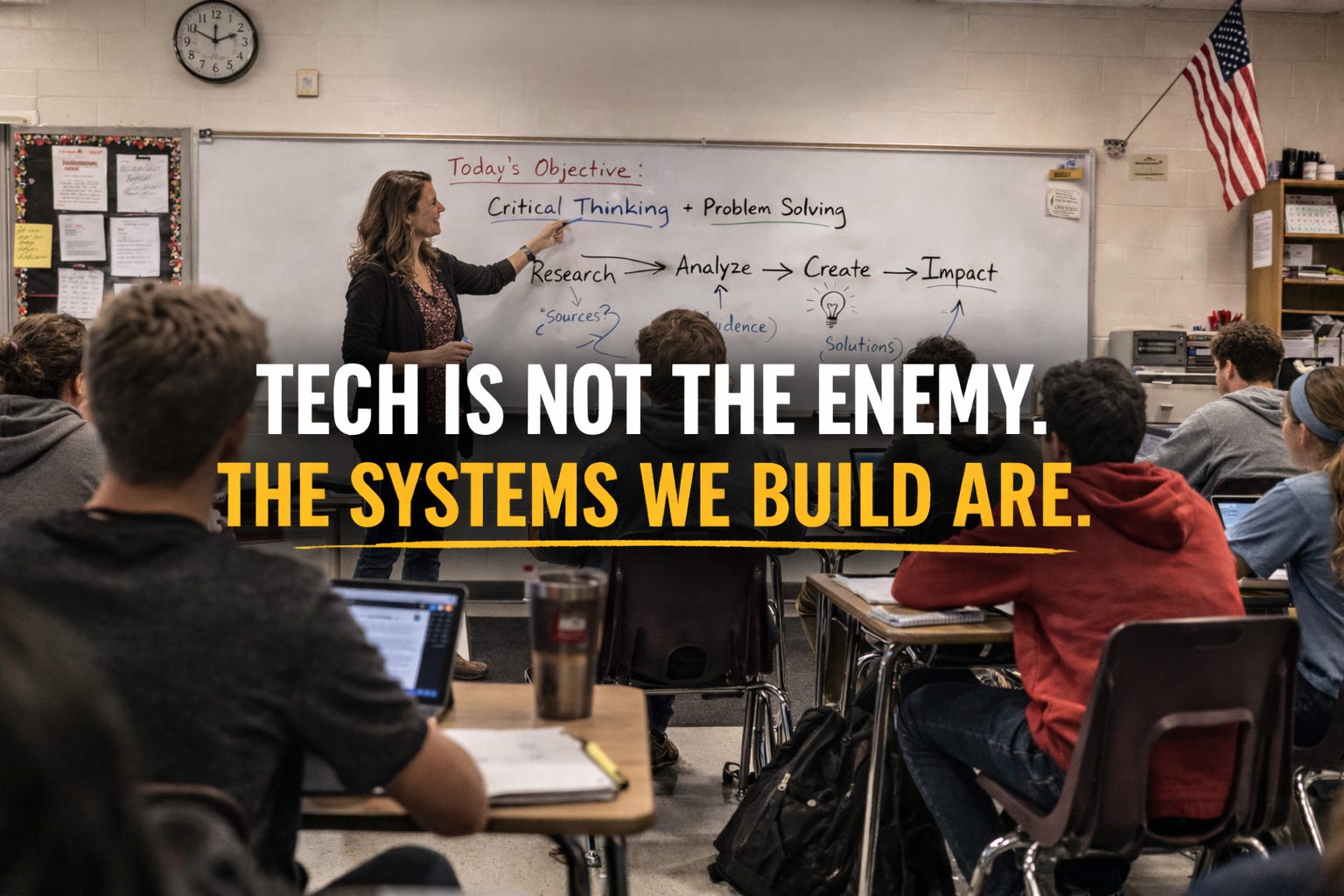
She wrote about her disappointment with how students are using technology. She described the irony of living in the most technologically advanced age in human history while watching tools designed to empower instead become shortcuts to disengagement. She spoke about students cheating. About creativity being dulled. About markets that reward platforms more than producers. About a world that feels increasingly dependent rather than independent.
It was not a rant. It was a lament.
And if you are a parent, educator, or leader, you have likely felt some version of what she described.
The struggle is real.
But I want to suggest something that may be uncomfortable.
Technology is an easy scapegoat.
And almost every example used to critique technology is, in reality, a powerful argument for it.
The Temptation to Blame the Tool
When students use AI to shortcut learning, it feels like the machine is stealing something sacred. When social platforms monetize attention, it feels exploitative. When ride share companies insert themselves between driver and passenger, it feels like unnecessary layering.
The instinct is to say the tool corrupted the system.
But tools amplify intent. They do not create it.
Students cheated long before smartphones existed. Markets concentrated wealth long before apps. Middlemen have existed for as long as trade has existed. Credit card fees predate digital wallets. Industrial agriculture did not begin with an iPhone.
Blaming technology for these dynamics is like blaming the printing press for propaganda or the telephone for gossip.
Technology accelerates human behavior. It does not invent it.
Education Has Always Faced Disruption
If you rewind history, every major advancement in information sharing triggered fear.
When the printing press was introduced, scholars worried that memorization would disappear. When calculators entered classrooms, teachers feared the death of arithmetic skills. When Google emerged, people predicted the end of research rigor.
And yet literacy exploded. Mathematical modeling advanced. Access to information democratized opportunity in ways unimaginable just decades earlier.
The web that my friend references, the smartphones, the translation tools, the medical breakthroughs, these are not minor conveniences. They represent the single greatest expansion of human capability in recorded history.
A student in rural America today can access lectures from MIT, language tutors from across the globe, and research databases that would have required elite institutional access thirty years ago.
That is not oppression. That is empowerment.
The Uber Driver and the Coffee Shop
My friend imagines a day when the Uber driver is paid directly without the tech platform taking a cut. When the coffee shop keeps the full revenue. When musicians are paid without intermediaries.
It sounds noble.
But those very same platforms lowered the barrier to entry for thousands of drivers, shop owners, and artists who otherwise would never have reached a broad audience.
Before ride share apps, becoming a driver required navigating taxi medallion systems that were artificially constrained and often politically controlled. Before digital payment systems, small shops struggled with cash flow and fraud. Before streaming platforms, independent musicians had virtually no path to national distribution without signing away control to record labels.
Technology did not create middlemen. In many cases, it dismantled older, more entrenched ones and replaced them with more accessible alternatives.
Are the systems perfect? No.
But they are more open than what came before.
The Myth of Better Times
There is another quiet assumption underneath much of our frustration with technology. The belief that there was a better time before all of this. A slower time. A more honest time. A more human time.
But different does not automatically mean better.
The 1950s were not better for women who had limited professional options. The 1960s were not better for African Americans in many parts of the country. The 1970s were not better if you were trying to access reliable information without a university library. The 1980s were not better if you wanted to start a business without significant capital or geographic advantage.
Go back further and the picture becomes even clearer.
In 1900, the average life expectancy in the United States was around 47 years old. Child labor was common. Workplace safety regulations were minimal. Infectious diseases that are now treatable were often fatal.
Even education, the very arena we are discussing, was far less accessible. A century ago, large portions of the population did not complete high school. College was largely reserved for elites. Today, nearly anyone with an internet connection can access lectures, certifications, and training from world class institutions.
Were there strengths in prior eras? Absolutely. Stronger local communities in some places. Slower pace. Perhaps fewer digital distractions.
But those eras also had gatekeepers, limitations, and inequities that we conveniently forget when nostalgia sets in.
Technology did not ruin a golden age.
It reshaped the conditions of human life, just as industrialization did, just as electrification did, just as the automobile did.
The challenge has never been preserving a mythical better past. The challenge has always been stewarding the present well enough to build something better than what came before.
AI and Intellectual Property
Perhaps the most emotionally charged concern is artificial intelligence. The fear that it steals creativity. That it replaces original thought. That it robs students of the moment when ideas click and confidence is born.
I understand that concern deeply.
There is nothing more powerful in education than watching a student realize they can think.
But AI does not eliminate that moment. It forces us to rethink how we get there.
If a student can use AI to generate a mediocre essay, perhaps the assignment was measuring output rather than understanding. If information is instantly accessible, perhaps education must shift from memorization to discernment.
Throughout history, whenever cognitive load decreased due to technology, human expectations increased.
Spreadsheets did not eliminate accountants. They elevated them. GPS did not eliminate navigation. It changed how we travel. Word processors did not eliminate writing. They increased the volume and reach of it.
AI will do the same.
The Market Is Not a Monster Created by Code
Those who look to make technology the scapegoat, write about the capitalization monster and the gluttony of a few. It is easy to associate that with Silicon Valley and digital platforms.
But concentrated wealth predates the microchip.
Railroads created titans. Oil created magnates. Steel created empires. Technology did not invent inequality. It simply changed the industry in which inequality manifests.
In fact, many of today’s tools have reduced barriers to entrepreneurship dramatically. A small business can launch with a website, digital marketing, and cloud infrastructure at a fraction of the cost required twenty years ago. A creator can build an audience without a publisher. A consultant can reach clients globally without a physical storefront.
The same technology that can centralize can also decentralize.
The difference is how we choose to use it.
Agency Still Belongs to Us
One line from my friend’s post stood out to me. She wrote that this could be the day when we collectively trust our own intelligence and take responsibility for each other.
That is not a technological issue. That is a human one.
If students are disengaged, we should examine incentives and culture, not just devices. If markets are misaligned, we should examine policy, values, and purchasing behavior. If communities feel hollowed out, we should ask how we invest our time and money.
Technology is a multiplier. It magnifies what we prioritize.
If we prioritize convenience over craftsmanship, technology will make that easier. If we prioritize excellence, local engagement, and meaningful relationships, technology can amplify that as well.
The internet can distract a student, or it can connect them to mentors across the world. AI can write a shallow essay, or it can help refine a brilliant idea. Social platforms can fuel comparison, or they can spread a message that uplifts millions.
The tool does not decide.
We do.
A Better Framing
It is understandable to feel overwhelmed by the pace of change. It is understandable for a teacher to grieve moments of authentic learning that feel threatened. It is understandable for any of us to question whether convenience has come at a cost.
But if we cast technology as the villain, we miss the deeper issue.
The real challenge is not the presence of powerful tools. It is whether we cultivate disciplined, responsible, creative people who know how to use them.
Every era faces this test.
Ours just happens to run on fiber optic cables and machine learning models.
When I finished reading my friend’s post, I did not feel defensive about technology. I felt reflective about leadership. About parenting. About culture.
Because the truth is this.
We have more access, more leverage, more capability, and more opportunity than any generation in history.
If we fail to build empowered, creative, morally grounded people in this environment, it will not be because the tools were too powerful.
It will be because we were not intentional enough in teaching people how to wield them.