


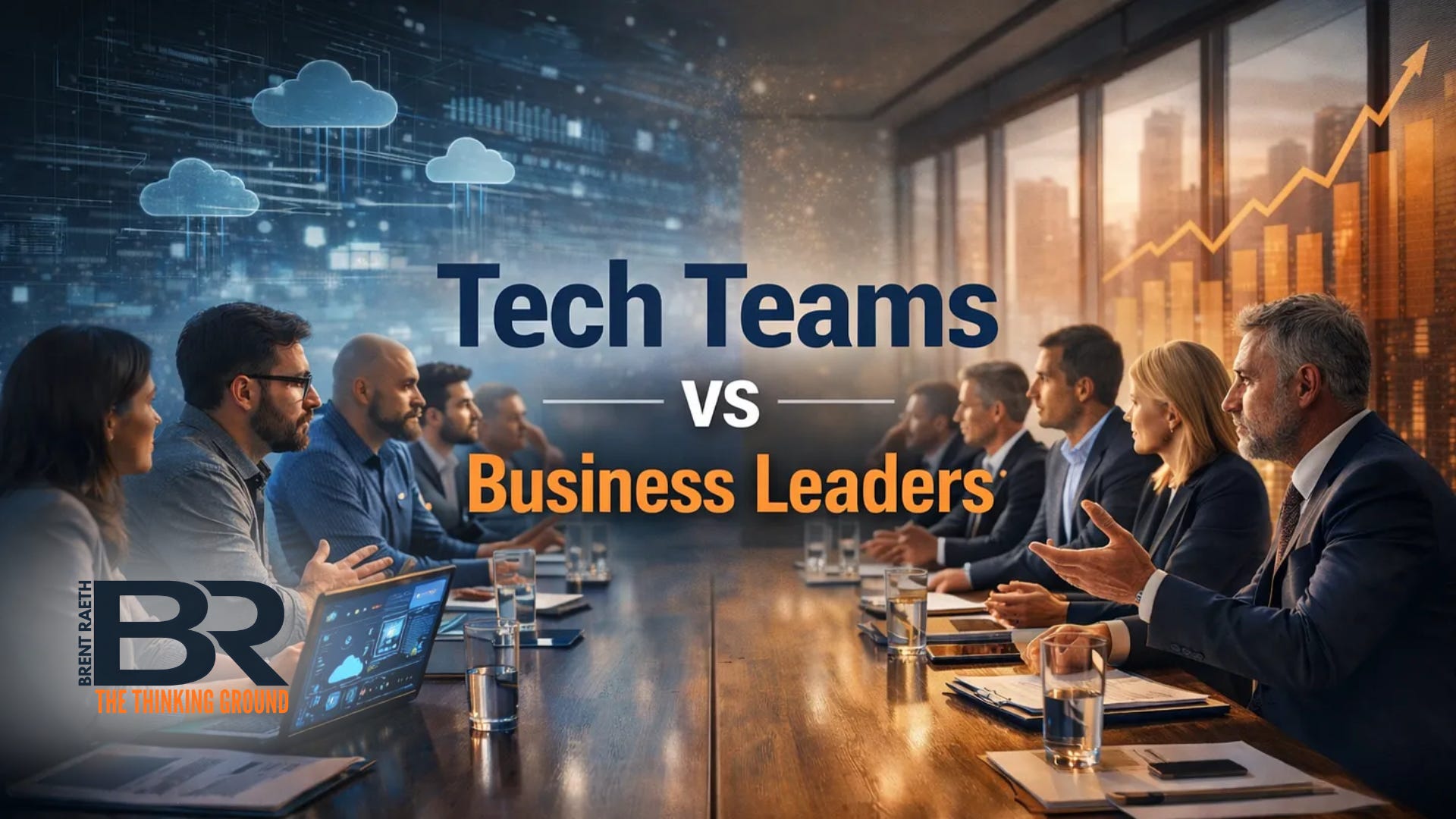
A few years ago, I sat in a leadership meeting where the executive team was discussing a major technology investment. The room was full of smart people. Revenue leaders. Operations leaders. Finance. Strategy.
The conversation moved quickly.
“Why can’t IT just automate this?”
“Can we move everything to the cloud this year?”
“How long could that really take?”
Across the table, the technology leaders shifted slightly in their chairs.
They understood the systems. They understood the dependencies. They understood the risk, the architecture, the operational realities, and the work required to make those ideas function.
But they also understood something else.
The room was speaking two different languages.
This moment is not unusual. It happens every day inside organizations of every size. And it reveals one of the most persistent and costly problems in modern business: the gap between technology teams and executives. It is not a gap in intelligence. It is a gap in perspective. And if it is not intentionally closed, it quietly undermines strategy, execution, and trust.
Technology Is Deeply Operational
Most executives interact with technology as a capability. Email works. Reports generate. Systems process transactions. Applications appear when needed. From this vantage point, technology can look deceptively simple, almost like a utility that you purchase, deploy, and operate.
Inside the technology organization, however, the picture looks very different.
Technology is an ecosystem of interdependencies. Infrastructure supports platforms. Platforms support applications. Applications integrate with other applications. Security controls wrap around everything. A change in one place often ripples into several others.
What appears to be a single request from the executive level is frequently a cascade of architectural, operational, and security considerations. When that complexity is invisible, executives naturally underestimate the work involved. The result is frustration on both sides. Executives begin to believe technology teams move too slowly, while technologists quietly conclude that leadership does not understand what is required. In reality, both groups are reacting rationally to what they can see.
Executives Think in Outcomes
Executives are responsible for outcomes. Revenue growth. Market position. Customer experience. Operational efficiency. Their job is to move the organization forward and remove obstacles that stand in the way of progress.
When executives ask questions like, “Why can’t we just implement this platform?” or “Why would this take six months?” they are not being unreasonable. They are doing exactly what their role requires. They are pushing for speed, innovation, and competitive advantage.
The difficulty is that outcome-driven thinking often skips over the operational layers required to make those outcomes real. Technology leaders live in those layers. They understand that systems have history, architecture has constraints, and security decisions have consequences. They have also seen what happens when technology is implemented quickly but poorly. The resulting problems can linger for years.
Without shared understanding, executives see hesitation where technologists see prudence.
Technologists Think in Systems
Technology professionals are trained to think in systems. Their mindset revolves around dependencies, failure points, security controls, and integration paths. Their instinct is to ask questions before making commitments.
What does this connect to?
What breaks if we change it?
What are the security implications?
What will it cost to maintain long term?
This mindset is not a barrier to progress. It is the reason stable systems exist in the first place. But when communicated poorly, it can easily sound like resistance. Executives hear reasons why something cannot be done. Technologists are actually describing the work required to do it correctly.
That misunderstanding is where the communication breakdown begins.
The Real Problem Is Translation
At its core, the issue is not disagreement. It is translation.
Executives speak the language of business outcomes. Technology teams speak the language of systems and risk. Both languages are valid, but when they collide without translation, organizations struggle.
Executives begin to bypass technology leadership because they feel progress is being slowed. Technology teams withdraw into defensive postures because they feel pressured to move faster than is responsible. Projects stall, budgets grow, and trust slowly erodes.
Ironically, both groups are trying to protect the organization. They are simply protecting it from different threats.
Executives protect the organization from stagnation. Technologists protect it from instability. A healthy organization needs both perspectives.
The Role of the Technology Leader
This is where true technology leadership becomes essential. The job of a CIO, CTO, or technology executive is not simply to manage systems. It is to translate between worlds.
Technology leaders must be able to explain complexity without hiding behind it. They must communicate risk without sounding like obstruction. They must clearly show how technical realities influence business outcomes.
At the same time, they must help technology teams understand the pressures executives face. Businesses operate in competitive environments. Markets move quickly. Customers expect rapid innovation. Technology cannot simply function as an anchor that slows the organization. It must become an engine that enables it.
That requires leaders who are fluent in both domains: business and technology, strategy and architecture, vision and implementation.
Closing the Gap
Organizations that successfully close this gap tend to operate differently. Executives develop a working understanding of technology constraints. They do not need deep engineering expertise, but they gain enough awareness to appreciate complexity and risk.
Technology leaders, in turn, frame conversations in terms of business impact. Instead of saying, “This integration is complicated,” they explain how rushing the implementation could introduce operational risks that affect revenue systems or customer experiences.
Technology teams are also given exposure to broader business discussions. They begin to understand why timelines matter and how strategic decisions are made.
When this happens, the entire tone of the conversation changes. Requests become collaborative design discussions. Constraints become planning inputs. Technology stops feeling like a mysterious black box and starts functioning as a strategic capability.
Technology Is Now the Business
Twenty years ago, technology supported the business. Today, technology is the business.
Customer experiences run on software. Operations run on platforms. Security threats target digital infrastructure. Competitive advantage increasingly depends on technological capability.
That reality means the gap between executives and technology teams is no longer just inconvenient. It is dangerous.
Organizations that fail to bridge it move slower, make poorer decisions, and accumulate technical debt that eventually becomes strategic debt. Organizations that close it unlock something far more powerful.
Technology stops being viewed as a cost center.
It becomes a strategic weapon.
And that transformation begins with something surprisingly simple: learning to speak each other’s language.