


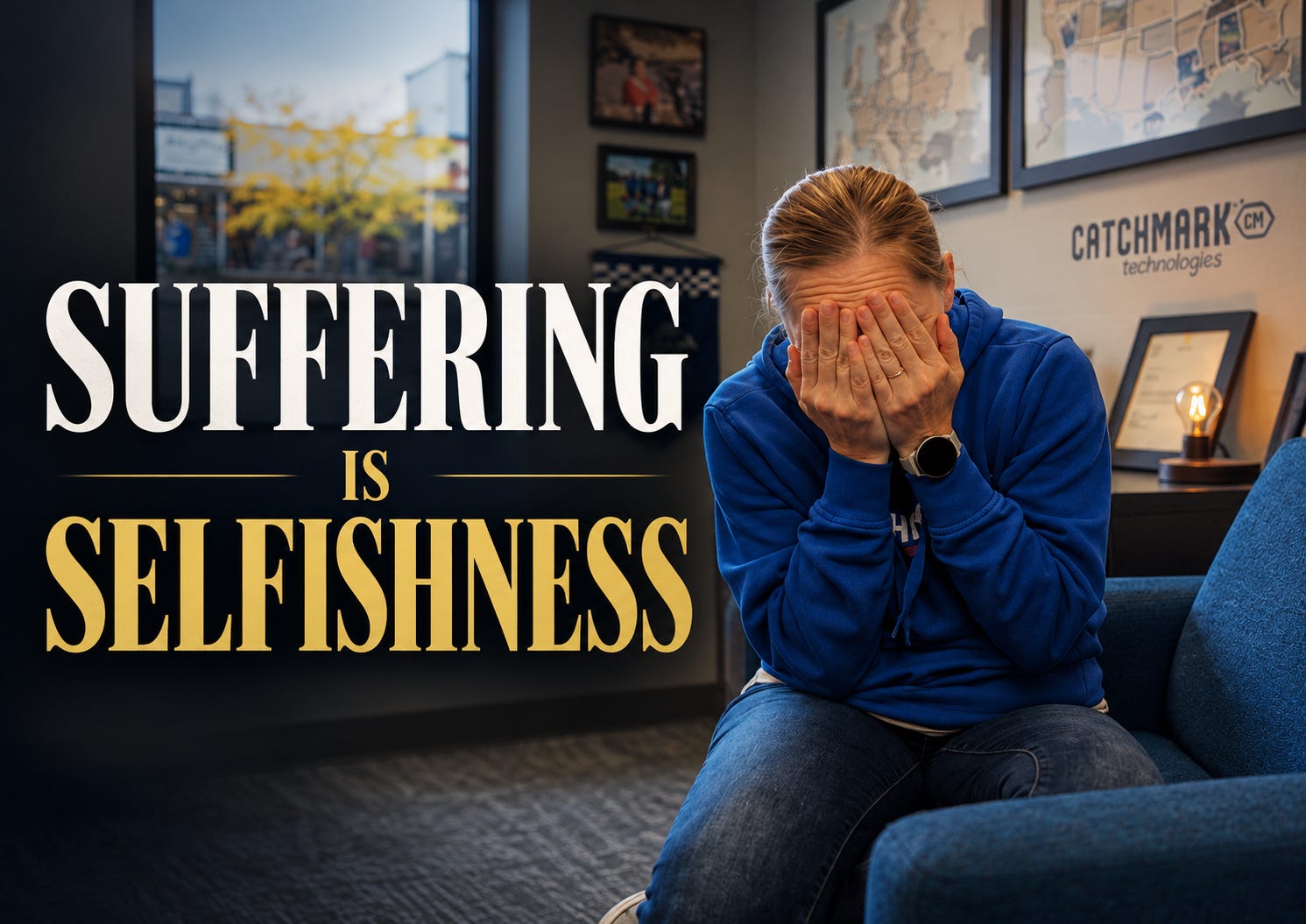
There is a sentence that sounds almost cruel the first time you hear it: suffering is selfishness.
It feels wrong because suffering is so closely associated with things we do not choose. We lose people we love. We are betrayed. We get sick. Careers fall apart. Relationships end. Plans fail. People disappoint us. Sometimes life is simply unfair.
None of that is selfish.
Pain is not selfish. Grief is not selfish. Trauma is not selfish. Fear, sadness, anger, and disappointment are not moral failures. They are part of being human, and pretending otherwise only makes things worse.
But pain and suffering are not exactly the same thing.
Pain is what happens to us. Suffering is often what begins to happen inside us when that pain becomes the center of our attention, our identity, and eventually our world.
That is where the distinction matters.
When we are hurting, it is natural to turn inward. We replay conversations. We think about what happened, what should have happened, what someone else should have done, or why we deserved something different. We notice who called and who did not. We remember every slight. We compare our lives to those of people who seem to have escaped the difficulty we are facing.
For a while, this is normal. Sometimes it is even necessary. Grief needs room. Anger needs to be understood. Trauma needs to be processed. Some wounds require therapy, medication, rest, time, and the support of other people.
But there is also a point where reflection can turn into rumination, and rumination can slowly become self-absorption.
The world begins to shrink until nearly everything is interpreted through the lens of our pain.
Why did this happen to me?
Why did they treat me this way?
Why does nobody understand what I am going through?
Why should I have to deal with this?
Why do other people seem to have it easier?
There is one word that begins appearing again and again: me.
That does not mean the pain is illegitimate. It means suffering has a way of narrowing our vision until we become the center of our own universe.
The World Does Not Stop When Ours Falls Apart
One of the harder truths of adulthood is that life continues even when ours becomes difficult.
Our children still need parents. Our spouses still need partners. Our friends still need friends. Coworkers still need teammates. Communities still need people willing to participate.
This does not mean we should pretend to be fine when we are not. There are seasons when we genuinely need other people to carry us. There should be no shame in that. Strength is not the refusal to need help.
But there is a difference between needing to be carried for a time and deciding that everyone around us must permanently organize their lives around our pain.
Eventually, healing asks something from us.
It asks us to begin carrying something again.
A responsibility. A relationship. A purpose. A commitment. Another person.
Sometimes the first sign that we are beginning to heal is not that we feel better. It is that we become useful again.
That is important because suffering is inherently inward-looking. Purpose almost always points us outward.
When we help someone, build something, teach something, solve a problem, care for another person, or simply show up where we are needed, our pain does not disappear. What changes is that our pain is no longer the only thing occupying our field of vision.
The world gets bigger again.
When Pain Becomes an Identity
One of the most dangerous things about prolonged suffering is that it can become part of who we believe we are.
At first, something bad happened to us.
Then we became someone who had something bad happen to us.
Eventually, we can become the person to whom that happened.
The betrayal, failure, illness, injustice, loss, or disappointment becomes the organizing story of our life.
This can happen so gradually that we do not notice it. We may even begin receiving something from the identity: sympathy, attention, permission, lowered expectations, or an explanation for why we no longer have to risk failure.
Again, this is rarely conscious. People do not typically decide to make suffering their personality.
But familiar pain can become strangely comfortable.
If our identity has been built around being wronged, overlooked, betrayed, abandoned, or mistreated, healing creates an uncomfortable question:
Who am I if this is no longer the most important thing about me?
That question can be frightening because healing requires us to write a new story.
And new stories come with new responsibilities.
If I am no longer defined by what someone did to me, then I have to decide what I am going to do next.
If I am no longer defined by my failure, then I may have to try again.
If I am no longer defined by the person who hurt me, then I may have to stop giving that person so much power over my life.
Sometimes staying wounded feels safer than moving forward because moving forward means uncertainty.
But familiar suffering is still suffering.
Pain Explains Behavior. It Does Not Excuse Everything.
Another danger is believing that our pain gives us unlimited permission.
People who are hurting sometimes hurt other people. That is understandable.
It is not always acceptable.
Being betrayed does not require us to become cruel. Being disappointed does not entitle us to become cynical. Having endured hardship does not give us permanent authority over everyone who has not experienced life exactly as we have.
Pain can explain our behavior without excusing it.
There is a point where each of us has to take responsibility for what our suffering produces in the lives of others.
What happened to us may not have been our choice.
What we become afterward increasingly is.
That is a difficult idea because it removes one of suffering’s greatest temptations: the belief that because something unfair happened to us, we no longer have responsibility for our response.
But responsibility is not punishment.
Responsibility is power.
The moment we accept responsibility for what happens next is the moment the person, event, or circumstance that hurt us begins to lose control over our future.
Pain Deserves Recognition, Not Worship
Healing does not require pretending something did not matter.
You can admit that someone betrayed you.
You can acknowledge that you were treated unfairly.
You can grieve the person you lost.
You can recognize that a chapter of your life did not turn out the way it should have.
You can say plainly, “That hurt me.”
What you do not have to say is, “Therefore, this will define me forever.”
Pain deserves recognition.
It does not deserve worship.
There is an enormous difference between honoring what happened and building an altar to it.
We sometimes believe that moving forward means minimizing the past. It does not.
A person can carry grief and still laugh.
A person can remember betrayal and still trust.
A person can survive failure and still attempt something difficult.
A person can acknowledge injustice without spending a lifetime demanding that the universe somehow make everything even.
Moving forward does not mean the wound was insignificant.
It means the wound no longer gets to make every decision.
Eventually, the Question Has to Change
When something painful first happens, we naturally ask, “Why did this happen to me?”
There may even be value in that question for a while.
But eventually, the more important question becomes:
Now what?
What am I going to do with what happened?
Who am I going to become because of it?
Will this make me more bitter or more compassionate?
More afraid or more courageous?
More withdrawn or more useful?
Will I spend the next decade arguing with yesterday, or will I participate in tomorrow?
That is where suffering begins to lose its grip.
The goal is not to become indifferent to our own pain. The goal is to stop making ourselves the permanent center of our own universe.
There are still people around us who need encouragement. There are still problems worth solving. There is work worth doing. There are relationships worth repairing. There are people worth loving.
There is still a life worth participating in.
At some point, remaining completely absorbed in our own suffering means withholding ourselves from all of it.
That is where suffering becomes selfish.
Not because we hurt.
Not because we struggle.
Not because we need help.
But because eventually life asks us to look beyond ourselves again.
Pain naturally turns us inward.
Healing begins when we choose to turn outward.