


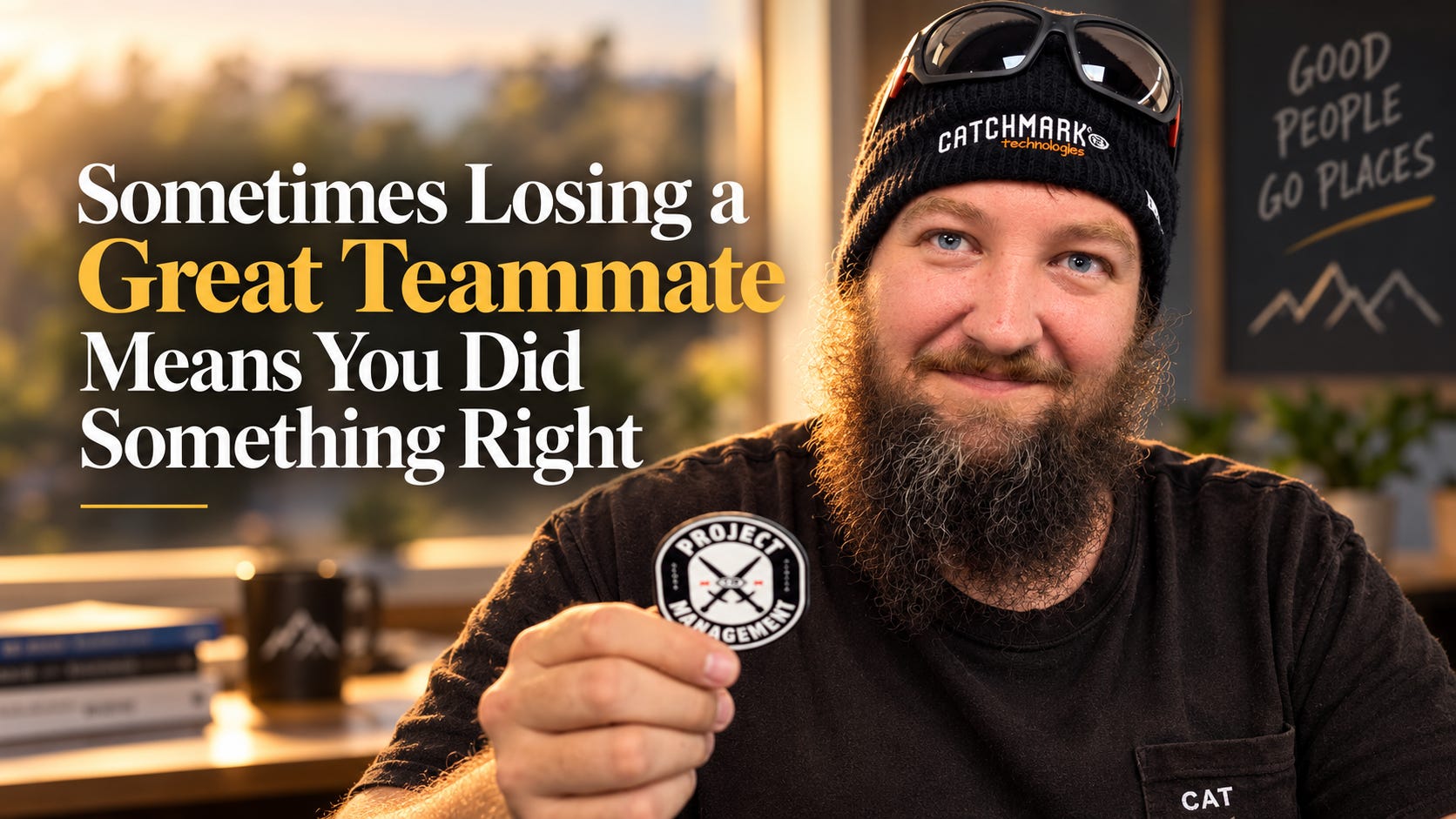
A few weeks ago morning, one of my teammates told me he was leaving CatchMark.
I couldn’t have been happier for him.
He had received an unexpected opportunity to take a position that was, in many ways, his dream job. It was the kind of opportunity that doesn’t come along very often. A chance to take on new responsibilities, challenge himself, and move his career in a direction he was genuinely excited about.
Of course, losing a good teammate creates challenges. There are responsibilities to redistribute, knowledge to transfer, and a position to fill. Those are legitimate concerns, and any business owner understands the disruption that comes with losing someone who contributes meaningfully to the organization.
But those concerns were overshadowed by something much more important.
As we talked about his new opportunity, he shared that much of what he had learned at CatchMark about leadership, culture, teamwork, and responsibility had helped prepare him for this next step.
I don’t know if he fully understood how much that meant to me.
Because in that moment, I was reminded of something I believe deeply about leadership.
Our responsibility isn’t simply to build a successful business. It’s to help build successful people.
The Real Measure of Leadership
We spend a tremendous amount of time measuring business success.
Revenue. Profitability. Customer satisfaction. Growth. Employee retention.
Those things matter. They help us understand whether an organization is healthy and sustainable. They tell us whether we are accomplishing the objectives we have established.
But there are other measures of success that don’t fit neatly into a spreadsheet.
Did someone become more confident because they worked with us?
Did they learn to take responsibility when things didn’t go their way?
Did they discover what it means to be dependable, to communicate clearly, or to put the needs of a team ahead of their own preferences?
Did they become better at solving problems, making decisions, and leading others?
And perhaps most importantly, did their experience with us prepare them for opportunities they might not otherwise have been ready to pursue?
Those questions matter just as much to me as the financial statements.
Maybe more.
Good People Aren’t Ours to Keep
I think some leaders make the mistake of viewing employee departures as personal failures.
When a talented person leaves, they immediately wonder what went wrong. Was the compensation inadequate? Was the culture broken? Did leadership fail to recognize their potential?
Sometimes those are exactly the questions that need to be asked.
Organizations lose good people because of poor leadership, unhealthy cultures, limited opportunities, and broken promises. Leaders should be willing to examine those possibilities rather than automatically assuming the employee is making a mistake.
But sometimes people leave because they have grown.
Sometimes the experience, responsibility, and encouragement they received helped prepare them for an opportunity that simply didn’t exist within their current organization.
And sometimes the next step in someone’s development requires them to move on.
That isn’t necessarily failure.
It can be evidence that something went right.
We should want people to grow beyond the opportunities we can provide, even when their growth eventually takes them somewhere else.
That doesn’t mean we shouldn’t work hard to retain talented people. We absolutely should. Good compensation, meaningful work, opportunities for advancement, and a healthy environment are responsibilities that every employer should take seriously.
But there’s a difference between creating a place people want to stay and believing they owe us their continued employment.
The first is leadership.
The second is ownership of something that was never ours to begin with.
Culture Should Follow People Out the Door
I’ve always believed that organizational culture is much more than a collection of values printed on a wall.
Culture is what people experience every day.
It’s how teammates treat one another when things get difficult. It’s whether people take responsibility or look for someone to blame. It’s how leaders respond to mistakes, how success is shared, and whether people are encouraged to think for themselves.
At CatchMark, we’ve worked hard to create an environment where people are expected to contribute, take ownership, solve problems, and support one another.
We certainly haven’t done everything perfectly.
I’ve made plenty of leadership mistakes over the years, and our organization has experienced its share of challenges. Building a healthy culture is never a finished project. It requires continuous attention, honest reflection, and a willingness to change when something isn’t working.
But moments like this morning remind me why the effort matters.
When someone leaves an organization and takes those lessons with them, the influence of that culture doesn’t end at the office door.
It travels with them.
They bring those expectations into their next role. They influence new teammates. They make decisions based on what they’ve learned. And if they eventually lead others, they have an opportunity to pass those lessons along.
The impact of a healthy organization can extend well beyond the people currently on its payroll.
That’s something worth celebrating.
Give Credit Where It Belongs
There is another important distinction in all of this.
While I was incredibly grateful to hear that CatchMark had helped prepare this teammate for his next opportunity, I don’t want to confuse our contribution with his accomplishment.
He earned this opportunity.
He was the one who showed up, accepted responsibility, worked through challenges, learned from mistakes, and developed the skills that made someone else recognize his potential.
Our culture may have provided an environment that encouraged that growth. His teammates may have helped him along the way. Our leadership may have influenced how he approached his responsibilities.
But he still had to do the work.
And that’s an important reminder for leaders.
We don’t create successful people through our leadership alone. We create conditions where people have an opportunity to become successful.
What they do with those opportunities is ultimately up to them.
When someone takes advantage of those opportunities and succeeds, the credit belongs primarily to that individual.
We should be proud to have played a part, not eager to claim the accomplishment as our own.
The Best Kind of Return
There’s a practical reality to running a business that makes employee departures difficult.
Replacing a talented person costs time and money. Relationships have to be rebuilt. Knowledge can be lost. Other teammates may need to shoulder additional responsibilities during the transition.
I’m not dismissing any of those things.
But I also believe leadership requires us to look beyond what’s immediately convenient for ourselves.
If someone has an opportunity to improve their life, pursue meaningful work, and achieve something they’ve been working toward, how could I genuinely care about that person and not be happy for them?
Especially when they tell me that our time together helped make it possible.
I’ve spent a significant portion of my professional life trying to build a business where people feel supported, challenged, respected, and accountable to one another.
Not because I expect everyone to stay forever.
But because I believe the time people spend working together should make all of them better.
That includes me.
This morning, I was reminded that the return on investing in people isn’t always measured by how long they remain with us.
Sometimes it’s measured by what they’re able to accomplish after they leave.
And while I’ll certainly miss having this teammate at CatchMark, I’m far more excited about what comes next for him than I am disappointed about what his departure means for us.
If someone can look back at their time on your team and genuinely believe they became a better person, teammate, or leader because of it, you’ve accomplished something worth being proud of.
That’s not a consolation prize for losing a good employee.
That’s part of the reason we should lead in the first place.
And today, I’m grateful to have been reminded of it. You will do great things Ethan but will also be greatly missed! Good luck to you my friend!!!