


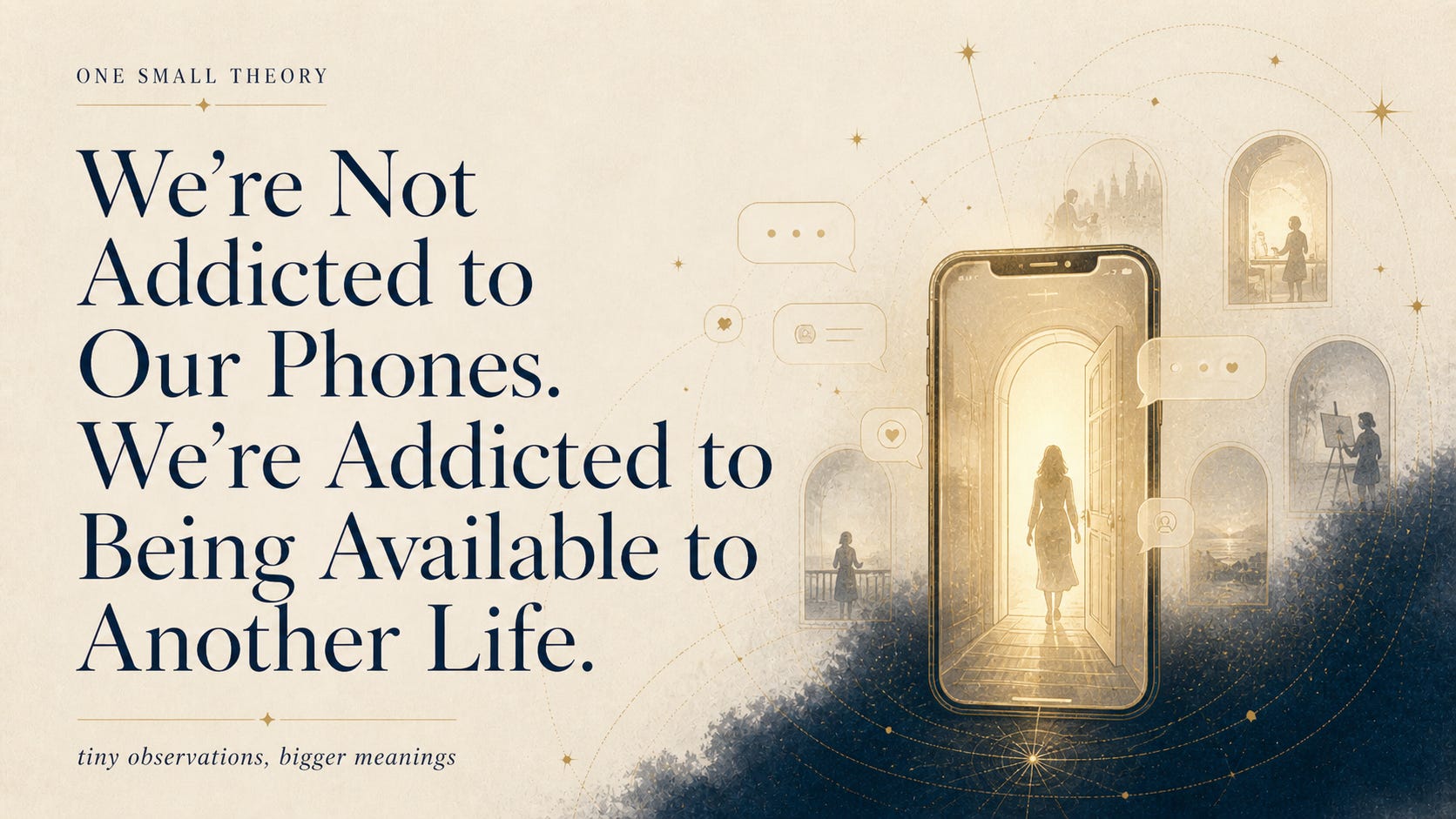
My small theory is that we are not addicted to our phones.
Not exactly.
We are addicted to being available to another life.
That is the real pull. Not the glass rectangle itself. Not even the apps, though they are designed with frightening precision. Not only the dopamine, the scroll, the notifications, the infinite feed, or the bright little rituals of checking and rechecking.
Those things matter.
But I think something deeper keeps us reaching.
The phone is not just a distraction machine. It is a doorway.
Every time we pick it up, we are opening the possibility that another version of life is waiting for us. A better version. A more interesting version. A more urgent version. A version where someone needs us, wants us, noticed us, replied to us, invited us, admired us, or interrupted us with news that changes the shape of the hour.
We are not only checking our phones.
We are checking whether another life has begun without us.
This is why the phone can feel so powerful even when nothing is happening.
You unlock it, and there is no message. No update. No invitation. No emergency. No astonishing news. Just the same old weather, the same old inbox, the same old app icons sitting there like closed doors.
And yet, ten minutes later, you check again.
Not because you believe the phone has become more interesting.
Because possibility has refreshed.
Maybe now.
Maybe something has happened.
Maybe someone has thought of me.
Maybe the day has opened a side door.
That may be the emotional center of phone attachment: the constant possibility of interruption.
Interruption sounds like a nuisance, but often it is secretly seductive. An interruption means the current life does not have final authority. It means the task in front of us, the room we are sitting in, the conversation we are half having, the boredom we are enduring, the self we are currently being, can be suspended.
A message arrives, and suddenly the present is no longer complete.
The phone says: you are also wanted elsewhere.
That elsewhere may be trivial. It may be a group chat, a work email, a sale notification, a breaking news alert, a video, a stranger’s opinion, a photo from someone else’s evening. But the emotional pattern is the same. Something outside the room has reached in.
That reach is hard to resist.
Because ordinary life is often very ordinary.
It contains dishes, meetings, errands, waiting rooms, small talk, traffic, repetition, indecision, chores, discomfort, and stretches of time where nothing appears to be happening. It asks us to remain inside one version of reality long enough to live it.
The phone offers escape without departure.
You can be physically present and psychologically elsewhere. You can sit on the couch and enter six social worlds. You can be in a meeting and silently visit the news, your email, your messages, your bank account, a vacation rental you will not book, a restaurant menu in a city you are not visiting, a person you have not spoken to in years, a version of yourself who wears different clothes, lives somewhere else, knows different people, wants different things.
That is not simply distraction.
That is multiplicity.
The phone lets us become temporarily porous. Other lives leak in.
This is why it can feel so difficult to put down. To put the phone away is not just to stop consuming content. It is to accept the limits of the current moment.
This room.
This person.
This task.
This silence.
This version of me.
That can be harder than we admit.
There is a grief in choosing one life at a time.
A small one, perhaps, but real.
Every moment asks us to not be somewhere else. Every choice closes other doors. Every life, no matter how good, contains the ache of all the lives not being lived. The phone makes those unlived lives feel close enough to touch.
You see someone traveling, and an alternate life opens.
You see someone’s career announcement, and an alternate life opens.
You see someone’s kitchen, marriage, body, outfit, book deal, vacation, renovation, dinner party, morning routine, friendship, or quiet afternoon in beautiful light, and another version of existence briefly becomes available.
Not truly available, of course.
But imaginatively available.
And sometimes that is enough to unsettle us.
We are not just comparing. We are rehearsing.
What would it be like to be that kind of person?
What would it be like to live there?
What would it be like to be wanted that way?
What would it be like to have that clarity, that freedom, that beauty, that importance, that ease?
The phone turns envy into a portal.
It lets us stand at the edge of other people’s lives and mistake the view for an invitation.
Social media intensifies this, but the pattern exists even outside it. Email offers the possibility of relevance. Texting offers the possibility of being needed. News offers the possibility that the world has shifted. Shopping offers the possibility of becoming different through acquisition. Dating apps offer the possibility of an alternate romantic plot. Maps offer the possibility of elsewhere. Photos offer the possibility of reentering the past.
The phone is not one addiction.
It is a thousand tiny doors.
And behind each door is a slightly different promise.
You could be informed.
You could be desired.
You could be productive.
You could be entertained.
You could be rescued from boredom.
You could be affirmed.
You could be outraged.
You could be transformed.
You could be interrupted just in time.
This may explain why we reach for the phone most urgently in moments of discomfort. Not only when we are bored, but when we are uncertain, lonely, embarrassed, tired, anxious, or stuck between actions.
Standing alone before a meeting starts.
Waiting for someone at a restaurant.
Sitting in a parked car before going inside.
Lying in bed after the lights are off.
Stalling before a difficult task.
Ending a conversation and not knowing what to do with the silence that follows.
These are threshold moments. Small gaps in the structure of the day. Places where the self becomes briefly unoccupied.
The phone rushes in to fill the vacancy.
It gives us somewhere to put our attention before the discomfort can become a question.
Why am I uneasy?
What am I avoiding?
What do I want?
Who am I when no one is asking anything of me?
The phone does not answer those questions.
It prevents them from fully arriving.
That may be one of its greatest powers. It does not only distract us from tasks. It distracts us from self-contact.
A quiet moment used to be a place where a thought might form. Not necessarily a profound thought. Maybe just a strange one. A memory. A worry. A sentence. A realization. A little uninvited truth.
Now, many of those moments are absorbed before they can become anything.
We rarely wait long enough to discover what our minds were about to do.
The result is not only shortened attention.
It is interrupted becoming.
We are constantly available to other lives, but less available to the one trying to speak from within.
This is not a moral lecture about phones. I do not think the answer is to sneer at technology or pretend we can return to some pure, undistracted past. The past had its own evasions. People have always found ways to avoid themselves. Magazines, television, errands, gossip, work, noise, busyness, anything can become a shelter from interior life.
The phone is different because it is always with us.
It is portable elsewhere.
A pocket-sized exit.
And because it contains so many kinds of possibility, we can always justify opening it.
I am checking the time.
I am responding to work.
I am keeping up with people.
I am reading the news.
I am relaxing.
I am learning.
I am being efficient.
I am being reachable.
Often, some of that is true.
That is what makes it complicated.
The phone really does connect us. It lets us maintain friendships across distance. It helps us find our way, capture memories, learn skills, respond to emergencies, coordinate family life, and participate in the world. It is not merely a thief. It is also a tool.
But the most powerful tools become environments.
And the phone has become an environment we carry around inside every other environment.
We are never only at dinner.
We are at dinner, plus the possibility of the group chat.
We are never only on a walk.
We are on a walk, plus the possibility of documenting the walk.
We are never only with our children.
We are with our children, plus the possibility of a work message.
We are never only resting.
We are resting, plus the possibility that the world has something new to show us.
This plus is exhausting.
It makes every moment feel slightly doubled.
Part of us is here. Part of us is monitoring elsewhere.
Even when the phone is face down, the elsewhere remains available. That availability changes the room. It introduces a silent third presence into whatever we are doing.
The possible interruption.
The life outside the life.
This is why simply putting the phone away can feel strangely dramatic. A small act, almost nothing, and yet it can produce a kind of withdrawal. Not because the phone is gone, but because the alternate lives are no longer immediately reachable.
Now you are left with the unmultiplied moment.
The one thing.
The one room.
The one conversation.
The one body.
The one life.
At first, that can feel like deprivation.
Then, sometimes, it begins to feel like relief.
There is a kind of peace in becoming unavailable.
Not forever. Not irresponsibly. Not in a way that abandons the people who depend on us. But for a while. Long enough for the present to stop competing with every possible elsewhere.
Unavailable to the feed.
Unavailable to the news cycle.
Unavailable to the fantasy of a better room.
Unavailable to the urgent non-urgent message.
Unavailable to the version of yourself that exists only when observed.
Unavailable to every life except the one in front of you.
That kind of unavailability now feels almost radical.
Because availability has become a virtue. We are expected to respond, to know, to see, to react, to stay current, to keep up, to be reachable. The person who replies quickly seems responsible. The person who knows the latest thing seems engaged. The person who is easy to contact seems considerate.
And sometimes, that is true.
But constant availability has a cost.
If you are always available to interruption, you are never fully available to attention.
If you are always available to other people’s lives, you may become less available to your own.
This is not only about productivity. It is about intimacy. Depth requires a kind of refusal. To be deeply with a person, a task, a place, or a thought, we have to be unavailable to many other things.
A conversation deepens because no one leaves at the first silence.
A book opens because the mind stays past the first restlessness.
A child feels seen because the adult is not half elsewhere.
A difficult idea becomes clear because attention remains long enough to follow it.
A life becomes livable because we stop trying to keep every alternate life open at once.
Maybe that is what we are really practicing when we put the phone down.
Not discipline.
Devotion.
The devotion to this moment instead of all possible moments.
The devotion to this person instead of all possible audiences.
The devotion to this life instead of all possible selves.
Of course, this is difficult because the other lives are not imaginary in every sense. Real people are behind the messages. Real needs. Real opportunities. Real relationships. Real news. Real work. We cannot simply seal ourselves off and call it wisdom.
But we can begin to notice the difference between connection and compulsion.
Connection has a human shape.
Compulsion has a loop.
Connection leaves us more present afterward.
Compulsion leaves us scattered.
Connection says: this matters.
Compulsion says: maybe something matters somewhere, check again.
That distinction may be more useful than screen time alone. An hour on the phone can be nourishing if it involves a real conversation with someone you love. Five minutes can be corrosive if it fractures your attention and sends you back into your actual life feeling smaller, angrier, emptier, or less real.
The question is not only, how much time did I spend?
The question is, what life was I trying to enter?
And what life was I trying to leave?
Sometimes the answer is innocent. We want amusement. We want company. We want information. We want a break.
Sometimes the answer is more revealing.
We want to leave the life where we feel uncertain.
We want to enter the life where we are admired.
We want to leave the room where we are ordinary.
We want to enter the room where someone is waiting.
We want to leave the task that makes us feel inadequate.
We want to enter the feed where desire is endless and consequence is delayed.
We want to leave our one unfinished self and briefly become a spectator of many possible selves.
No wonder the phone is hard to resist.
It offers not one escape, but an entire architecture of elsewhere.
Still, I think there is hope in naming the pull correctly.
If we think we are merely addicted to phones, the answer seems mechanical. Delete apps. Turn off notifications. Set limits. Put the device in another room. These things can help. Sometimes they help a lot.
But if we are addicted to being available to another life, then the deeper work is different.
We have to ask why the current life feels so hard to stay inside.
We have to ask what kinds of interruptions we secretly hope for.
We have to ask which alternate selves we keep visiting, and what they are trying to tell us.
We have to ask whether our rest is really rest, or just absence from presence.
We have to ask what we are afraid might surface if we are not constantly reachable.
These are harder questions than screen time.
They are also more humane.
Because the goal is not to become a person who never checks a phone.
The goal is to become a person who can return.
Return to the room.
Return to the work.
Return to the conversation.
Return to the body.
Return to the silence.
Return to the life that is actually asking to be lived.
Maybe this is the real practice now. Not perfect digital minimalism. Not moral superiority. Not pretending that we can live untouched by the tools of our age.
Just return.
Again and again.
Notice the reach. Notice the hunger inside the reach. Notice the little doorway opening. Then decide, when possible, whether to step through it.
Sometimes you will.
Sometimes you should.
The other life may contain someone you love. A message that matters. A real need. A necessary piece of information. A moment of joy.
But sometimes the other life is only a mirage with good lighting.
Sometimes it is just the old desire not to be here.
And here, inconveniently, is where life happens.
Not the imagined life.
Not the alternate life.
Not the life refreshed every few seconds.
This one.
The one with the chipped mug, the unfinished sentence, the person across the room, the quiet that feels awkward before it becomes spacious.
The one that does not always notify you when it matters.
So, one small theory:
We are not addicted to our phones.
We are addicted to being available to another life.
A life where something might happen. Someone might need us. Someone might notice us. We might become informed, admired, rescued, entertained, desired, or briefly released from the weight of being only ourselves in only one place.
But maybe peace begins when we let some of those other lives remain unopened.
When we stop treating every silence as a vacancy.
When we stop mistaking interruption for possibility.
When we let the present be the only room for a while.
Because there is a life trying to reach us too.
It may not buzz.
It may not glow.
It may not arrive with a notification.
But it is here.
And it has been waiting for our attention.