


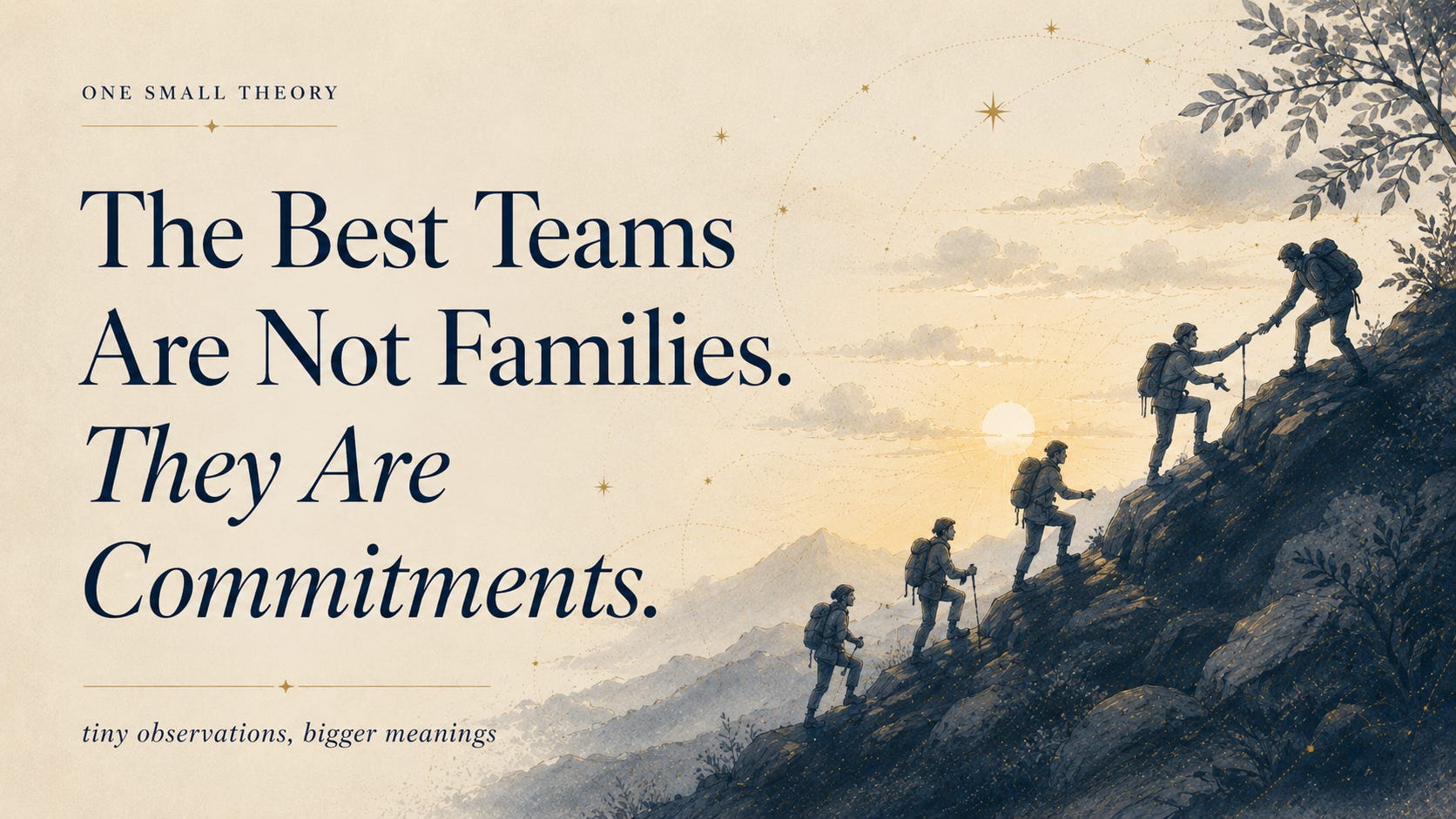
The best teams are not families.
They are commitments.
That may sound cold at first, especially because so many organizations like to say, “We’re a family here.”
I understand why people say it.
They usually mean something good. They mean people care about each other. They mean the workplace is not transactional. They mean people are willing to help, sacrifice, forgive, and show up when things are hard. They mean the relationship is more than a paycheck and a job description.
Those are good instincts.
But the family metaphor can become dangerous when it is used to avoid the truth about what a healthy team actually requires.
Families are permanent in ways teams are not. Families carry bonds that usually exist beyond performance, fit, accountability, alignment, or shared mission. A family member can struggle, disappoint, drift, fail, return, and still remain family.
A team is different.
A team has a purpose.
A team exists to do something together.
A team requires contribution.
A team requires trust.
A team requires clarity.
A team requires standards.
A team requires people who are willing to put the mission above their own preferences, comfort, and ego.
That does not make a team less meaningful.
It makes it honest.
A great team can care deeply about its people without pretending that everyone belongs in every role forever.
That distinction matters.
The Problem With “We’re a Family”
The phrase “we’re a family” can feel warm, but it can also create confusion.
It can blur boundaries.
It can make accountability feel like betrayal.
It can make leaders hesitant to address performance issues because the conversation feels personal instead of professional.
It can make employees feel guilty for leaving.
It can make people tolerate unhealthy behavior because “that’s just how family is.”
It can turn normal business decisions into emotional injuries.
When a company calls itself a family, it can unintentionally suggest that commitment should be unconditional.
But work is not unconditional.
A healthy workplace should be respectful, fair, generous, and humane. It should care about people as people. It should create room for growth, mistakes, hard seasons, honest feedback, and grace.
But it should not pretend that role fit does not matter.
It should not pretend that performance does not matter.
It should not pretend that culture does not matter.
It should not pretend that staying aligned is optional.
A business has responsibilities to its customers, employees, community, and mission. When someone consistently undermines those responsibilities, love is not proven by avoiding the issue.
Sometimes care requires clarity.
Sometimes respect requires honesty.
Sometimes the kindest thing a leader can do is tell the truth before resentment becomes culture.
Teams Are Built on Chosen Responsibility
The best teams are not held together by vague affection.
They are held together by chosen responsibility.
I choose to do my part.
I choose to communicate clearly.
I choose to own my mistakes.
I choose to bring concerns directly instead of poisoning the room quietly.
I choose to support the person next to me.
I choose to protect the standard.
I choose to care about the outcome, not just my own comfort.
I choose to keep growing because the team needs me to keep growing.
That is not family language.
That is commitment language.
And commitment is powerful because it is active.
It does not depend on mood. It does not depend on constant emotional closeness. It does not require everyone to be best friends. It does not require pretending conflict does not exist.
A committed team can disagree and stay aligned.
A committed team can challenge each other and stay respectful.
A committed team can hold high standards without becoming cruel.
A committed team can care deeply without becoming sentimental.
This is one of the marks of a mature culture.
It knows the difference between warmth and avoidance.
Care and Accountability Belong Together
Some organizations act as if care and accountability are opposites.
They are not.
In healthy teams, care and accountability strengthen each other.
If I care about you, I will not let you keep damaging your own credibility without saying something.
If I care about the team, I will not ignore behavior that makes everyone else carry more weight.
If I care about the mission, I will not pretend that misalignment is harmless.
If I care about the customer, I will not allow sloppy work to become normal.
Accountability is only harsh when it is disconnected from care.
Care is only weak when it is disconnected from accountability.
The best teams know how to hold both.
They create cultures where people are supported and expected to contribute. Where people are given grace and expected to grow. Where people are valued as humans and still held responsible for how they show up.
That balance is not easy.
It requires leadership maturity.
It requires courage.
It requires conversations people would often rather avoid.
But without it, culture gets soft in all the wrong places.
People begin to confuse kindness with silence.
They confuse loyalty with tolerance.
They confuse peace with the absence of honest conversation.
And eventually, the strongest people get tired of carrying the cost of everyone else’s avoidance.
A Team Can Be Personal Without Being Permanent
One of the reasons the family metaphor sticks is because work can be deeply personal.
People spend years together. They walk through hard seasons. They celebrate wins. They solve problems. They watch each other grow up, get married, have kids, lose loved ones, move, struggle, rebuild, and change.
Those things matter.
A good team should not pretend people are interchangeable parts.
There is real relationship inside meaningful work.
But relationship does not require pretending the structure is something it is not.
A team can be personal without being permanent.
A team can be loyal without being unconditional.
A team can be compassionate without being unclear.
A team can love people well and still recognize when the fit is no longer right.
That last part is important.
Sometimes someone outgrows a team.
Sometimes the team outgrows someone.
Sometimes the role changes.
Sometimes the business needs something different.
Sometimes a person’s gifts belong somewhere else.
Sometimes the most honest thing is to bless the person and let the relationship change.
That does not mean the relationship was fake.
It means it was a commitment for a season, and the season changed.
Mature teams can handle that.
Immature teams turn every transition into betrayal.
Commitment Is Better Than Family Language
Commitment is better language because it is clearer.
It says we are here for a shared purpose.
It says we owe each other honesty.
It says we will work through hard things.
It says we will protect trust.
It says we will hold standards.
It says we will not use care as an excuse to avoid responsibility.
It says we will not use performance as an excuse to stop caring.
A commitment can be deeply human.
In fact, it may be more human than the family metaphor because it respects the nature of the relationship.
People are not trapped by it.
They choose it.
And because they choose it, it has to be renewed through action.
Every day.
Every meeting.
Every customer interaction.
Every hard conversation.
Every moment when someone could cut corners but does not.
Every moment when someone could blame but owns it.
Every moment when someone could stay silent but speaks with respect.
Every moment when someone could make it about themselves but chooses the mission.
That is how teams are built.
Not through slogans.
Through repeated commitments.
The Best Teams Feel Safe, But Not Soft
The best teams create safety, but not softness.
People should feel safe to ask questions.
Safe to admit mistakes.
Safe to challenge ideas.
Safe to bring concerns forward.
Safe to say, “I do not know.”
Safe to be human.
But safety does not mean the absence of standards.
It does not mean every behavior is acceptable.
It does not mean every role is guaranteed.
It does not mean feedback is optional.
It does not mean comfort is the highest value.
A healthy culture protects people from humiliation, politics, confusion, and unnecessary fear.
It does not protect people from responsibility.
That is the difference.
And that difference determines whether a team grows or slowly becomes a place where everyone is careful, frustrated, and quietly managing around the real issues.
What Great Teams Actually Say
Maybe the better phrase is not, “We’re a family.”
Maybe it is:
We are a team.
We care about each other.
We have a mission.
We tell the truth.
We do hard things.
We own our part.
We protect the standard.
We help each other grow.
We are committed to something bigger than individual preference.
That may not sound as warm as family.
But it is stronger.
And in the long run, it may be more loving.
Because the best cultures are not built on pretending.
They are built on clear commitments kept over time.
So, one small theory:
The best teams are not families.
They are commitments.
They are made of people who choose, again and again, to show up with humility, accountability, courage, and care.
They do not stay healthy because everyone feels close all the time.
They stay healthy because people understand what they owe each other.
And when that happens, work becomes more than a group of people sharing tasks.
It becomes a group of people worthy of trust.