


I have a small theory.
You can learn a great deal about people by watching what they do when the stakes are low.
Not during a crisis.
Not when everyone is watching.
Not when there is recognition, reward, or pressure.
Just in the small, ordinary moments when doing the right thing requires a little effort and doing nothing would probably go unnoticed.
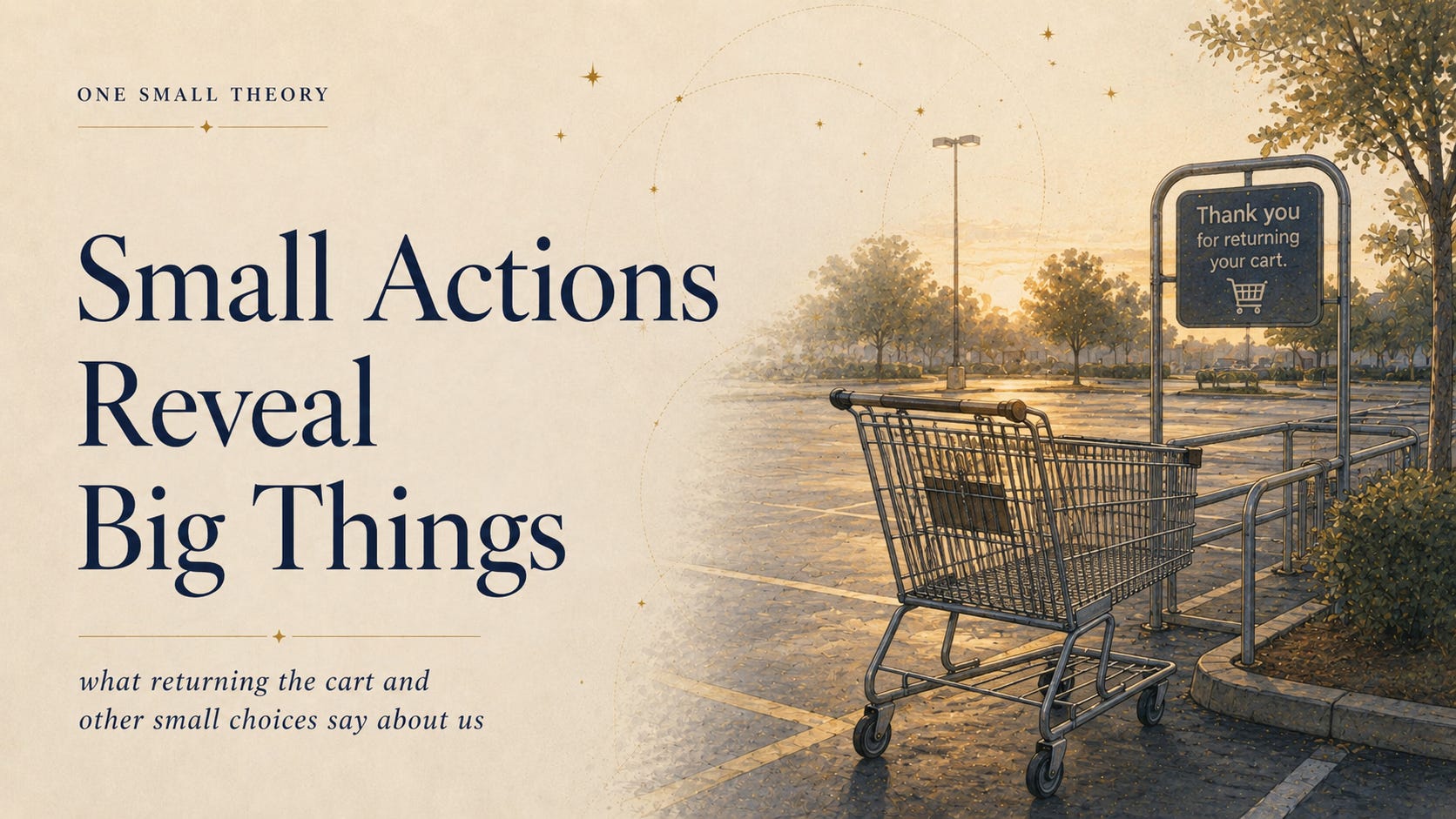
Take the shopping cart.
You finish loading your groceries into the car. The cart return is twenty or thirty feet away. No employee is standing nearby. No one is likely to confront you if you leave it beside your parking space.
You can return it.
Or you can leave it loose in the parking lot, where the wind may push it into someone else’s vehicle and where an employee will eventually have to retrieve it.
Returning the cart does not make someone a hero.
But leaving it behind says something.
It says, at least in that moment, that personal convenience mattered more than the inconvenience or damage left for someone else.
And I think life is filled with small choices like that.
The Door You Hold
You are walking into a building, and someone is a few steps behind you.
You can let the door close.
Or you can pause for a moment and hold it open.
It costs almost nothing.
But the action communicates awareness.
It says, “I noticed you.”
The opposite communicates something too.
Not always cruelty. Sometimes distraction. Sometimes hurry.
But repeated often enough, it can reveal a person who moves through the world without paying much attention to the people around them.
The Trash You Walk Past
A cup is lying on the floor.
A wrapper is blowing through the parking lot.
A piece of paper is sitting beside the trash can rather than inside it.
You did not put it there.
It is not your responsibility.
No one would blame you for walking past.
But some people pick it up anyway.
Not because they are responsible for the mess, but because they feel some responsibility for the place.
That distinction matters.
Healthy families, businesses, schools, teams, and communities are built by people willing to address problems they did not personally create.
Unhealthy ones are filled with people saying, “That is not my job.”
The Empty Coffee Pot
You take the last cup of coffee.
You can walk away.
Or you can make another pot.
This is one of the smallest workplace choices imaginable, but it reveals a familiar mindset.
Do you think only about what you need?
Or do you think about the next person?
The same thing happens when the printer runs out of paper, when the copier jams, when the trash can is full, or when the conference room is left messy after a meeting.
There are people who consume and leave.
And there are people who notice and reset.
Every strong team needs more of the second kind.
The Message You Ignore
Someone sends you an email or text that deserves a response.
Maybe you do not know the answer yet.
Maybe the conversation is uncomfortable.
Maybe replying will create more work.
It is easy to leave the message unanswered and hope the issue disappears.
A short response takes effort.
“Got it.”
“I am working on it.”
“I do not know yet, but I will follow up.”
“I missed this, and I apologize.”
Small communication prevents large frustration.
Ignoring people sends its own message. It tells them their question, concern, or time was not important enough to acknowledge.
The Space You Leave Behind
You use the break room.
You stay in a hotel.
You borrow someone’s vehicle.
You attend an event.
You work in a shared space.
Do you leave it better, worse, or exactly as you found it?
Do you push in the chair?
Do you wipe the counter?
Do you throw away your trash?
Do you return what you borrowed with gas in the tank?
Do you leave the bathroom in a condition you would be comfortable asking the next person to use?
These things seem too small to matter.
But they reveal whether a person believes shared spaces belong to everyone or to no one.
The Person Who Cannot Help You
Watch how someone treats a waiter, cashier, receptionist, custodian, intern, or customer service representative.
Especially when something has gone wrong.
People are often respectful toward those with authority, influence, or something they want.
Character is easier to see in how they treat someone who cannot advance their career, improve their status, or offer them anything in return.
Kindness that only moves upward is often strategy.
Kindness that moves in every direction is character.
The Line You Are Waiting In
A lane is closing.
Traffic is merging.
A long line forms at the grocery store.
Do you look for an opportunity to force your way ahead?
Do you pretend not to notice the people who have been waiting?
Do you take advantage because you can?
Or do you understand that your time is not automatically more valuable than everyone else’s?
Patience in small moments reveals humility.
Impatience often reveals entitlement.
The Credit You Share
Someone compliments a project.
You know other people helped.
Do you mention them?
Do you give credit quickly and specifically?
Or do you quietly allow people to assume you did more than you did?
Taking too much credit may create a small advantage in the moment, but it slowly destroys trust.
People remember who included them.
They also remember who used their work to make themselves look better.
The Mistake You Admit
A small error happens.
You sent the wrong file.
You forgot the appointment.
You misunderstood the instruction.
You damaged something.
You could probably blame the system, the schedule, the communication, or another person.
Or you could simply say, “That was my mistake.”
Ownership is rarely tested first in massive failures.
It is practiced in small ones.
People who cannot admit a minor mistake are unlikely to take responsibility when the consequences become larger.
The Cart Is Never Just the Cart
Of course, no single action defines a person.
Good people have distracted days.
Responsible people sometimes forget.
Kind people occasionally become impatient.
We should be careful not to build a complete judgment of someone from one moment in a parking lot.
But patterns matter.
Small actions repeated over time become habits.
Habits become character.
Character shapes families, teams, businesses, and communities.
Returning the cart is not really about the cart.
Holding the door is not really about the door.
Refilling the coffee is not really about the coffee.
Picking up the trash is not really about the trash.
They are all small opportunities to answer the same question:
Do I believe my convenience is the only thing that matters, or do I feel some responsibility for the people and places around me?
So, one small theory:
The things we do when no one is watching, when there is no reward, and when the effort is small tell the truth about us.
Not the whole truth.
But often more truth than we would like to admit.
Character rarely arrives with a spotlight.
Most of the time, it looks like a person walking a shopping cart back across the parking lot.