


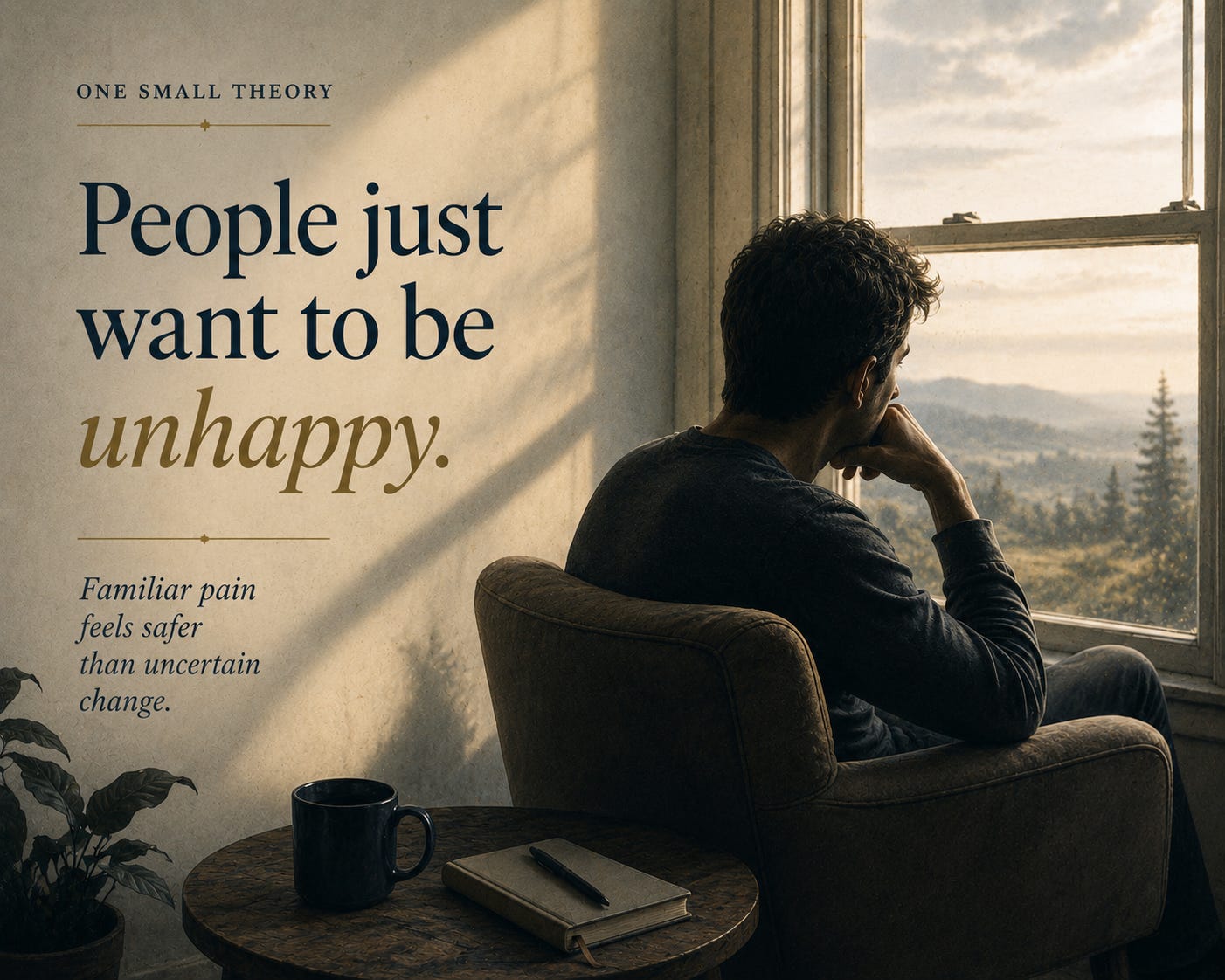
Some people do not actually want to be happy.
At least not in the way they say they do.
They want relief. They want attention. They want validation. They want someone to finally understand how hard things have been. They want the world to confirm that their frustration is justified. They want the people who hurt them to recognize what they did. They want life to become easier without requiring them to become different.
But happiness?
Real happiness?
The kind that requires ownership, forgiveness, change, responsibility, risk, discipline, gratitude, and the willingness to stop rehearsing old injuries?
That kind can feel strangely threatening.
Because unhappiness, for all its pain, can become familiar.
And familiar things are hard to surrender.
This is not about people who are walking through genuine grief, depression, trauma, loss, or hardship. There are seasons when unhappiness is not a choice. There are wounds that take time. There are burdens no one should minimize with a simple command to “choose joy.”
But there is another kind of unhappiness.
A chosen kind.
A protected kind.
A kind people quietly maintain because it gives them something.
It gives them an explanation.
It gives them an identity.
It gives them a reason not to try.
It gives them permission to stay cynical.
It gives them moral cover.
It gives them a familiar place to stand.
And over time, they begin to mistake that familiar misery for truth.
Unhappiness Can Become a Home
The strange thing about unhappiness is that it can become comfortable.
Not enjoyable.
Comfortable.
There is a difference.
A person may hate being unhappy, but still know how to live there. They know the emotional furniture. They know the script. They know the stories. They know who to blame. They know which disappointments to revisit. They know which offenses to keep polished. They know how to explain why things are the way they are.
Happiness would require rearranging the room.
It would require asking harder questions.
What if I am not as trapped as I say I am?
What if the thing that hurt me is real, but the story I built around it is no longer helping me?
What if my bitterness is understandable, but still costing me too much?
What if I have become more loyal to my disappointment than to my future?
Those questions are uncomfortable because they return responsibility to the person asking them.
And responsibility is heavy.
It is often easier to remain unhappy and certain than to become hopeful and exposed.
Hope asks something of us.
Unhappiness mostly asks us to repeat ourselves.
Complaining Can Feel Like Control
There is a kind of complaining that is not really about solving anything.
It is about control.
When someone complains, they get to define the story. They get to name the villain. They get to explain the problem in a way that protects their own position. They get the brief satisfaction of being right without the burden of doing anything different.
This is why complaining can become addictive.
It creates motion without movement.
It feels like processing, but often it is only rehearsing.
It feels like honesty, but sometimes it is only selective attention.
It feels like strength, but sometimes it is just fear wearing a louder voice.
A person can spend years talking about what is wrong without ever becoming more capable of making things right.
And if they are not careful, their complaints become their personality.
They become the person who always sees the flaw first.
The person who always explains why something will not work.
The person who can diagnose every problem but never contribute much to the repair.
The person who says they want peace, but keeps feeding the fire.
Misery Often Wants Company
Unhappiness can be lonely, but it also recruits.
A person who has become comfortable in negativity often wants others to join them there.
Not always maliciously.
Sometimes they simply want confirmation that they are not crazy. Sometimes they want solidarity. Sometimes they want someone to say, “You are right. That is terrible. You should be upset.”
There is a place for that.
We all need people who can sit with us in disappointment. We all need friends who can say, “That was wrong,” or “I understand why that hurt.”
But healthy support eventually helps us move.
Unhealthy support helps us stay stuck.
There is a difference between being comforted and being confirmed in dysfunction.
The first helps us heal.
The second helps us build a case.
Some people do not want counsel. They want co-signers.
They do not want perspective. They want agreement.
They do not want someone to help them find a way forward. They want someone to stand beside them in the same old complaint and call it loyalty.
That is not friendship.
That is emotional captivity.
Happiness Requires Letting Some Stories End
One of the hardest parts of becoming happier is letting certain stories lose power.
The old grievance.
The old betrayal.
The old unfairness.
The old explanation for why you are the way you are.
The old belief that everyone else had an easier road.
The old habit of comparing your hidden struggle to someone else’s visible success.
These stories may contain truth.
That is why they are hard to release.
But a story can be true and still be incomplete.
It may be true that someone hurt you.
It may be true that you were overlooked.
It may be true that life was unfair.
It may be true that you did not get what you needed.
But if that story becomes the only story, it stops being memory and becomes a prison.
Happiness requires the humility to say:
This happened.
It mattered.
It shaped me.
But it does not get to own every room in my life forever.
That is not denial.
That is freedom.
Some People Protect Their Unhappiness Because It Protects Their Ego
This may be the sharpest truth.
Sometimes unhappiness protects the ego.
If I stay unhappy, I do not have to risk failing at change.
If I stay unhappy, I can blame the conditions.
If I stay unhappy, I can keep the idea of a better life theoretical.
If I stay unhappy, I never have to find out whether I am capable of becoming the person I claim I want to be.
That sounds harsh, but most of us have done this in some form.
It is safer to criticize than to create.
Safer to explain than to attempt.
Safer to stay disappointed than to hope and be disappointed again.
Unhappiness can become armor.
It keeps us from looking foolish.
It keeps us from being vulnerable.
It keeps us from needing to ask for help.
It keeps us from admitting that our next step might be small, boring, and entirely ours.
The problem with armor is that it protects you and traps you at the same time.
Gratitude Is Not Naive
One reason unhappy people resist happiness is that they mistake gratitude for naivety.
They think grateful people are ignoring reality.
Sometimes that is true. There is such a thing as shallow positivity. There is such a thing as pretending everything is fine when it is not.
But real gratitude is not pretending.
Real gratitude is disciplined attention.
It says, “I will not let what is wrong become the only thing I see.”
That matters because attention shapes reality.
If you spend all your attention on what is missing, unfair, broken, irritating, disappointing, or insufficient, your life will start to feel like evidence for despair.
If you train yourself to notice what is good, useful, beautiful, funny, generous, ordinary, and still possible, your life will not become perfect.
But it may become more livable.
Gratitude does not solve every problem.
It keeps every problem from becoming everything.
Some People Do Not Want Happiness. They Want Vindication.
There is a big difference between happiness and vindication.
Happiness asks, “What kind of life can I build now?”
Vindication asks, “How can I prove I was right?”
Happiness moves forward.
Vindication keeps returning to the scene.
Happiness may require releasing the need for certain people to understand.
Vindication waits for the apology, the admission, the recognition, the correction, the public proof that yes, you were wronged.
Sometimes vindication comes.
Often it does not.
And if your peace depends on it, your peace remains in someone else’s hands.
That is a terrible place to leave it.
There are people who say they want to be happy, but what they really want is for everyone else to admit they had a reason to be unhappy.
That desire is human.
But it can also become endless.
At some point, the question is not, “Was I justified in feeling this way?”
Maybe you were.
The better question is, “Do I want to keep living this way?”
Happiness Is Often Less Dramatic Than People Expect
Many people imagine happiness as a big emotional arrival.
A new job.
A new house.
A new relationship.
A major breakthrough.
A sudden transformation.
But much of happiness is quieter than that.
It is a clean conscience.
A repaired relationship.
A morning without resentment.
A task completed.
A walk outside.
A good meal.
A laugh that surprises you.
A decision made.
A boundary kept.
A moment where you stop arguing with reality long enough to live inside it.
Happiness is often not the absence of problems.
It is the ability to stop making every problem the center of your identity.
That kind of happiness requires practice.
It requires choosing better thoughts before they feel natural.
It requires refusing to indulge every complaint.
It requires being honest without becoming cynical.
It requires noticing beauty without demanding that beauty fix everything.
The Invitation
Maybe the goal is not to force happiness.
Maybe that is too much pressure.
Maybe the better goal is to stop protecting unhappiness.
Stop feeding the complaint.
Stop rehearsing the injury.
Stop making disappointment the most reliable part of your personality.
Stop confusing cynicism with intelligence.
Stop waiting for life to become easy before you become grateful.
Stop giving the worst parts of your story the most authority.
There is no shame in being unhappy for a season.
There is danger in becoming committed to it.
So, one small theory:
People do not always want to be happy.
Sometimes they want to be understood.
Sometimes they want to be right.
Sometimes they want to be rescued.
Sometimes they want to avoid the risk of trying.
Sometimes they want the comfort of the old story more than the uncertainty of a new one.
But happiness, the real kind, usually begins when we stop treating our unhappiness as proof of our depth, our wisdom, or our innocence.
It begins when we admit that peace may require something from us.
Not everything.
Not all at once.
Just the next honest choice.
The next grateful thought.
The next released grievance.
The next small refusal to make misery feel at home.
And maybe that is enough to begin.