


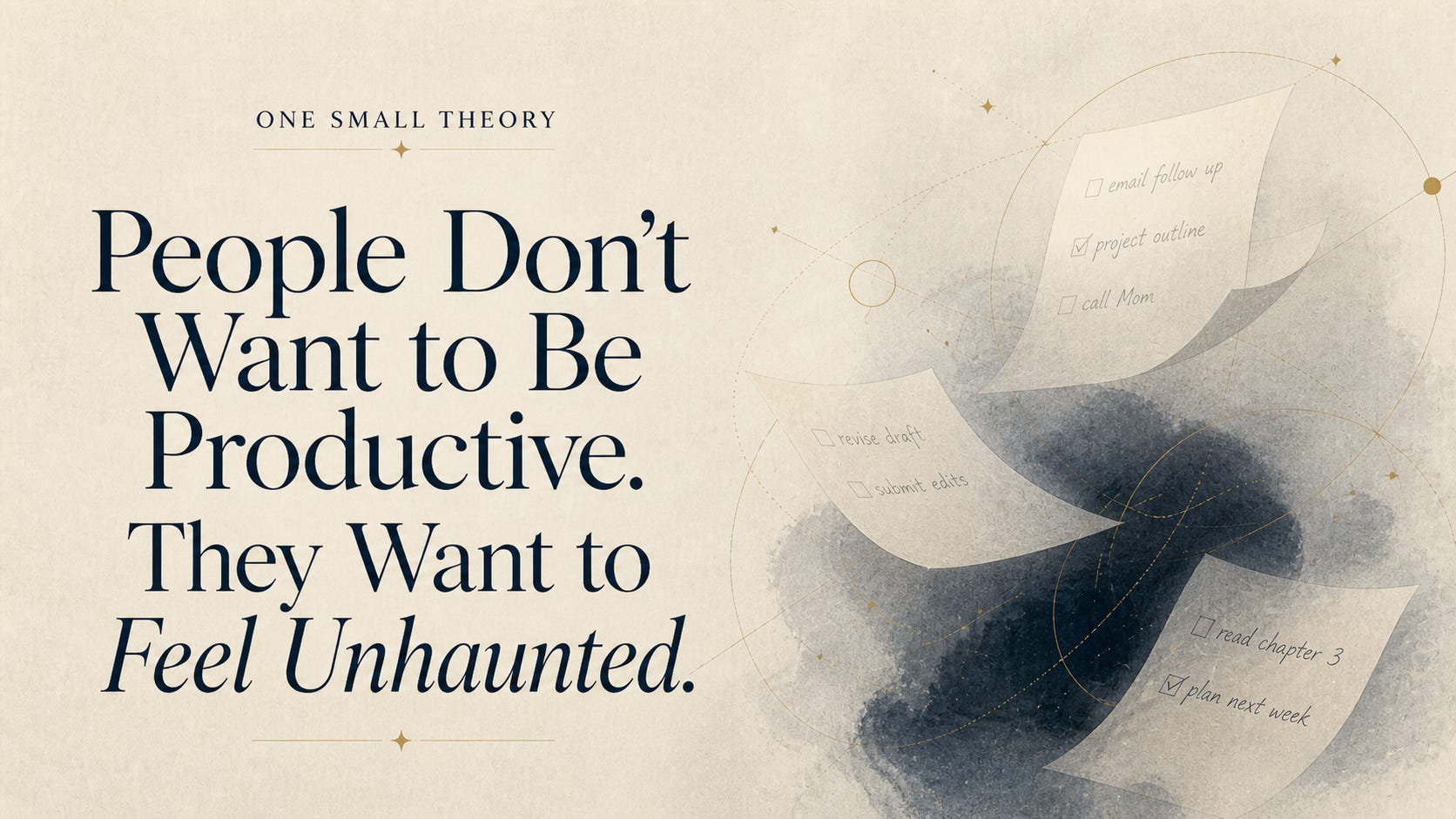
My small theory is that most people do not actually want to be productive.
Not in the way we usually talk about productivity, at least. Not as a personal brand, a moral achievement, a perfectly optimized calendar, or a life arranged into neat little blocks of usefulness.
Most people are not secretly yearning to become frictionless machines of task completion.
What they want is much more tender and much less marketable.
They want to feel unhaunted.
By the email they have not answered.
By the text they left hanging.
By the appointment they need to schedule.
By the form they need to fill out.
By the pile on the chair.
By the thing they promised someone three weeks ago.
By the vague, awful item on the list that just says “insurance” or “taxes” or “dentist.”
A task list, at its worst, is not a plan.
It is a list of ghosts.
Each unfinished thing hovers somewhere near the edge of consciousness. Not always visible, but present. You feel it when you are trying to rest. You feel it when you are watching a movie and suddenly remember that one message you never replied to. You feel it in the shower, in the grocery store, in bed at 11:42 p.m., when the mind decides, perversely, that now would be an excellent time to review every open loop in your life.
This is the emotional life of productivity culture that we do not talk about enough.
We talk about systems. Habits. Discipline. Prioritization. Deep work. Inbox zero. Time blocking. The perfect notebook. The perfect app. The perfect way to finally become the sort of person who is not always slightly behind.
But underneath all that, I think many of us are asking a quieter question:
How do I stop feeling followed by my own life?
There is a particular kind of exhaustion that does not come from doing too much. It comes from being unable to put anything down.
You can have a relatively ordinary day. You answer some emails, go to work, buy groceries, make dinner, fold half the laundry, return one phone call, and forget another. Still, you arrive at the evening feeling pursued. Not because the day was dramatic. Because it remained unfinished in too many directions.
Modern life is full of things that do not end cleanly.
Messages invite replies. Replies invite follow ups. Work creates more work. Forms require passwords. Passwords require resets. Bills require accounts. Accounts require verification codes. Verification codes expire. Every small administrative task seems to open a trapdoor into three more tasks, each with its own portal, deadline, and emotional residue.
You sit down to do one simple thing, such as schedule an appointment or cancel a subscription. You emerge 45 minutes later with six new tabs open, a customer service chatbot asking whether you are still there, and the strange sense that civilization has become a series of locked doors designed by people who hate you personally.
No wonder we fantasize about productivity.
Productivity promises not just accomplishment, but exorcism.
It says: here is a way to get the ghosts out of the room.
Make a list. Build a system. Sort everything into categories. Give every task a due date. Divide your day into blocks. Become intentional. Become streamlined. Become someone who has no vague dread attached to the word “miscellaneous.”
And sometimes, of course, this works.
There is real relief in writing things down. There is real dignity in order. There is a reason a crossed off task feels so disproportionately good. The little line through the words is not just evidence that something got done. It is a tiny burial. One less thing floating around, tugging at your sleeve.
Done is not only practical.
Done is spiritual.
The problem is that productivity culture often misunderstands the nature of the haunting.
It assumes the issue is inefficiency, when often the issue is guilt.
It assumes the issue is poor time management, when often the issue is emotional congestion.
It assumes we need to become better at doing things, when sometimes we need to become better at deciding what does not need to be done, what cannot be done today, what was never ours to carry, and what can be released without a ceremony.
A lot of what we call procrastination is actually dread with no place to go.
A task becomes harder the longer it sits there, not only because of the task itself, but because it starts collecting meaning. At first, it is just an email. Then it becomes an email you should have answered yesterday. Then it becomes proof that you are inconsiderate. Then proof that you are disorganized. Then proof that you are bad at friendship, bad at work, bad at being an adult, bad at being a person who can be trusted with a life.
The task has not changed.
But now it has a costume.
Now it is not “reply to Anna.”
It is “confront the accumulating evidence of my inadequacy through the medium of replying to Anna.”
No wonder you avoid it.
The longer something remains undone, the more it becomes a story about you.
This is one of the cruelties of the task list. It looks so neutral. So clean. So reasonable. Just a few words on paper, or in an app, or typed into the notes folder where all good intentions go to fossilize.
But each item carries its own little charge.
Some tasks are simple. Some are sticky. Some are secretly emotional. Some involve admitting you forgot. Some involve money. Some involve your body. Some involve calling a person who may be annoyed with you. Some involve asking for help. Some involve discovering information you are afraid to know.
“Make appointment” can mean: I am scared something is wrong.
“Update résumé” can mean: I am unhappy and do not want to admit how unhappy.
“Call Dad” can mean: I do not know how to have the conversation we need to have, so I will pretend the problem is scheduling.
“Clean closet” can mean: I am surrounded by old versions of myself, and none of them quite fit.
The list says task.
The body hears threat.
This is why so much productivity advice can feel strangely insulting. It treats every undone thing as if it is merely a failure of organization. But sometimes the undone thing is where the feeling lives.
You are not avoiding the spreadsheet. You are avoiding the shame attached to the spreadsheet.
You are not avoiding the phone call. You are avoiding the version of yourself you become when you have to make the phone call.
You are not avoiding the pile of mail. You are avoiding whatever the pile of mail might reveal about the part of your life you have not wanted to look at directly.
There is a reason people will spend more time reorganizing their task management system than doing the tasks inside it. Rearranging dread feels like progress. It gives the mind something to do with the fear. You can create categories, labels, priorities, and contexts. You can move the same doomed item from one week to the next with the solemnity of someone preserving a sacred text.
And for a moment, it helps.
The ghosts are still there, but now they are alphabetized.
I say this with affection because I have done it. I have bought the notebook. I have made the beautiful list. I have rewritten the ugly list into the beautiful notebook so the unfinished things could at least disappoint me in better handwriting.
There is something almost touching about this impulse.
A list is a small act of faith. It says: I believe there is a version of me who will know what to do with all this.
Every planner, every productivity app, every carefully designed system is, in some way, a message to a future self.
Please be better at this than I am.
Please hold this for me.
Please make order out of what I cannot face right now.
But the future self is not always more capable. Sometimes the future self is just us, later, with more emails.
This is where the haunting deepens.
Because the undone things do not only follow us through work. They follow us into rest.
Rest is supposed to be the opposite of productivity, but for many people, rest is where the ghosts get louder. The moment you stop moving, everything catches up. You lie down and your mind begins its little inventory. Did you pay that bill? Did you respond to that message? Did you miss the deadline? Did you ever send the thing? What was the thing? Was there a thing? There was definitely a thing.
So you reach for your phone, not necessarily because you want stimulation, but because stimulation is easier than being alone with the list.
This is one reason distraction is so seductive. It gives us temporary asylum from self accusation.
A video, a scroll, a feed, a game, a little online wandering: these things do not exactly solve the haunting, but they muffle it. They create enough noise that we cannot hear the floorboards creak.
Then, of course, the distraction becomes its own source of guilt.
Now you have not done the thing, and you have also spent 40 minutes watching a stranger organize their refrigerator.
The ghosts multiply.
Productivity culture enters at this vulnerable point and offers a bargain: become more disciplined, and you will become free.
But I wonder if the freer life is not always the more productive one.
Maybe it is the life with fewer false obligations.
Maybe it is the life where tasks are allowed to be small again, instead of moral referendums.
Maybe it is the life where rest does not have to be earned through exhaustion.
Maybe it is the life where you can say, without drama, I am not doing that.
There is a kind of peace that comes not from finishing everything, but from telling the truth about what everything is.
Some things are urgent.
Some things are important.
Some things are neither, but noisy.
Some things feel urgent because someone else is anxious.
Some things feel important because you have attached your identity to them.
Some things are old promises made by a version of you who had no idea what she was agreeing to.
Some things are not tasks at all, but grief, fear, ambition, resentment, or longing wearing a task shaped mask.
A better task list might begin there.
Not with What do I need to do?
But with What is haunting me, and why?
This changes the texture of the list.
Instead of writing “laundry,” maybe you write, “I want my room to feel less chaotic.”
Instead of “email Mark,” maybe, “I feel guilty that I have not replied, and I need to send a simple answer.”
Instead of “budget,” maybe, “I am afraid to look at my money, but looking will make it less monstrous.”
Instead of “finish essay,” maybe, “I want to stop carrying this half made thing everywhere I go.”
There is something clarifying about naming the emotional weather around a task. It restores proportion. The thing becomes less ghostly once it is seen.
Maybe this is why the smallest completed tasks can bring such enormous relief. You finally make the appointment. You finally send the email. You finally take the bag of donations out of the trunk of your car, where it has lived for so long it has basically become a passenger.
And immediately, the world feels lighter.
Not because your life is transformed.
Because one tiny haunting has ended.
The relief is almost embarrassing in its intensity. How could such a small thing have been taking up so much space? How could a two minute task occupy three weeks of emotional real estate? How could a form, a call, a pair of pants that needed returning become part of the atmosphere?
But this is how humans are.
We are not clean machines. We are symbolic creatures. We turn objects into evidence. We turn delays into character flaws. We turn obligations into fog. We are capable of being undone by an email whose entire necessary response is, “Sounds good, thank you.”
So perhaps the goal is not to become productivity people.
Perhaps the goal is to become less haunted people.
People who can complete what matters, yes, but also release what does not. People who can distinguish between a real obligation and a lingering emotional debt. People who can rest inside an unfinished life without mistaking incompletion for failure.
Because every life is unfinished.
There will always be something. The inbox will refill. The laundry will return. The forms will generate new forms. The task you complete today may have a follow up tomorrow. The idea that you can one day reach a permanent state of being caught up is one of the great lies of adulthood, right up there with “this will only take five minutes” and “I’ll remember where I put that.”
There is no final clearing.
There are only little clearings.
A clean kitchen at 9 p.m.
A sent message.
A crossed off errand.
A morning where the list is honest.
An afternoon where you do one hard thing and then let that be enough.
A night where you decide that whatever remains undone will have to wait, and this does not make you bad. It makes you a person with limits. It makes you alive.
I like the phrase feel unhaunted because it suggests something gentler than optimization. It does not require becoming a new person. It does not demand a total system overhaul. It does not turn life into a performance review.
It asks only: what is following you?
And what would help it rest?
Maybe the answer is doing the thing.
Maybe the answer is deleting the thing.
Maybe the answer is apologizing.
Maybe the answer is making the task smaller.
Maybe the answer is admitting that you are scared.
Maybe the answer is deciding that the person you are disappointing is imaginary, or at least much less powerful than you thought.
Maybe the answer is closing the loop.
Maybe the answer is letting the loop remain open without letting it become a noose.
This is not an argument against ambition or effort or beautiful lists. I still believe in the minor romance of a good notebook. I still believe in the sacred pleasure of checking a box. I still believe there are few sensations more adult and luxurious than remembering to do something before it becomes a crisis.
But I am suspicious of any culture that turns every undone thing into evidence of personal failure.
The unfinished task is not always an indictment.
Sometimes it is just a task.
Sometimes the list is long because life is dense and needy and full of maintenance.
Sometimes you are tired because being a person requires an astonishing amount of invisible labor.
Sometimes you are not behind. You are simply inside a life that keeps asking things of you.
And maybe the most humane kind of productivity is the kind that helps you return to yourself.
Not the self who can do more.
The self who can breathe.
The self who can look around the room and not feel accused by every surface.
The self who can sit down to dinner without mentally negotiating with tomorrow.
The self who understands that peace is not the same as completion.
The self who knows that being alive means carrying unfinished things, but not necessarily being chased by them.
So, one small theory:
People do not want to be productive.
They want to feel unhaunted.
They want the quiet after the email is sent. The softness after the apology is made. The clean edge of a decision. The mercy of a crossed off line. The strange, holy relief of realizing that the thing you feared has become ordinary again.
They want to stop being followed by all the versions of themselves who meant to do something sooner.
They want to enter a room, a night, a weekend, a life, and feel, even briefly, that nothing is waiting in the corner with its arms crossed.
And honestly, who could blame them?
What’s one small thing that has been haunting you lately, and what would it take to let it rest?