


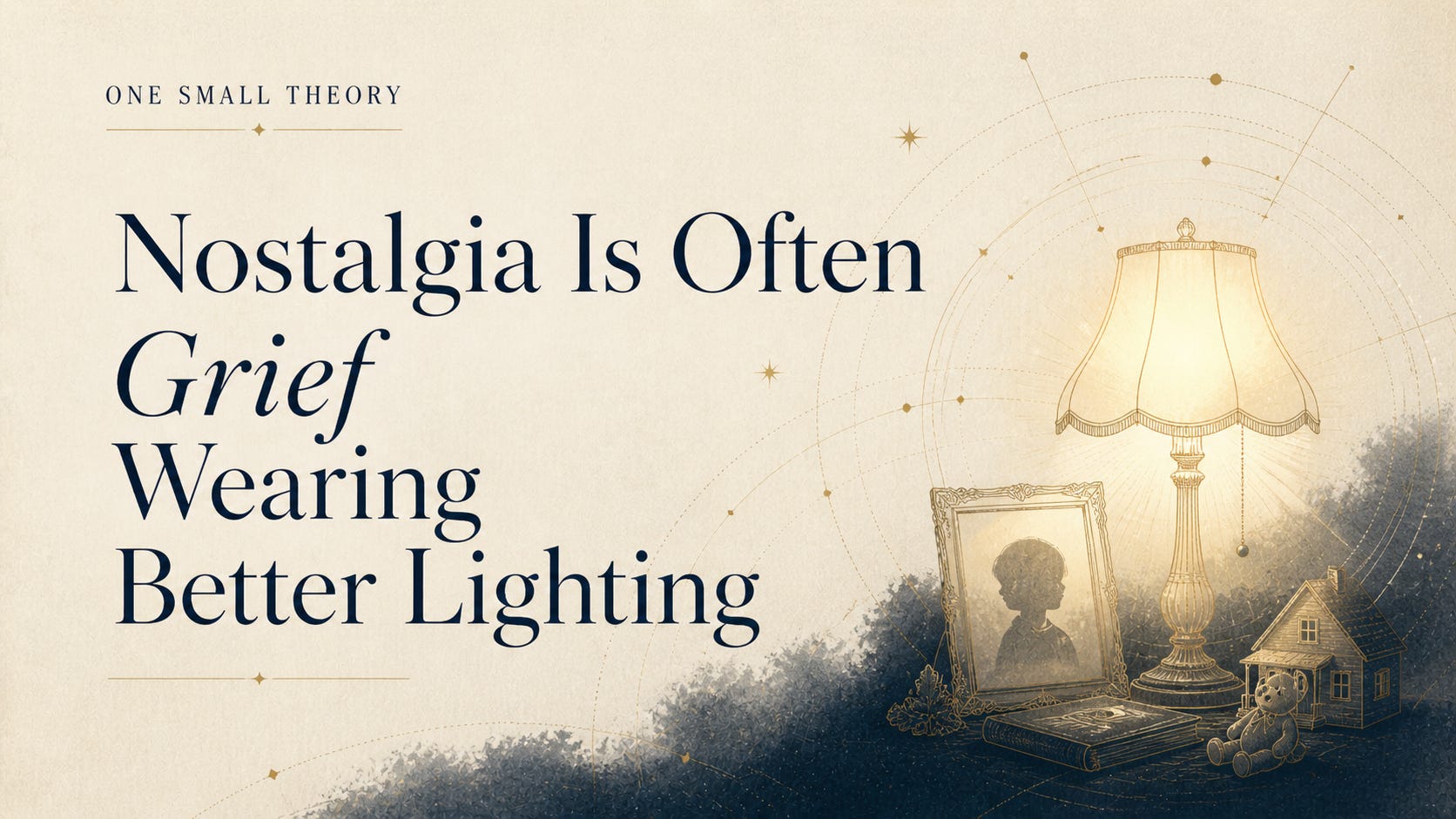
My small theory is that nostalgia is often grief wearing better lighting.
Not always.
Sometimes nostalgia is simply affection. A warm memory. A song that returns you to a summer night. The smell of cut grass. The sound of a screen door. A certain kind of light in the kitchen. The first cold evening after a long season of heat. A movie you watched too many times as a kid. A place you have not been in years, but could still walk through in your mind without turning on a single light.
Nostalgia can be tender. It can be beautiful. It can remind us that life has held more meaning than we realized while we were living it.
But often, underneath the warmth, there is something else.
A loss we have softened.
A sadness we have decorated.
A grief we have learned to make aesthetically pleasing.
The past has a way of becoming more coherent after we leave it. While we are living through it, life is scattered. It is messy, interrupted, unfinished, and ordinary. There are dishes in the sink. Bad moods. Awkward conversations. Boring afternoons. Things we did not understand. People we failed to appreciate. Moments we rushed through because we thought something better was waiting.
Then time passes.
The rough edges blur. The lighting changes. The ordinary becomes symbolic. The rooms become warmer. The people become simpler. The season becomes more beautiful than it probably was. The old house becomes not just a house, but a whole atmosphere. The childhood street becomes not just pavement and mailboxes, but a map of who we were before we knew we were becoming anyone.
Memory does not merely remember.
Memory composes.
It chooses angles. It adjusts color. It turns down the noise. It turns up the music. It removes the clutter from the frame. It gives the past a shape the present almost never has.
This may be why the past can look so peaceful from a distance.
It has been edited.
Not dishonestly, exactly. More like lovingly. More like mercifully.
We remember the golden parts because they help us survive the fact that they are gone.
Childhood is especially vulnerable to this kind of lighting.
There are whole eras of life that return to us not as facts, but as textures.
The carpet in a grandparents’ living room.
The hum of an old refrigerator.
A bowl of cereal at a kitchen table.
The particular smell of a school hallway.
The sound of cartoons from another room.
A parent’s coat hanging by the door.
The orange light of a bedroom in the evening.
A backyard that felt enormous because we had not yet learned the actual size of things.
When we are children, we do not know that ordinary places are gathering power. We do not understand that the room we are trying to escape may one day become sacred. We do not know that the voices calling us to dinner, telling us to clean up, asking if we finished our homework, may someday become voices we would give almost anything to hear again in their most ordinary form.
That is one of the quiet cruelties of time.
It makes things precious after it makes them unreachable.
Nostalgia often begins there, in the realization that we cannot return to the exact conditions under which we once felt held by the world.
Even if the house still exists, the room is different.
Even if the room is the same, the people are older.
Even if the people are there, we are not the same person who once belonged there without effort.
What we miss is not only the place.
We miss the version of ourselves who did not yet know it could be lost.
This is why nostalgia can feel so strangely physical. It is not only a thought. It is an ache. A pull. A pressure somewhere behind the ribs. You hear a song from fifteen years ago and, for a second, time folds. You are back in a car, in a parking lot, in a season of life that seemed unfinished because it was. You remember the weather. You remember who you were trying to impress. You remember the feeling of the future being large and unclaimed.
Then the song ends.
You are here.
The present returns with all its obligations and emails and aging bodies and practical concerns. The spell breaks. You are left not only with the sweetness of the memory, but with the knowledge that the moment cannot be reentered. It can only be revisited from the outside.
That is where nostalgia and grief begin to resemble each other.
Grief says: something I loved is gone.
Nostalgia says: something I loved is beautiful because it is gone.
The difference is lighting.
Grief is often harshly lit. It is fluorescent. It shows too much. It leaves nothing softened. It makes the absence impossible to ignore.
Nostalgia dims the room. It lights a candle. It plays the old song. It lets the absence become atmosphere.
And sometimes, that is a mercy.
We cannot live forever in the rawness of loss. We need ways to hold what has passed without being destroyed by it. Nostalgia gives grief somewhere gentler to sit. It lets us approach loss indirectly, through images and smells and songs and colors. It lets us say, “I miss that,” when what we may mean is, “I am still learning how to live after that.”
The trouble is that nostalgia can also lie.
Not always by inventing things, but by arranging them too beautifully.
It can make the past seem simpler than it was.
It can make childhood look safer than it felt.
It can make old relationships seem purer than they were.
It can turn difficult seasons into charming ones.
It can convince us that we once had something whole, when what we really had was something unfinished that we now understand through the mercy of distance.
This happens with eras as much as with personal memory.
People speak about “the way things used to be” as though the past was a clean, stable country from which we were exiled. Simpler times. Better manners. Stronger communities. Slower days. Real conversations. Kids outside until dark. Families around dinner tables. Towns where everyone knew each other.
Some of that may be true.
Some of it may be selective.
Because the past also contained loneliness. Conflict. Exclusion. Fear. Illness. Unspoken pain. People trapped in roles they did not choose. Children misunderstood. Marriages endured more than lived. Communities that were close, but not always kind. A slower world was not automatically a gentler one.
Nostalgia often remembers the porch light and forgets who was not allowed inside.
That does not mean the longing is false.
It means it needs to be handled carefully.
There may be something real inside it. A desire for rootedness. A hunger for community. A longing for childhood’s sense of scale, when the world was smaller and therefore easier to love. A wish for fewer interruptions. A grief over how fast everything moves now. A yearning for people and places that did not yet feel temporary.
Those longings are worth honoring.
But they should not be mistaken for history.
Nostalgia is not a reliable historian.
It is more like a painter.
It does not give us the whole record. It gives us the emotional truth of what remains.
This is why aesthetics matter so much to nostalgia.
Certain colors, textures, objects, and sounds become carriers of memory. Old photographs. Film grain. Faded denim. Wood paneling. Christmas lights. Cassette tapes. Handwritten recipes. Polaroids. Dusty windows. Worn books. Wallpaper patterns. The glow of a lamp in a room that no longer exists.
These things do not simply remind us of the past.
They make the past feel designed.
They give memory a visual language. They suggest that what happened had shape, mood, and meaning. They turn the randomness of lived experience into something curated by time.
This is why a childhood photo can undo us.
Not because it captures everything.
Because it captures so little.
A couch. A birthday cake. A bad haircut. A parent in the background. A toy on the floor. A kitchen we did not know we were seeing for the last era of its life.
The photograph is small, but it opens into a whole world. We do not only see the image. We see the room beyond the image. We hear what might have been happening after the picture was taken. We feel the air around it. We remember, or imagine we remember, what it was like to live inside that version of time.
And because the photo is still, the past appears still too.
But it was not.
It was moving the whole time.
Everyone in the picture was becoming someone else. The house was aging. The children were growing. The adults were carrying private worries. The day was passing. The cake was being eaten. The dishes were going to need washing. Some small frustration probably happened ten minutes later. Someone was tired. Someone was distracted. Someone was trying their best.
The photograph makes it look complete.
Life was not complete.
Life was only briefly arranged.
Maybe this is why nostalgia is so powerful. It gives us what life rarely gives us while we are living it: composition.
In the present, meaning is usually hidden inside inconvenience. The beautiful evening also contains a headache. The family gathering also contains tension. The vacation also contains logistics. The meaningful work also contains emails. The season we will one day miss is currently full of small irritations we are trying to get through.
Then later, memory lifts the meaning out of the inconvenience.
It says: this mattered.
And because we can no longer be annoyed by the inconvenience, we finally believe it.
There is a danger in this, but also a lesson.
The danger is that we spend our lives longing backward, chasing a version of the past that never fully existed.
The lesson is that much of what we will one day miss is happening now, in forms too ordinary to recognize.
There is probably something in your life right now that will someday break your heart with tenderness.
A messy kitchen.
A child asking the same question again.
A dog sleeping in an inconvenient place.
A friend texting too late.
A parent’s familiar complaint.
A commute you hate.
A house that feels too loud.
A job that exhausts you.
A season you are trying to survive.
One day, some detail from this period may return to you with impossible softness. A song. A smell. A phrase. A photo you barely remember taking. And you may feel that old ache, the sudden awareness that life was happening, fully and irreversibly, even while you were busy wanting something else.
This is not a command to enjoy every moment.
That advice is usually impossible and sometimes cruel.
Not every moment is enjoyable. Some seasons are genuinely hard. Some homes are not safe. Some childhoods are not golden. Some memories do not deserve better lighting. Some grief should not be aestheticized into something pretty just because enough time has passed.
But for the ordinary ache of ordinary life, nostalgia can teach us something.
It can remind us that we often recognize meaning late.
We see the beauty after the fact.
We understand the gift once it has become memory.
We feel the love most sharply once it has been placed at a distance.
Maybe nostalgia is not only a longing for the past.
Maybe it is also a warning from the future.
It tells us: pay attention.
Not perfectly. Not constantly. Not with the desperate pressure to cherish everything before it disappears. Just enough to notice that this, too, is becoming something.
This breakfast.
This room.
This voice.
This drive.
This ordinary Saturday.
This person sitting across from you.
This version of yourself, unfinished and unaware, living inside a moment you may someday wish you could visit once more.
There is a kind of humility in that.
The present does not usually announce itself as meaningful. It rarely arrives with music and golden light. More often, it looks like errands, weather, dishes, work, noise, repetition, and people asking where something is.
Then, years later, memory returns with a lamp.
Suddenly the whole thing glows.
But maybe we do not have to wait until everything is gone to see some of it clearly.
Maybe we can learn to recognize, even briefly, the future nostalgia hidden inside the current mess.
Not to make life sentimental.
To make it visible.
Because the past was not as coherent as it looks.
It was confusing, unfinished, and alive.
Just like now.
So, one small theory:
Nostalgia is often grief wearing better lighting.
It is grief that has learned softness. Grief that has found a song. Grief that has arranged the room so we can bear to enter it again. It lets us love what is gone without standing forever in the raw absence of it.
But it should also remind us that memory is not the only place beauty lives.
The present is already gathering light.
Quietly.
Unevenly.
Without our permission.
And someday, what feels ordinary now may return to us as a world.