


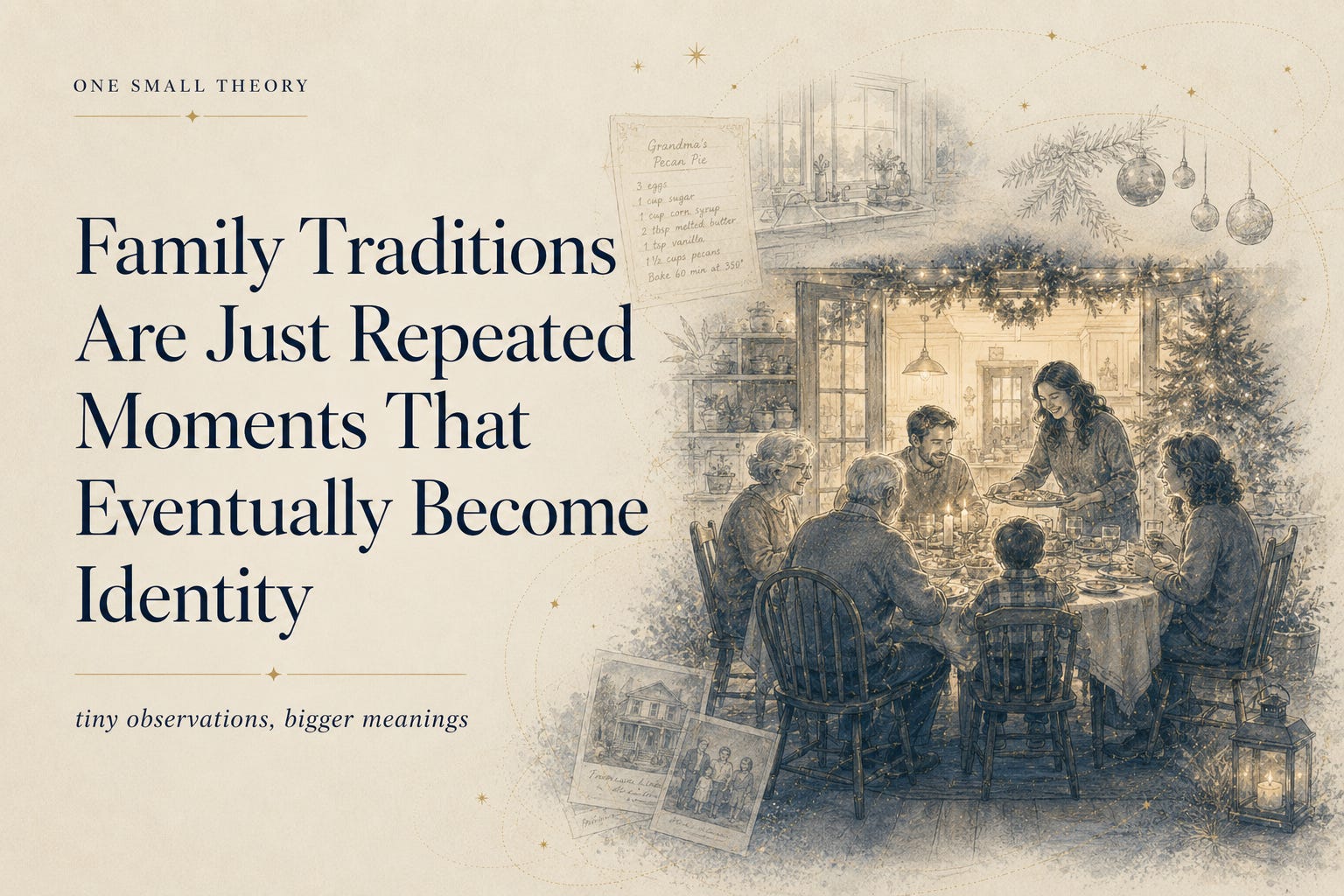
Family traditions are just repeated moments that eventually become identity.
They usually do not feel that important while they are happening.
That may be the strange thing about them.
A tradition often begins as something practical, accidental, or ordinary. Someone makes the same meal because everyone liked it. Someone puts the tree in the same corner because that is where it fit the first year. Someone starts watching the same movie on the same night because there was nothing else going on. Someone always makes pancakes on the first day of school. Someone always drives around to look at Christmas lights. Someone always says the same ridiculous phrase before leaving the house.
At first, it is just a thing you do.
Then, without asking permission, it becomes part of who you are.
That is how family identity is built.
Not mostly through speeches.
Not mostly through big declarations.
Not mostly through the moments parents think will matter most.
It is built through repetition.
The same table.
The same recipe.
The same argument over where the decorations go.
The same chair someone always sits in.
The same joke that stopped being funny years ago but somehow became funnier because everyone knows it is no longer funny.
The same road to grandma’s house.
The same way someone says grace.
The same ornament with the broken hook.
The same meal that never turns out exactly right but still shows up every year like it has tenure.
These small repetitions become emotional furniture. They give a family something to return to. They tell people, often without words, “This is us. This is what we do. This is where you belong.”
The Ordinary Becomes Sacred Slowly
Most traditions do not announce themselves as sacred.
They sneak up on us.
A child may not realize that Friday night pizza is becoming a memory. To them, it is just Friday. They may not understand that the way the house smells before Thanksgiving dinner will someday become a doorway back to childhood. They may not know that the song playing in the kitchen, the sound of dishes, the chaos of cousins, the parent rushing around while pretending not to be stressed, all of it is being quietly stored somewhere deep.
Later, when they are older, something will bring it back.
A smell.
A song.
A plate.
A certain kind of weather.
The sight of a porch light at dusk.
Suddenly, they will not just remember the tradition.
They will remember the feeling of being inside a family.
That is the real power of tradition.
It does not only preserve an activity. It preserves an atmosphere.
It carries the emotional weather of a home.
This is why the smallest things can become the most meaningful. The matching pajamas may not matter, except that they did. The birthday breakfast may not matter, except that it did. The same old cookie recipe may not matter, except that it tastes like three generations standing in the kitchen at once.
The thing itself is rarely the whole point.
The point is what the thing holds.
Children Remember Repetition as Love
Parents often worry about the big things.
Are we giving them enough? Are we teaching them enough? Are we making the right decisions? Are we creating enough opportunities? Are we giving them the childhood they deserve?
Those questions matter.
But I think children often experience love through repetition more than production.
They remember what was dependable.
The hug before school.
The note in the lunchbox.
The way Dad always asked about the game.
The way Mom always knew when something was off.
The meal that showed up after a hard day.
The bedtime routine.
The drive to practice.
The holiday rhythm.
The way everyone knew where to be without needing it explained.
Repetition gives love a shape.
It turns affection into something a child can predict.
And predictability is one of the quiet languages of safety.
Of course, no home is perfectly consistent. Every family has messy seasons. Parents get tired. Work gets demanding. Schedules break. Kids grow. Traditions fall apart. Life interrupts the plan, sometimes gently and sometimes with force.
But even imperfect repetition matters.
Maybe especially imperfect repetition.
Because traditions do not have to be flawless to become meaningful. In fact, some of the best ones are held together by mild chaos.
The burned rolls.
The late arrival.
The forgotten ingredient.
The family photo where someone is blinking.
The vacation where it rained the whole time.
The holiday when everyone was tense but still somehow ended up laughing.
The tradition survives not because everything went right, but because people kept showing up.
That is often what family is.
People keep showing up.
Traditions Tell Us Who We Are
Every family has a language.
Some of it is spoken. Much of it is not.
It is in the stories that get retold.
It is in the meals that get repeated.
It is in the way people celebrate, grieve, tease, gather, forgive, avoid, work, serve, and remember.
Over time, traditions become a family’s unofficial constitution.
They say:
We eat together when we can.
We show up for birthdays.
We help each other move.
We watch the game.
We make too much food.
We take the picture even when everyone complains.
We stop by.
We save a seat.
We make room.
We remember.
Some traditions are serious. Others are silly. But both matter.
The silly ones may matter more than we admit.
A family needs inside jokes. It needs ridiculous rituals. It needs things that would make no sense to anyone outside the house. Those little oddities create belonging. They mark the difference between people who know you generally and people who know the strange, specific details of your life.
A tradition does not have to be impressive to be formative.
It just has to repeat often enough to become part of the family story.
The Table Is Never Just a Table
Meals have a special place in family memory.
Not because every meal is profound.
Most are not.
A lot of meals are rushed, loud, repetitive, interrupted, and slightly underappreciated. Someone does not like what was made. Someone spills something. Someone has practice in twenty minutes. Someone is on their phone. Someone is annoyed. Someone asks what is for dinner while standing in front of the dinner.
Still, the table does quiet work.
It gathers people.
It creates a place where the day has to pass through a shared space.
Not every conversation at the table matters, but the pattern does.
The table says: we come back here.
Even when everyone is busy.
Even when the day was hard.
Even when no one has much to say.
Even when the meal is simple.
Especially then.
There is a reason so many memories are attached to food. Food is never just food inside a family. It is care made visible. It is effort you can smell. It is history served on a plate.
A recipe is a kind of inheritance.
It says someone made this before you.
Someone learned it.
Someone adjusted it.
Someone burned it once and never admitted it.
Someone brought it to a gathering.
Someone fed people with it.
And now it has arrived here, in your kitchen, at your table, among your people.
That is not a small thing.
Holidays Are Memory Machines
Holidays intensify tradition because they return.
Every year, whether we are ready or not, they come back around and ask us to rehearse who we are.
Where are we going?
Who is hosting?
What are we bringing?
Who makes the potatoes?
Are we doing gifts this year?
What time should everyone arrive?
Are we using the good dishes?
Do we really need this many desserts?
The details can be exhausting.
But underneath the logistics is a deeper rhythm.
Holidays give families a way to measure time.
The baby who was passed around last year is now running through the room.
The kid who used to sit at the children’s table is now driving himself there.
The grandparents are moving slower.
The cousins are taller.
The house feels the same and different.
Someone is missing.
Someone new is there.
Someone is carrying grief quietly.
Someone is trying to keep the day light.
Someone is remembering when the family was younger.
This is why holidays can feel both joyful and heavy.
They gather more than people.
They gather time.
Every holiday has all the previous holidays inside it.
That is beautiful.
It is also why they can ache.
Traditions remind us of continuity, but they also remind us of change. The same song plays, but not everyone who used to sing it is still there. The same recipe gets made, but the hands making it are different. The same room fills up, but the family has shifted.
A tradition holds memory and loss in the same bowl.
That is part of its power.
Parenting Is Mostly Repetition Before It Becomes Memory
When you are in the middle of parenting, traditions can feel like one more thing to manage.
One more expectation.
One more plan.
One more attempt to make something meaningful while someone refuses to wear shoes.
But children are not usually grading the production value.
They are absorbing the rhythm.
They are learning what home feels like.
A parent may think the tradition is the big event. The trip. The party. The perfect holiday. The carefully planned moment.
But the child may remember something much smaller.
The way you sang in the car.
The way you sat on the edge of the bed.
The way you made breakfast on Saturdays.
The way you waved from the porch.
The way you always said yes to one more story.
The way the house felt when everyone was home.
This is both comforting and humbling.
It means the pressure is lower than we think.
It also means the ordinary matters more than we think.
We are always creating atmosphere.
We are always teaching belonging.
We are always giving our children a working definition of home.
Not perfectly.
Never perfectly.
But repeatedly.
And repetition becomes memory.
Memory becomes meaning.
Meaning becomes identity.
Traditions Change Because Families Change
One of the hardest parts of family tradition is accepting that it cannot stay the same forever.
Children grow up.
Schedules change.
People move.
Marriages begin.
Marriages end.
New families form.
Grandparents pass away.
Houses are sold.
Health changes.
Work changes.
What once felt effortless now requires planning.
What once included everyone now has empty chairs.
A tradition that once gave life can become a source of stress if we demand that it remain frozen.
This is where families have to be gentle.
The goal of tradition is not to preserve every detail.
The goal is to preserve the meaning.
Maybe the meal changes.
Maybe the location changes.
Maybe the date changes.
Maybe the ritual gets smaller.
Maybe the old tradition becomes impossible, but a new one begins quietly in its place.
That does not mean the family has failed.
It means the family is alive.
Living things change.
A tradition should not become a museum exhibit where everyone is afraid to touch anything. It should be more like a fire. Something tended. Something passed. Something that may change shape but still gives warmth.
The question is not always, “How do we keep this exactly the same?”
Sometimes the better question is, “What were we really trying to hold?”
Was it togetherness?
Was it gratitude?
Was it laughter?
Was it remembrance?
Was it rest?
Was it the feeling that everyone had a place?
If we know what the tradition was holding, we can find new ways to hold it.
The Best Traditions Are Invitations
Some traditions become heavy because they turn into obligations without affection.
Everyone must attend.
Everyone must act happy.
Everyone must pretend nothing has changed.
Everyone must follow the old script even if no one remembers why.
That is not tradition at its best.
That is emotional maintenance.
The best traditions feel like invitations.
They say, “Come back to this.”
Come back to the table.
Come back to the story.
Come back to the people who know you.
Come back to gratitude.
Come back to laughter.
Come back to something that existed before today’s problems.
Come back to the reminder that you belong somewhere.
A good tradition gives people a place to stand.
It does not trap them.
It roots them.
There is a difference.
Roots do not prevent growth. They make growth possible.
What We Are Really Passing Down
When we pass down traditions, we are rarely only passing down activities.
We are passing down a way of seeing the world.
We are teaching our children what deserves attention.
We are telling them what matters enough to repeat.
We are showing them how love behaves when it has a calendar, a kitchen, a driveway, a living room, and a few tired people doing their best.
We are saying:
This family gathers.
This family remembers.
This family laughs.
This family makes room.
This family shows up.
This family eats together when it can.
This family keeps trying.
This family knows that the small things are not always small.
That may be why traditions matter so much.
They are not only about the past.
They are a way of giving the future something to recognize.
Someday, the children will be adults.
They may not do everything the same way.
They probably will not.
They will build their own homes, their own rhythms, their own strange little rituals. But every now and then, something will surface.
They will make the recipe.
They will say the phrase.
They will play the song.
They will hang the ornament.
They will tell the story.
They will find themselves doing something they once watched you do, and they may realize that home was not only a place they lived.
It was something being quietly built inside them.
That is the gift of tradition.
It lets love outlive the moment.
The Small Repetitions
In the end, a family is not formed by one perfect holiday, one perfect meal, or one perfect memory.
It is formed by the small repetitions.
The ordinary returns.
The familiar sounds.
The annual arguments.
The expected jokes.
The food everyone asks for.
The light in the kitchen.
The person who always falls asleep after dinner.
The story that gets told every year even though everyone knows the ending.
The way people gather again and again, imperfectly, lovingly, sometimes loudly, sometimes quietly, and somehow make a life out of it.
So, one small theory:
Family traditions are just repeated moments that eventually become identity.
They begin as things we do.
Then they become things we remember.
Then, if we are lucky, they become part of who we are.
Not because they were grand.
Because they returned.
And in a world where so much changes, there is mercy in having something that says:
This is us.
Come home.