


I have a college degree.
I graduated from Davenport University with highest honors.
I worked hard for it. I am proud of the discipline it required, the experience I gained, and the accomplishment itself.
But I also believe the system that awarded me that degree has become outdated.
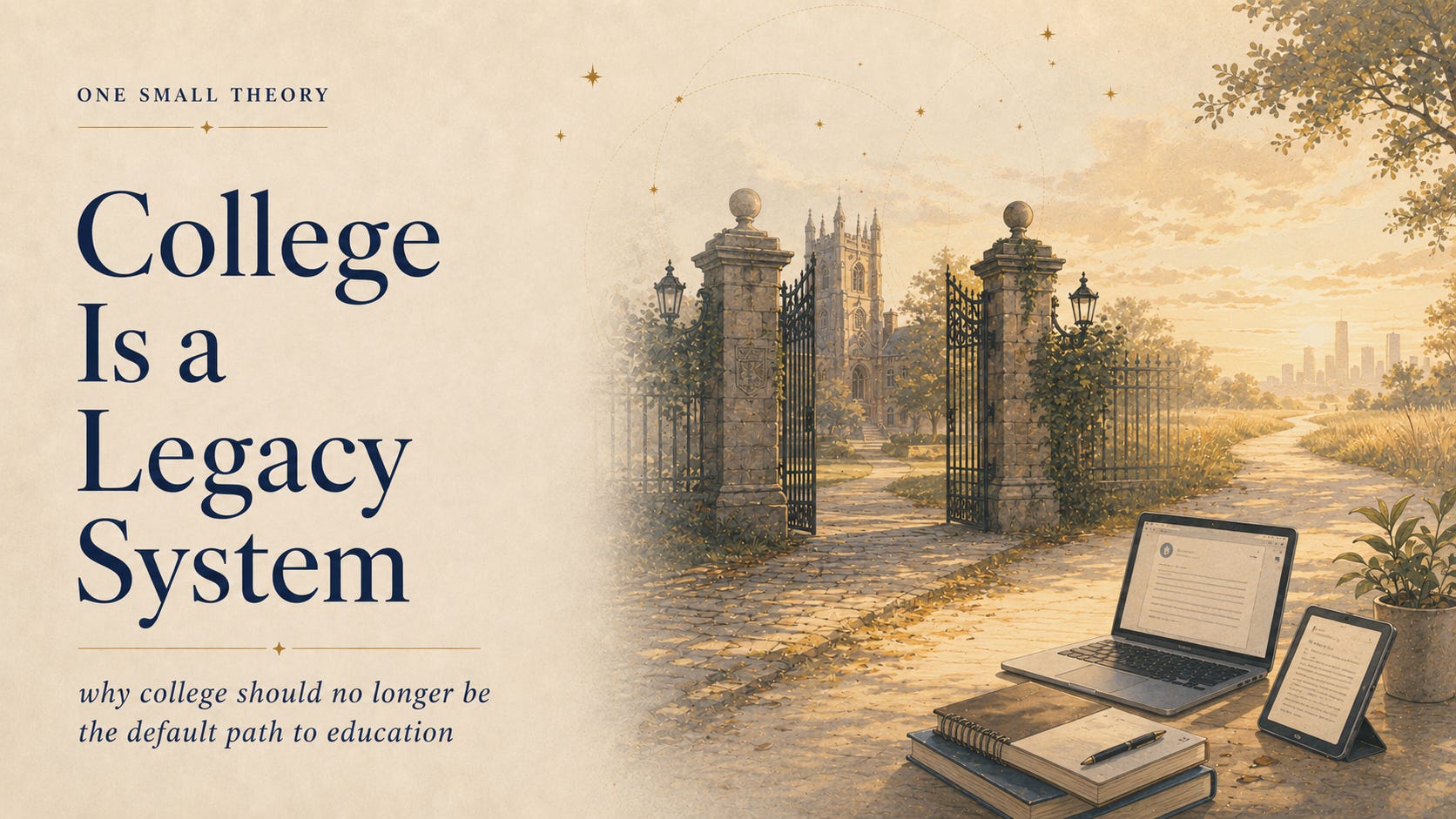
College, in its current form, is a legacy system.
That may sound strange coming from someone who successfully completed the process. But questioning a system does not require regretting your experience within it. It requires being honest about whether that system still serves the purpose it was designed to serve.
For generations, college has been treated as the default next step for anyone who wants a successful life.
Graduate from high school.
Choose a school.
Pick a major.
Spend four years in classrooms.
Earn a degree.
Then begin the process of figuring out how to apply what you learned to the real world.
We have repeated this path for so long that most people rarely stop to question it.
But I think we should.
College was built for a different time, when access to knowledge was limited, information was difficult to distribute, and physical institutions were necessary to gather teachers, books, laboratories, and students in one place.
That world no longer exists.
Knowledge is everywhere.
Lectures can be delivered instantly.
Books, research, demonstrations, simulations, and expert instruction can be accessed from almost anywhere.
People can learn from the best teachers in the world without living near them, applying to their institution, or sitting inside their classroom.
And yet we continue to organize education as though knowledge still lives inside a few buildings and must be distributed by a small group of approved gatekeepers.
That model no longer makes sense.
The Physical Location Is No Longer the Value
There was a time when a university campus served a practical purpose.
It brought scarce resources together.
It housed the library.
It employed the experts.
It provided access to laboratories, tools, equipment, and information that most people could not obtain elsewhere.
The physical campus was not just part of the experience.
It was the infrastructure required to make education possible.
Today, much of that infrastructure has been replaced by technology.
The library is no longer confined to a building.
The lecture is no longer limited to a room.
The teacher no longer needs to live in the same city as the student.
The textbook no longer needs to be printed, purchased, and carried across campus.
In many fields, there is no meaningful reason why students must relocate, live in expensive housing, attend classes at predetermined times, and pay enormous amounts of money to access information that could be delivered more effectively online.
We have confused tradition with necessity.
The campus may still offer community, social development, networking, and a shared experience.
Those things have value.
But they are not the same thing as education.
And they are certainly not enough to justify treating the current college model as the only legitimate path to knowledge, competence, or opportunity.
College Has Become a Gatekeeping System
The larger problem is not simply that college is expensive or inefficient.
It is that we continue to use degrees as a substitute for proof.
A degree is often treated as evidence that someone is intelligent, disciplined, capable, or prepared.
But it does not reliably prove any of those things.
It proves that a person completed a specific process.
That process may have required hard work.
It may have required persistence.
It may have exposed the student to valuable ideas.
But the degree itself does not tell us whether someone can solve a real problem, think clearly, communicate effectively, learn something unfamiliar, or make a responsible decision under pressure.
Too often, employers require degrees because it is easier than evaluating competence.
Institutions require credentials because credentials protect the institution.
The system reinforces itself.
Colleges award degrees.
Employers require degrees.
Students pursue degrees because employers require them.
Then rising demand allows colleges to charge more for the same credential.
That is not always education.
Sometimes it is simply gatekeeping.
We have created a system where access to many careers depends less on what a person can do and more on whether they were able to afford, navigate, and complete an approved institutional path.
That should concern us.
The Purpose of Education Should Be Capability
Education should not primarily be about collecting information.
It should be about developing capability.
The most important outcomes are not memorization, test performance, or time spent in a classroom.
They are the ability to solve problems.
The ability to reason logically.
The ability to ask better questions.
The ability to evaluate evidence.
The ability to communicate clearly.
The ability to recognize when your assumptions are wrong.
The ability to learn something new without needing someone else to organize the entire process for you.
In other words, education should teach people how to think and how to learn.
Because the world changes too quickly for any fixed body of knowledge to remain sufficient for long.
A person may learn a tool, process, platform, or technical skill today and find that it has changed completely five years from now.
The most valuable skill is not knowing everything.
It is knowing how to approach what you do not yet know.
That means defining the problem.
Breaking it into parts.
Finding reliable information.
Testing possible solutions.
Learning from failure.
Adjusting your approach.
Explaining your reasoning.
And continuing until the problem is solved.
That is what education should be built around.
Learning Should Be Applied
One of the greatest weaknesses of the traditional college model is how far it often separates learning from application.
Students spend years studying theories, concepts, and frameworks before being asked to use them in meaningful environments.
Then employers complain that graduates are not ready for work.
Students are told they need experience.
But the educational system they just completed often provided very little of it.
That is backward.
Learning should happen alongside doing.
Someone studying business should build, operate, or improve something.
Someone studying technology should troubleshoot, design, secure, and deploy real systems.
Someone studying communication should write, present, persuade, and respond to real audiences.
Someone studying leadership should have responsibility for real people, real outcomes, and real consequences.
Someone studying public policy should work through real tradeoffs rather than only discussing them in theory.
Education should look more like apprenticeship, project work, coaching, simulation, and demonstrated mastery.
The student should not simply be asked, “What grade did you earn?”
The better question is, “What can you now do that you could not do before?”
We Should Replace Degrees With Demonstrated Competence
The alternative to college is not the absence of standards.
It should be better standards.
Instead of asking whether someone attended the right institution, we should ask whether they can demonstrate the required knowledge and capability.
That could include portfolios.
Work samples.
Practical examinations.
Apprenticeships.
Industry certifications.
Structured mentorship.
Project based learning.
Public demonstrations of skill.
Competency assessments.
Verified experience.
A person applying for a role should be able to show what they know, explain how they think, and demonstrate what they can do.
That is far more meaningful than assuming competence based on a diploma.
This approach would also create more flexible educational paths.
Some people might learn through online programs.
Some through work.
Some through mentorship.
Some through military service.
Some through independent study.
Some through community based programs.
Some through a combination of all of them.
The path would matter less than the outcome.
That is how it should be.
Specialized Situations Are Different
There are fields where physical institutions, extensive supervision, and highly structured education remain necessary.
Medicine is an obvious example.
So are certain areas of engineering, scientific research, aviation, law, and other professions where mistakes carry enormous consequences and where students need access to specialized equipment, clinical environments, laboratories, or tightly regulated training.
In those situations, colleges and universities may remain the best structure.
But even there, we should question which parts truly require a campus and which parts could be delivered more efficiently in other ways.
The point is not that every university should close tomorrow.
The point is that college should become the exception rather than the default.
It should be used where the model adds real value.
Not where it is simply familiar.
The Social Experience Is Not the Same as Education
One of the most common defenses of college is that it helps young people grow up.
It gives them independence.
It exposes them to new people.
It helps them build relationships.
It gives them time to discover who they are.
All of that can be true.
But those benefits do not require the current college system.
Young people can gain independence through work, travel, service, apprenticeships, entrepreneurship, military service, community involvement, or living away from home.
They can meet people through countless communities and experiences.
They can mature by accepting responsibility.
We should not require people to buy an expensive educational credential in order to gain a social experience.
If the real value is community, then build better communities.
If the real value is maturity, then create paths that require meaningful responsibility.
If the real value is exposure, then help people encounter different ideas, environments, and people.
But do not confuse those things with the necessity of a four year degree.
The Current System Delays Adulthood
The traditional college path also delays responsibility.
Many young adults spend four or more years preparing to begin their working lives while accumulating debt and remaining disconnected from the economic realities they will soon face.
They may graduate with credentials but little practical experience.
They may know how to complete assignments but not how to create value.
They may have been rewarded for following instructions but never taught how to identify what needs to be done without being told.
Then we act surprised when the transition into work is difficult.
A better system would introduce responsibility earlier.
Students would work on real problems.
They would interact with customers, organizations, mentors, and communities.
They would receive feedback based on results.
They would learn that effort matters, but outcomes matter too.
They would learn to be reliable.
They would learn to communicate.
They would learn to recover from mistakes.
They would learn how to contribute to a team.
Those lessons are not secondary to education.
They are education.
Education Must Become More Personal
The college model is also built around standardization.
Students move through courses, semesters, credit hours, and degree requirements at roughly the same pace.
But people do not learn at the same pace.
They do not begin with the same strengths.
They do not need the same level of instruction in every area.
One person may master a concept in a day.
Another may need several weeks.
One may learn best through reading.
Another through demonstration.
Another through practice.
Another through conversation and feedback.
Technology makes personalized education far more possible than it once was.
Students can move more quickly through material they understand and spend more time where they struggle.
They can receive immediate feedback.
They can revisit lessons.
They can learn from multiple instructors.
They can apply concepts in different settings.
The system should adapt to the learner.
The learner should not be forced to adapt to a rigid system designed around semesters and seat time.
The Role of the Teacher Should Change
Eliminating the traditional college model does not mean eliminating teachers.
It means changing what we ask teachers to do.
Teachers should not primarily be distributors of information.
Information is already available.
Their greater value is in helping students understand difficult ideas, challenge weak assumptions, ask better questions, improve their work, and continue when learning becomes frustrating.
The teacher becomes a coach.
A mentor.
A guide.
A critic.
A source of perspective.
Someone who helps the learner turn information into judgment and knowledge into capability.
That role may be more important than ever.
But it does not require every teacher and student to gather in the same building at the same hour.
We Need a New Definition of Being Educated
We have spent too long defining education by institutions.
Where did you go?
What degree did you earn?
What letters appear after your name?
Those questions may tell us something.
But they do not tell us enough.
A truly educated person should be able to think clearly.
They should know how to distinguish evidence from opinion.
They should understand how incentives influence behavior.
They should recognize the limits of their own knowledge.
They should be able to explain what they believe and why.
They should be willing to revise their thinking when better evidence appears.
They should know how to solve problems with other people.
They should be curious enough to keep learning and humble enough to know that learning is never finished.
None of those qualities require a traditional college campus.
And attending one does not guarantee them.
I Am Grateful for My Degree, but That Does Not Make the System Right
I am grateful for the education I received.
I am proud that I graduated from Davenport University with highest honors.
That experience helped shape me.
But personal benefit is not proof that a system should remain unchanged.
A system can help some people and still be outdated.
It can create meaningful experiences and still be inefficient.
It can produce successful graduates and still fail too many others.
It can have value in some situations and still be treated as far more necessary than it really is.
I do not need to reject my own experience in order to question the model.
In fact, having gone through it gives me a stronger reason to ask what parts were truly valuable, what parts were simply traditional, and what a better system could look like.
The Future Should Be Built Around Learning, Not College
We do not need to eliminate education.
We need to separate education from college.
We need to stop assuming that learning must happen inside an institution, on a campus, according to a fixed schedule, over a predetermined number of years.
We need systems that reward competence instead of attendance.
Systems that value curiosity instead of compliance.
Systems that connect knowledge to real work.
Systems that help people learn how to learn.
Systems that allow people to prove what they can do.
College will still have a role.
But it should be a specialized tool, used where concentrated physical resources, regulation, research, or supervised practice truly require it.
It should not be the universal gatekeeper to opportunity.
The world no longer suffers from a shortage of information.
It suffers from a shortage of people who can think clearly, solve hard problems, make good decisions, and continue learning.
That is what education should produce.
And we no longer need a legacy system to do it.