


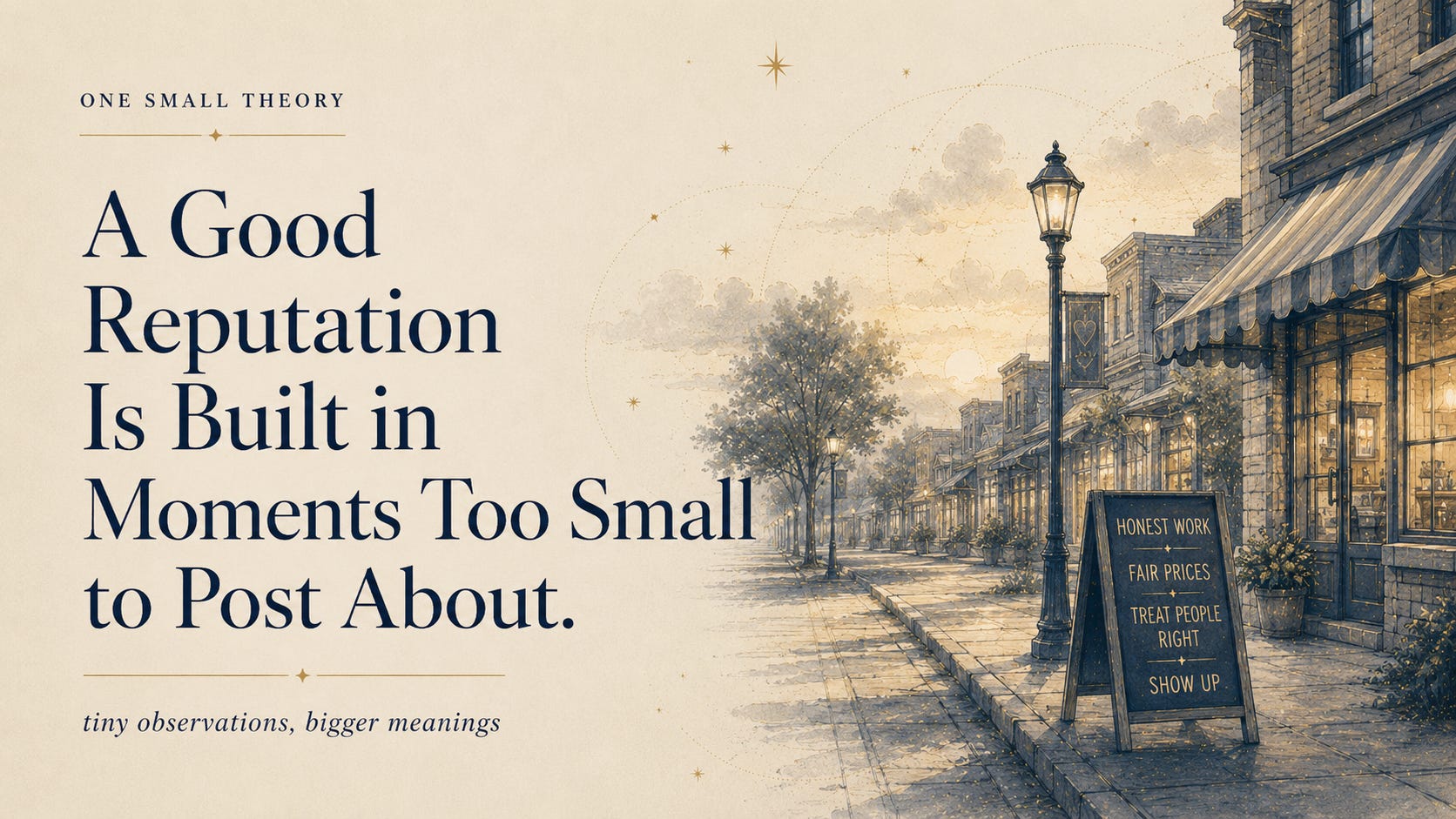
A good reputation is built in moments too small to post about.
Not the grand ones.
Not the award photos.
Not the ribbon cuttings.
Not the public statements.
Not the polished testimonials, though those can matter.
Reputation is built in the tiny private decisions that most people will never see.
The call you return when it would be easier not to.
The mistake you own before anyone forces you to.
The invoice you correct because you noticed it was not quite right.
The promise you keep even after the excitement wears off.
The customer you help when there is no obvious upside.
The employee you defend when they are not in the room.
The shortcut you refuse because it would make the numbers look better but the work worse.
That is where reputation lives.
Not in the image.
In the pattern.
A reputation is not what people think about you after one impressive moment.
It is what people come to believe after repeated exposure to your choices.
Reputation Is Slow
A good reputation takes a long time to build because trust is not created all at once.
It accumulates.
A little at a time.
Through ordinary consistency.
People watch whether your actions match your words.
They watch whether your values survive inconvenience.
They watch whether your character changes when money is involved.
They watch how you treat people who cannot help you.
They watch what happens when there is pressure, conflict, embarrassment, competition, or risk.
Most of the watching is not dramatic.
It happens quietly.
Someone notices that you followed through.
Someone notices that you told the truth.
Someone notices that you showed up prepared.
Someone notices that you did not overpromise.
Someone notices that you handled a problem without making excuses.
Someone notices that you gave credit away.
Someone notices that you did not make the moment about yourself.
Those small observations collect.
Eventually, people stop merely knowing what you say you stand for.
They begin to know what to expect from you.
That is reputation.
Local Reputation Is Different
In a local business community, reputation carries a special weight.
It is not theoretical.
It walks into rooms before you do.
People remember.
They remember who treated them fairly.
They remember who disappeared when things got hard.
They remember who did good work.
They remember who blamed everyone else.
They remember who helped without needing attention.
They remember who talked about values but did not practice them when it counted.
In a small community, credibility is not built by branding alone.
Branding may help people notice you.
Reputation determines whether they trust you.
That is why local business credibility is so personal.
You are not only selling a service, a product, or an idea.
You are putting your name into circulation.
People attach that name to experiences.
Was it easy to work with you?
Did you do what you said?
Were you honest about cost, timing, limitations, and risk?
Did you make things right when something went wrong?
Did you treat people with dignity?
Did your success make you generous or arrogant?
Those questions matter more than most marketing.
Because people may forget an ad.
They remember how you made them feel when something mattered.
Ethics Usually Happen Before the Crisis
We tend to think of ethics as something tested in major moments.
And sometimes it is.
But most ethical lives are shaped before the crisis ever arrives.
They are shaped in small decisions that train the conscience.
Do I tell the whole truth or the useful version?
Do I fix this quietly or hope no one notices?
Do I take responsibility or redirect blame?
Do I honor the agreement even if the other person forgot?
Do I make this right even if it costs me?
Do I let the customer believe something that benefits me but is not fully accurate?
Do I treat a small commitment like it matters?
The big ethical test usually reveals the habits built in smaller moments.
People do not suddenly become trustworthy under pressure.
They practice trustworthiness when the stakes are low enough that no one would have known the difference.
That is where character is formed.
Not in the speech.
In the unseen choice.
Consistency Is Underrated
A good reputation does not require perfection.
That is fortunate, because no one has it.
What it requires is consistency.
People can forgive mistakes when the larger pattern is trustworthy.
They can handle a delay if the communication is honest.
They can accept a problem if the response is responsible.
They can extend grace when they believe the person or business is acting in good faith.
But inconsistency wears people down.
When people never know which version of you they are going to get, they stop trusting the good version.
The good version may be real.
But if it is unpredictable, it is not reliable.
Reliability is one of the most practical forms of integrity.
You do not have to be flashy.
You do not have to be the loudest.
You do not have to make every moment inspirational.
You just have to keep showing up in a way people can count on.
That is rare enough to be powerful.
Follow-Through Is a Moral Act
Follow-through sounds like a productivity issue.
It is also a character issue.
When you tell someone you will do something, even something small, you create an expectation. You borrow a little bit of their trust.
Following through pays it back.
Not following through does something too. It teaches people to discount your words.
This is why small broken promises matter.
“I’ll call you tomorrow.”
“I’ll send that over.”
“I’ll take care of it.”
“I’ll get back to you.”
“I’ll stop by.”
“I’ll follow up.”
None of those statements may feel significant in the moment.
But they become significant when repeated.
A person who casually breaks small promises eventually becomes someone whose words require verification.
That is an expensive way to live.
And an expensive way to do business.
The opposite is also true.
When people learn that your word usually becomes action, you create a kind of ease around you.
People relax.
They do not have to chase.
They do not have to wonder.
They do not have to protect themselves from your inconsistency.
That is one of the gifts of a good reputation.
It lowers the amount of suspicion people have to carry.
The Best Work May Never Be Public
Some of the most important work a person does will never be posted.
No one will see the hard conversation handled with care.
No one will see the late night spent making something right.
No one will see the quiet generosity.
No one will see the restraint.
No one will see the time you could have taken credit but chose not to.
No one will see the moment you chose fairness over advantage.
No one will see the decision that cost you in the short term but preserved your integrity in the long term.
That can feel strange in a world that rewards visibility.
We are used to turning moments into content.
But not everything meaningful should be content.
Some things lose value when they are performed.
Reputation is not built by making every good act visible.
It is built by becoming the kind of person or organization that does good whether or not visibility follows.
Eventually, people can sense the difference.
They can tell when values are marketing.
They can also tell when values have roots.
Good Names Are Built Slowly and Lost Quickly
There is an old truth in business and life:
It takes years to build a good name and only moments to damage it.
That can sound unfair.
But it is also a reminder that reputation is precious.
A good name is not an entitlement.
It is a responsibility.
You carry it into each conversation, each transaction, each meeting, each decision, each unresolved problem, and each opportunity to do the easier wrong thing or the harder right thing.
This is especially true in a local community where business and personal credibility overlap.
People do not only remember what your organization did.
They remember how you handled yourself.
A good reputation is built when people come to believe that your standards do not disappear when the room gets quiet.
That is the kind of credibility no campaign can fake for long.
The Quiet Math of Trust
Trust has a quiet math to it.
Every kept promise adds.
Every honest conversation adds.
Every responsible correction adds.
Every act of fairness adds.
Every moment of consistency adds.
But every excuse subtracts.
Every avoided responsibility subtracts.
Every broken commitment subtracts.
Every exaggerated claim subtracts.
Every moment where someone feels used, dismissed, or misled subtracts.
Over time, the total becomes what people believe about you.
Not what you say.
What they believe.
That is why reputation is not controlled.
It is earned.
You can influence it by how you live and work, but you cannot demand it.
People decide whether your pattern is trustworthy.
Your job is to make the pattern clear.
The Small Things Are the Big Things
In the end, reputation is rarely built in the moments we think will define us.
It is built in the small things.
The email.
The follow-up.
The apology.
The detail.
The fair decision.
The quiet repair.
The honest answer.
The respectful conversation.
The willingness to do what is right when doing what is right is inconvenient, unnoticed, or unprofitable.
These moments may be too small to post about.
But they are not too small to matter.
In fact, they may matter most.
So, one small theory:
A good reputation is built in moments too small to post about.
It is built when no one is clapping.
When no one is watching.
When no one will know unless you tell them.
It is built in the private agreement between your values and your actions.
And over time, if you are consistent enough, people begin to trust not just what you do.
They trust who you are becoming.