


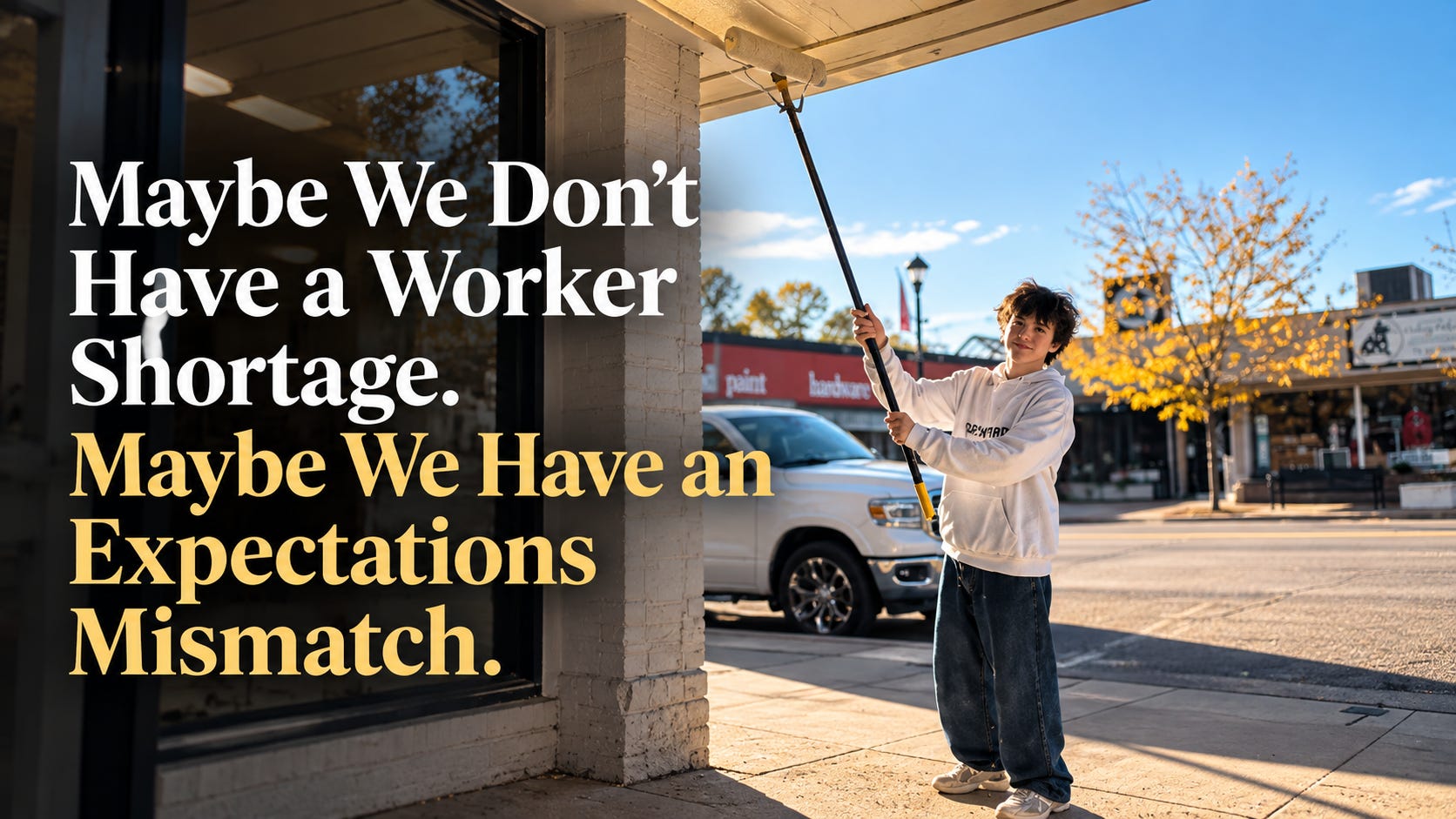
For the last several years, we have heard almost constantly about the worker shortage.
Restaurants cannot find enough people.
Manufacturers struggle to fill shifts.
Small businesses post openings for months.
Schools, hospitals, construction companies, technology firms, municipalities, and nearly every other industry seem to have some version of the same complaint:
Nobody wants to work anymore.
Workers often tell a very different story.
They say employers want too much for too little. They point to wages that have not kept pace with housing, healthcare, childcare, education, or transportation. They question rigid schedules, limited flexibility, weak benefits, poor leadership, and jobs that expect complete commitment without offering much stability in return.
Their version sounds more like:
Nobody wants to work under those conditions anymore.
Maybe the interesting question is not which side is right.
Maybe the problem is that employers and employees are operating with two increasingly different definitions of what work is supposed to be.
Employers Have Expectations Too
It has become fashionable to criticize employers for expecting too much, but employers have legitimate expectations.
If someone agrees to do a job, the employer should reasonably expect that person to show up.
On time.
Prepared.
Capable of doing the work.
Willing to learn.
Willing to accept feedback.
Willing to occasionally do something inconvenient because the job requires it.
An employer should be able to expect employees to communicate when something goes wrong, follow through on commitments, solve reasonable problems without constant supervision, and care at least somewhat about the quality of the work carrying their name.
None of that strikes me as abusive.
It is employment.
Yet many employers increasingly feel as though basic expectations have somehow become controversial.
Managers describe employees who want promotions before mastering their current jobs, greater flexibility without corresponding accountability, increased compensation without increased responsibility, or complete autonomy while still expecting managers to solve every difficult problem.
Whether those perceptions are universally fair is another question.
But the frustration is real.
Employers are asking:
When did expecting someone to do the job they agreed to do become unreasonable?
That is a fair question.
Workers Have Expectations Too
But employees are asking an equally fair question.
When did employment become a one-way commitment?
For decades, workers were often told that loyalty mattered.
Give the company your best years.
Stay late.
Come in early.
Take on extra responsibility.
Sacrifice when necessary.
Help the organization succeed, and the organization will take care of you.
Then many workers watched companies restructure, outsource, automate, eliminate pensions, reduce benefits, freeze wages, conduct layoffs, and make financial decisions that demonstrated something uncomfortable:
The relationship was never quite as permanent as they were told.
Younger workers especially absorbed that lesson.
They watched parents devote decades to organizations only to discover that loyalty did not necessarily produce loyalty in return.
So they changed the bargain.
They began asking harder questions.
What am I being paid?
What am I learning?
What flexibility do I have?
What opportunities exist?
How will this job affect my family?
What happens if the company decides it no longer needs me?
Those are not necessarily signs of laziness.
They may simply reflect a workforce that has become more transactional because employment itself became more transactional.
Both Sides Think the Other Changed
This is where the conversation gets interesting.
Employers say workers changed.
Workers say employers changed.
They may both be right.
Employers remember a labor market where simply providing a stable job created loyalty.
Workers increasingly view employment as an exchange that must continually make sense.
Employers think:
I am giving you a paycheck, benefits, training, opportunity, equipment, customers, infrastructure, and a place to build a career. Why wouldn’t you value that?
Workers think:
I am giving you forty or more hours of my life every week, my experience, my attention, my energy, and a significant portion of my productive years. Why shouldn’t I expect something worthwhile in return?
Those perspectives are not actually incompatible.
The problem begins when either side believes its contribution is the only one that matters.
The Old Employment Contract Has Changed
There used to be an unofficial employment contract that looked something like this:
Work hard.
Stay loyal.
Build experience.
Move up.
Retire.
That model was never universal, but it shaped how generations thought about employment.
Today, the psychological contract looks very different.
Employees change jobs more frequently.
Companies restructure more frequently.
Technology changes roles faster.
Remote work changed expectations around geography and flexibility.
Employees have greater access to salary information and job opportunities.
Employers have greater access to outsourcing, automation, contractors, and global talent.
Both sides have more options.
More options create more negotiating power.
They also create less loyalty.
And somewhere in that shift, employers and employees kept parts of the old expectations that benefited them while rejecting the parts that did not.
Employers sometimes still expect old-school loyalty while offering modern-day job security.
Employees sometimes expect modern flexibility while maintaining old-school expectations of stability and advancement.
That tension is not really a worker shortage.
It is a contract negotiation happening across the entire economy.
Employers May Need to Reconsider What They Are Offering
There are employers who complain endlessly about being unable to hire but have never seriously examined the job they are trying to fill.
The schedule is terrible.
The wage is mediocre.
The manager is difficult.
The work is repetitive.
The benefits are weak.
There is little opportunity for advancement.
And the recruiting strategy amounts to wondering why nobody applies.
At some point, the market is giving you information.
If nobody wants what you are selling, yelling at the market does not make the product more attractive.
Employers constantly understand this when dealing with customers.
If customers repeatedly reject an offering, we reconsider the price, product, positioning, experience, or value proposition.
Labor is also a market.
Sometimes the solution really is higher compensation.
Sometimes it is flexibility.
Sometimes better leadership.
Sometimes clearer career paths.
Sometimes better tools.
Sometimes reducing unnecessary bureaucracy.
Sometimes redesigning the job entirely.
And sometimes the answer is admitting that the position you designed ten years ago no longer makes sense.
Workers May Need to Reconsider Their Expectations Too
But market forces work in both directions.
A meaningful career will sometimes require inconvenience.
Growth usually requires discomfort.
Higher compensation generally follows increased capability, scarcity, responsibility, or value creation.
Flexibility requires trust.
Trust requires reliability.
Advancement requires performance.
You cannot reasonably demand complete flexibility while being unreliable.
You cannot expect rapid promotion while resisting feedback.
You cannot demand autonomy while refusing accountability.
You cannot expect an employer to continually invest in your development if you demonstrate little interest in improving.
And you cannot expect every uncomfortable workplace expectation to disappear simply because it interferes with your preferences.
Work is still work.
There will be mornings when you would rather stay home.
There will be customers who frustrate you.
There will be difficult conversations.
There will be deadlines.
There will be responsibilities that do not perfectly align with your passions.
Some of the rhetoric around modern employment occasionally confuses a healthy workplace with a workplace that never asks anything difficult of us.
Those are not the same thing.
The Best Workplaces Are Reciprocal
The healthiest employment relationships are rarely built around one side winning.
They are built around reciprocity.
The employer can say:
We will pay you fairly, treat you with respect, give you the tools you need, communicate honestly, invest in your growth, and create opportunities when your performance earns them.
And the employee can say:
I will show up, learn, contribute, communicate, solve problems, accept accountability, and give you honest effort while I am here.
That seems remarkably reasonable.
Neither side is promising unconditional loyalty.
Neither side is demanding unconditional sacrifice.
Both are agreeing to make the relationship worthwhile.
The employer earns commitment.
The employee earns opportunity.
And both sides continually demonstrate why the arrangement should continue.
Maybe Nobody Has Become Unreasonable
There are certainly unreasonable employers.
There are certainly unreasonable employees.
I have met both.
But I am increasingly skeptical of sweeping statements about entire generations of workers or entire classes of employers.
Most people are responding rationally to the incentives around them.
Employers are under pressure to control costs, increase productivity, satisfy customers, adapt to technology, and compete in markets that change quickly.
Workers are under pressure from housing costs, childcare, healthcare, family responsibilities, career uncertainty, and an economy where changing jobs can sometimes produce greater advancement than staying loyal.
Put those pressures together and you get friction.
Employers feel workers are asking for more while giving less.
Workers feel employers are asking for more while offering less.
Both sides become defensive.
Both sides tell stories about how unreasonable the other has become.
And then we label the result a worker shortage.
Maybe the Better Question Is Different
Instead of asking:
Why can’t we find workers?
Employers might ask:
Why would a talented person choose to work here instead of somewhere else?
And instead of asking:
Why won’t employers give me what I want?
Workers might ask:
What value am I creating that makes an employer want to give me those things?
Those are harder questions.
They are also more productive ones.
Because the future of work probably will not be solved by employers lecturing workers about work ethic.
And it will not be solved by workers treating every expectation as exploitation.
It will be solved when both sides recognize something fairly simple:
Employment is an exchange.
A good employer should be able to expect effort, reliability, accountability, and growth.
A good employee should be able to expect fair compensation, reasonable treatment, opportunity, transparency, and respect.
When either side stops delivering value, the relationship eventually stops working.
So maybe we do have worker shortages in certain industries, communities, and professions.
But I suspect at least part of what we are calling a worker shortage is something else.
Millions of employers and workers are renegotiating what they believe a fair deal looks like.
And right now, we are not always agreeing on the terms.