


There are moments in business when leadership sounds bigger than it really is.
Strategy. Vision. Culture. Growth. Accountability. Execution.
All of those things matter. I believe that deeply. But sometimes, the most important leadership lesson shows up in a much smaller moment.
When Leadership Becomes Practical
Years ago, I remember being in the middle of a busy season at work. We had a lot going on. Client needs were high. Internal pressure was high. Everyone was moving fast, and like most growing businesses, there were more things to do than there were hours in the day.
One of our team members was stuck on an issue. It was not the biggest problem in the company. It was not something that would have made a dramatic story in a leadership book. It was just one of those frustrating problems that slows everything down. The kind of issue where the person working on it starts to feel like they are failing, even though they are really just trapped inside something confusing.
I had other things I could have been doing. Probably more “important” things, at least by title or category. There were emails to answer, decisions to make, meetings to prepare for, and bigger business concerns sitting in the background.
But in that moment, the best thing I could do was not give a speech about ownership or urgency. It was not to remind them how busy everyone was. It was not to step in, take over, and prove that I knew the answer.
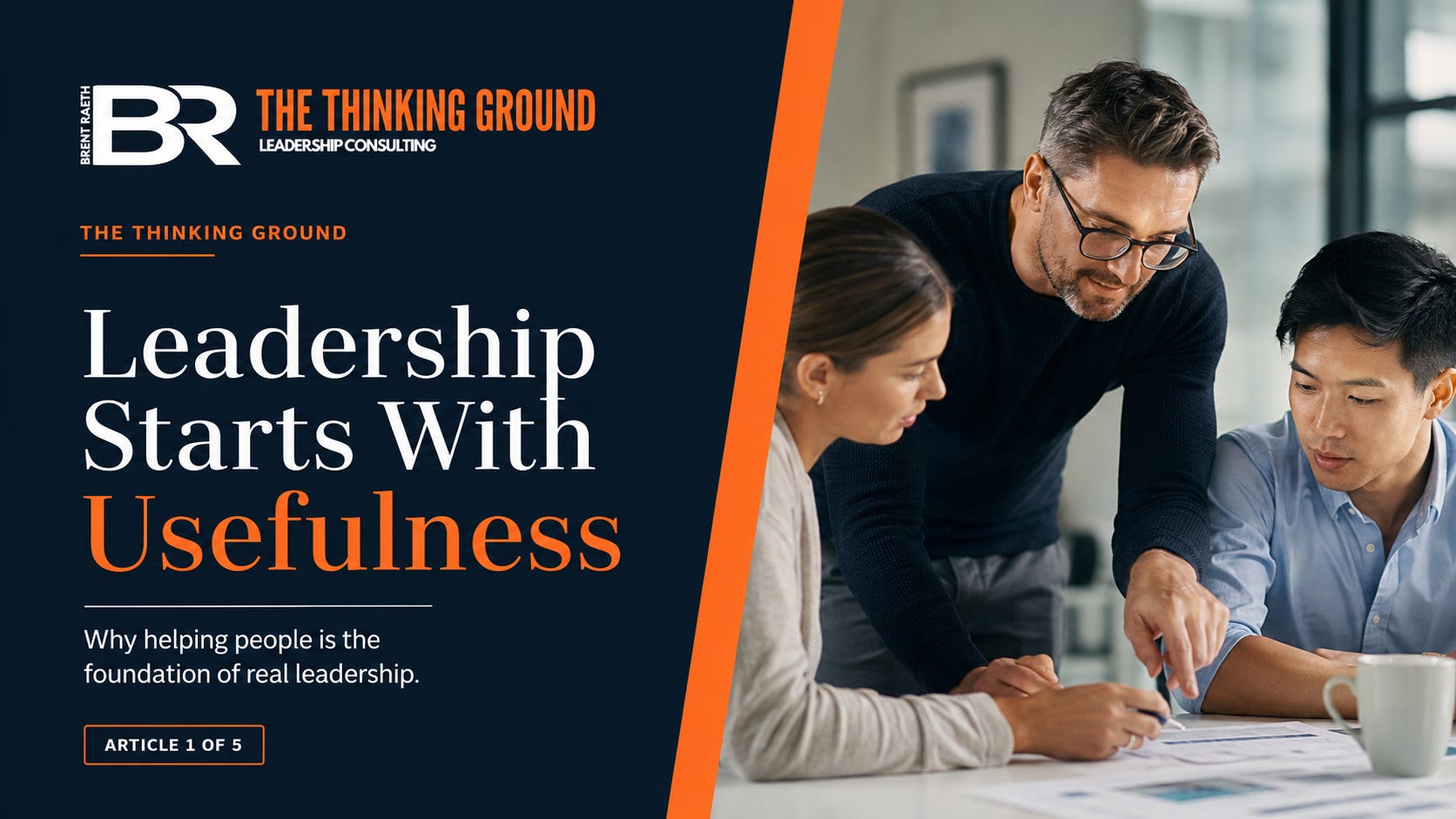
The best thing I could do was sit down next to them and help.
Not because they were incapable. Not because I needed to be the hero. But because leadership, at its most practical level, is often about making yourself useful.
That moment has stuck with me because it reflects something I have come to believe more strongly over time: leadership starts with usefulness.
Not importance. Not authority. Not visibility.
Usefulness.
A useful leader helps people move forward. A useful leader brings clarity when things are confusing. A useful leader removes obstacles, asks better questions, provides perspective, and helps people get unstuck. A useful leader does not need every situation to become a stage for their own importance.
That sounds simple, but it is not always easy.
The Difference Between Being Important and Being Useful
One of the traps of leadership is that it can slowly make people more concerned with being important than being useful.
Importance asks different questions.
Do people know I am in charge?
Am I getting enough credit?
Was I included in the decision?
Do people recognize how much I do?
Usefulness asks better questions.
What does this person need right now?
What problem are we actually trying to solve?
Where can I remove friction?
How can I help without creating dependence?
What would make this better?
There is nothing wrong with responsibility, authority, or recognition. Leaders often carry real weight, and that should not be dismissed. But when leadership becomes primarily about being seen as important, something begins to shift. The leader becomes the center of the story.
The healthiest leaders understand that they are not always supposed to be the center of the story. Sometimes their role is to help someone else succeed, help the team think clearly, or help the organization get better.
That kind of leadership does not always draw attention to itself, but it builds trust.
People know when a leader is more interested in being useful than being admired. They can feel the difference. One creates pressure. The other creates confidence.
Helpfulness Is Not Weakness
Some people hear the word helpful and think it sounds soft.
I do not see it that way.
Helping people does not mean avoiding hard conversations. It does not mean lowering standards. It does not mean doing everyone’s work for them. It does not mean rescuing people from accountability.
In fact, real helpfulness often requires more courage than performative toughness.
Sometimes helping someone means telling them the truth. Sometimes it means coaching them through something difficult. Sometimes it means letting them struggle long enough to grow, while still making sure they know they are not alone. Sometimes it means asking them to rise to a higher standard because you believe they are capable of more.
There is a big difference between helping people and enabling people.
Enabling removes responsibility.
Helping builds capacity.
A good leader is not trying to create dependence. A good leader is trying to help people become stronger, clearer, more capable, and more confident.
That is why usefulness matters so much. The goal is not to make people need you more. The goal is to help them become better because you were involved.
The best leaders I have known did not make the room revolve around them. They made the room work better. They helped people understand the mission. They created clarity. They noticed when someone was stuck. They stepped in when they were needed and stepped back when someone else was ready.
That takes humility.
It also takes discipline.
Building Capacity, Not Dependence
One of the most rewarding parts of leadership is watching people grow.
Not just watching them complete tasks, but watching them become more capable. More confident. More thoughtful. More prepared for the next challenge.
That does not happen by accident.
It happens when leaders see their role as building capacity in others.
Early in my career, I thought leadership was largely about having answers. Over time, I have come to appreciate the value of better questions. Answers are still important, but questions teach people how to think. Questions help people slow down, assess reality, and make better decisions.
What have you tried?
What do you think is really happening?
What information are we missing?
What would you do next?
Where are you stuck?
What does success look like here?
Those questions can be more useful than simply giving someone the solution. They invite ownership. They build problem solving muscles. They communicate confidence.
Of course, there are times when a leader needs to give a direct answer. There are urgent situations where clarity matters more than coaching. But if leaders always jump straight to the answer, they may solve the immediate problem while weakening the long-term team.
Useful leaders think about both.
They help with the issue in front of them, but they also help prepare people for the next issue.
This is where leadership becomes much more than management. Management can assign work. Leadership develops people who can carry work well.
The Quiet Credibility of Showing Up
I have learned that credibility is built in small moments long before it is tested in big ones.
People decide whether they trust your leadership by watching how you show up when things are inconvenient, unclear, frustrating, or ordinary.
Do you listen when someone brings you a concern?
Do you help when there is no audience?
Do you stay calm when something breaks?
Do you care about the person, or only the output?
Do you make things clearer, or do you make people more anxious?
Do you follow through?
Leaders sometimes underestimate how closely people watch these things.
A leader can talk about values all day long, but the team learns what matters by observing behavior. They learn whether people are actually valued. They learn whether problems are handled honestly. They learn whether asking for help is safe. They learn whether standards are real.
When leaders consistently show up with a desire to be useful, they build a kind of quiet credibility. It is not flashy. It is not built from slogans. It is built through repeated evidence.
The team learns, “When this person gets involved, things usually get better.”
That is a powerful leadership reputation.
It does not mean you are perfect. It does not mean everyone will always agree with you. It does not mean every decision will be popular. But it does mean people have reason to trust your intent and your judgment.
That trust matters, especially when leadership gets hard.
Leadership Is Measured by What Improves
One of the simplest leadership questions is this:
Are things better because I am involved?
That question can be uncomfortable because it cuts through image and gets to impact.
Not, “Was I busy?”
Not, “Did I have an opinion?”
Not, “Did I sound smart?”
Not, “Did people know I was in charge?”
Are things better?
Are people clearer?
Are problems being solved?
Are teammates growing?
Is the culture healthier?
Are clients being served well?
Is the mission moving forward?
That is the real test.
Leadership should leave a positive wake. People should not feel smaller, more confused, more anxious, or more dependent because of our involvement. They should feel challenged in the right ways. Supported in the right ways. Clearer about what matters. More capable of doing the work.
That does not happen when leaders are obsessed with themselves.
It happens when leaders are committed to being useful.
A Standard Worth Building Around
This article is the first in a series about a simple leadership philosophy:
Help people. Solve problems. Be a great teammate on better teams.
That philosophy has shaped how I think about leadership, business, community, and success.
It is not complicated, but it is demanding.
Helping people requires humility.
Solving problems requires clarity.
Being a great teammate requires accountability.
Building better teams requires standards.
And shared success requires the willingness to make leadership about more than yourself.
For me, it starts here: be useful.
When someone is stuck, help them move forward.
When the room is confused, help create clarity.
When the team is carrying too much friction, help remove what you can.
When someone needs the truth, tell it with enough respect that they can receive it.
When someone is growing, give them room to become stronger.
When the work gets hard, do not just protect your own image. Step in and help make things better.
Leadership does not always begin with a grand vision. Sometimes it begins with a simple decision to sit down next to someone and help them get unstuck.
That may not sound impressive.
But over time, it is the kind of leadership people remember.
Because the best leaders are not always the loudest people in the room.
Often, they are the people making the room better.