


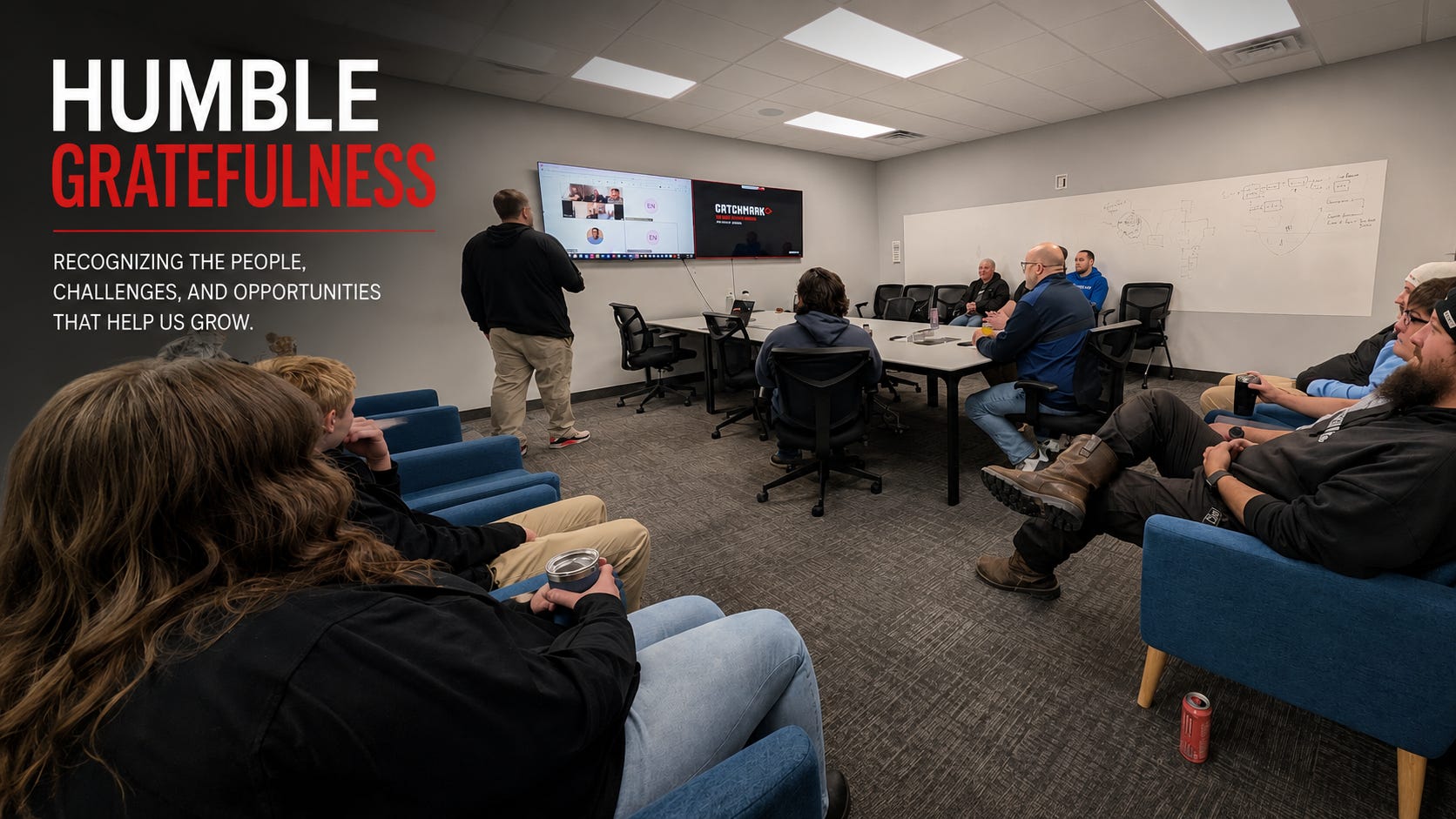
This Thursday, our team will gather for our quarterly tactical meeting.
These meetings give us an opportunity to step away from the daily work, look honestly at where we are, and decide where we need to improve together.
As part of that process, we choose a thematic goal that gives us a shared area of focus for the months ahead.
Heading into the end of summer and early fall, our goal is Humble Gratefulness.
The phrase may sound simple, but the idea is demanding.
Humble gratefulness means recognizing that our success is never achieved alone. It means appreciating the people, opportunities, challenges, and failures that help us grow. It is shown by staying open to feedback, giving credit freely, serving others well, and never believing that any responsibility is beneath us.
Most importantly, it changes the way we receive the difficult things that are necessary for growth.
Gratitude Is Easy Until It Becomes Uncomfortable
Gratitude is easy when it comes wrapped in encouragement.
It is easy to appreciate praise, flexibility, support, recognition, and second chances. Most of us naturally feel thankful toward the people who make life easier, affirm our decisions, and remind us of what we are doing well.
But that is not where gratitude is truly tested.
Gratitude becomes harder when it arrives through accountability.
When someone gives us difficult feedback.
When expectations are higher than we would prefer.
When someone tells us something we do not want to hear or believe.
When failure exposes a weakness we would rather ignore.
Those moments rarely feel like gifts.
But they often are.
That is where humility matters.
The People Who Push Us Often Care the Most
We sometimes misunderstand what care looks like.
We assume the people who encourage us are for us, while the people who challenge us are against us.
But encouragement without truth can leave us comfortable and unchanged.
The people who care enough to tell us the truth are taking a risk. They know we may become defensive. They know we may question their motives. They know the conversation may be uncomfortable.
They speak anyway because they believe we are capable of more.
Accountability is not always control.
Correction is not always criticism.
High expectations are not always unfair.
Sometimes they are evidence that someone sees potential in us that we are not fully living up to yet.
Humble gratefulness allows us to recognize the difference.
Humility Changes How We Receive Hard Things
Without humility, correction feels like an attack.
Accountability feels like someone trying to control us.
High expectations feel unreasonable.
Questions feel like accusations.
Failure feels like proof that we are not good enough.
With humility, we begin to see those same moments differently.
Hard conversations can mean someone believes in us.
Being pushed can mean someone sees greater potential.
Honest feedback can be an act of care.
Failure can become an opportunity to learn, adjust, and improve.
Humility does not mean every criticism is correct. It does not mean we blindly accept every opinion or allow others to treat us poorly.
It means we are secure enough to listen before becoming defensive.
We ask whether there is truth in what is being said.
We separate discomfort from disrespect.
We become more interested in growing than protecting our ego.
That is difficult.
It is also necessary.
Gratitude for Failure
Most people are grateful after success.
Far fewer are grateful for the failures that helped produce it.
Failure exposes gaps.
It shows us where our preparation was incomplete, where our habits were inconsistent, where our assumptions were wrong, or where our effort did not match the responsibility.
That can be painful.
But failure can teach us something success often cannot.
Success can hide weakness. Failure makes it visible.
The question is not whether we will fail. We will.
The question is whether we will waste the lesson.
Humble gratefulness allows us to say:
This did not go the way I wanted, but I am going to learn from it.
I do not like what this exposed, but I needed to see it.
I may not agree with every part of the feedback, but there is something here that can help me grow.
That is not weakness.
That is maturity.
Success Is Never Achieved Alone
Humble gratefulness also requires us to remember that none of us succeeds entirely on our own.
Someone taught us.
Someone gave us an opportunity.
Someone corrected us.
Someone covered for us while we learned.
Someone believed in us before we had proven ourselves.
Someone was patient when we made mistakes.
Someone challenged us when it would have been easier to remain silent.
Even our individual accomplishments are usually built on the support, sacrifice, trust, and effort of other people.
Humble people understand that.
They give credit freely.
They recognize the contributions of others.
They do not believe any responsibility is beneath them.
They serve well, even when the work is routine, inconvenient, or unnoticed.
They understand that gratitude is not simply something we say.
It is something we show through our actions.
What Humble Gratefulness Looks Like Practically
Humble gratefulness is not complicated, but it is demanding.
It means listening before becoming defensive.
It means appreciating the person who tells us the truth, not only the person who makes us feel good.
It means seeing accountability as support rather than punishment.
It means being grateful for the lessons failure provides.
It means giving credit without needing recognition in return.
It means showing appreciation by becoming better, more responsible, and more dependable.
The clearest response to someone investing in our growth is not simply saying thank you.
It is using what they gave us.
It is changing the habit.
Improving the work.
Owning the mistake.
Meeting the expectation.
Helping someone else grow.
Gratitude becomes real when it produces action.
A Better Question
When we receive difficult feedback, experience failure, or face accountability, our first reaction is often focused on how the moment makes us feel.
Why are they being so hard on me?
Why do they not recognize everything I have already done?
Why am I being held to this standard?
Why did this happen to me?
Humble gratefulness asks a better question:
What would it look like to receive this with humility and turn it into growth?
That question does not remove the discomfort.
It gives the discomfort purpose.
The people who push us, tell us the truth, hold us accountable, and remain beside us through failure are often the people who care about us most.
We may not recognize it immediately.
We may not appreciate it in the moment.
But with humility, we can learn to see hard things differently.
Not every challenge is an attack.
Not every correction is rejection.
Not every failure is an ending.
Sometimes the hardest moments are the very things helping us become who we are capable of being.
And that is something worth being grateful for.