


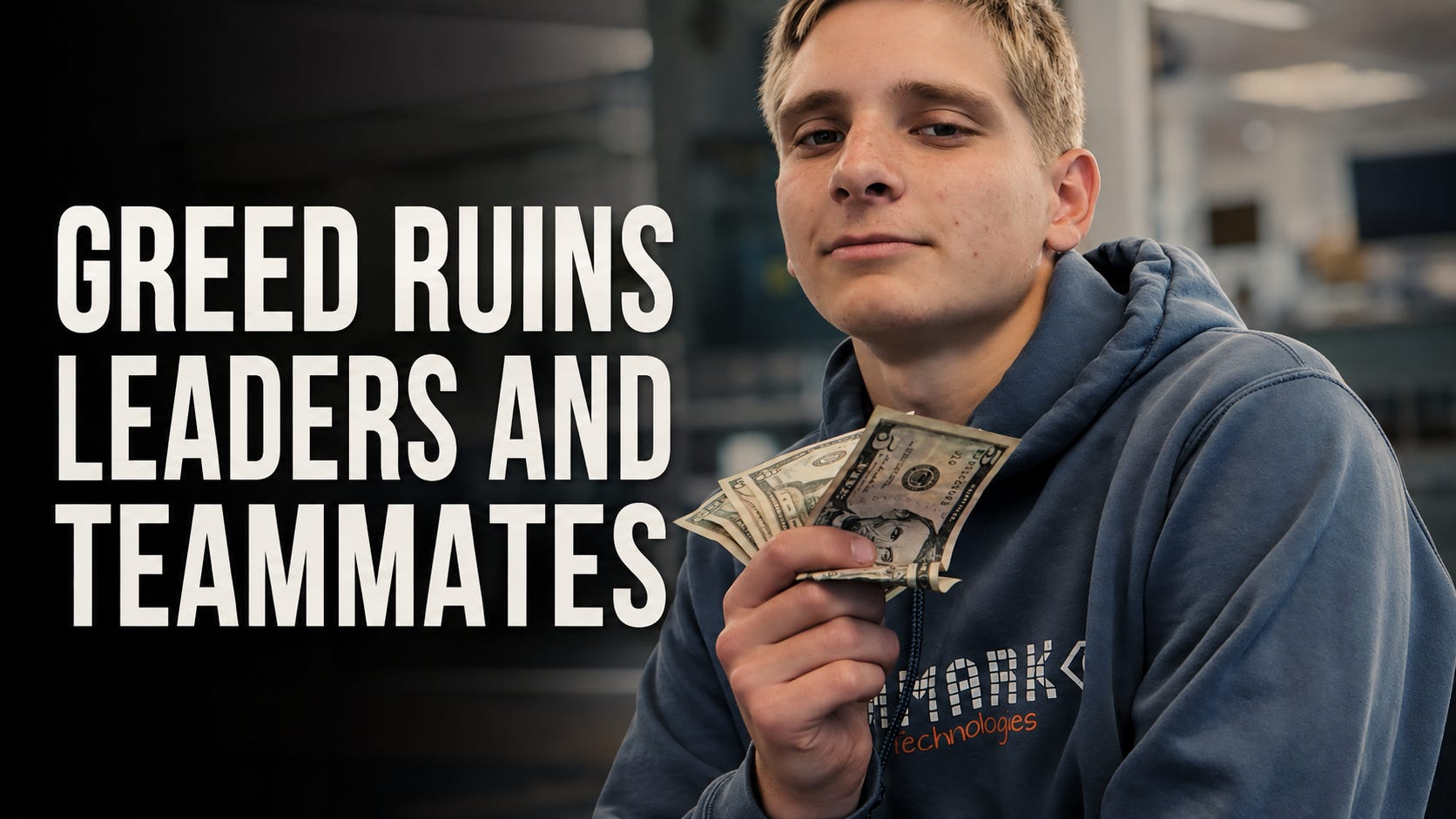
Earlier this week, after our Rotary meeting, I had a great conversation with my good friend, Mr. Bob Swan.
During that conversation, Bob made the statement that the elite are greedy, and that greed is one of the biggest problems facing our country.
I told him I thought he was right.
But I also pushed back on one part of the statement.
I believe limiting greed to the elite is a mistake.
The wealthy can be greedy. The powerful can be greedy. The politically connected can be greedy. Their position may give their greed greater reach and allow the consequences to affect more people.
But greed does not belong to a particular class, income level, political party, profession, or social station.
Greed exists anywhere people become more concerned with what they can take than with what they are responsible for contributing.
It can live in the executive suite, but it can also live in the break room. It can influence a boardroom, a government office, a union hall, a church, a classroom, a neighborhood, or a family.
Blanket greed, regardless of class or station, destroys teams and weakens society.
When most people hear the word greed, they think about money.
They picture someone who already has more than enough but still wants more. More profit. More possessions. More status. More control.
That is certainly greed, but it is only the most obvious version.
Greed can be about money, but it can also be about attention, authority, opportunity, recognition, information, influence, or credit.
It is the leader who needs every good idea to become their idea.
It is the teammate who protects knowledge because being the only person who knows something makes them feel valuable.
It is the person who wants the promotion but avoids the responsibility required to deserve it.
It is the executive who celebrates sacrifice when everyone else is making it.
It is the organization that talks about loyalty while treating every relationship as a transaction.
Greed is not simply wanting more. Ambition can be healthy. Growth can be healthy. Profit can be healthy. Recognition can be deserved.
Greed begins when getting more becomes more important than contributing well.
It begins when we stop asking, “What am I responsible for?” and start asking only, “What can I get?”
Once that mindset takes hold, it ruins leaders, damages teammates, weakens organizations, and eventually creates dysfunction across society.
Greed Turns Leadership Into Extraction
Leadership is supposed to be stewardship.
A leader is temporarily trusted with people, resources, authority, and opportunity. None of those things exist solely for the leader’s benefit. They are entrusted to the leader so something valuable can be built, protected, and passed forward.
Greed reverses that relationship.
Instead of seeing authority as something to use responsibly, a greedy leader sees it as something to consume.
People become tools.
Loyalty becomes something demanded rather than earned.
Success becomes personal property.
Failure becomes someone else’s fault.
The greedy leader wants the title, the compensation, the visibility, and the final word. They want to be surrounded by capable people, but not people who might outshine them. They say they want initiative, but only if it does not challenge their control. They encourage honesty until the truth becomes uncomfortable.
They may appear confident, driven, and decisive for a while. Greed often disguises itself as ambition. It can produce short term results because greedy leaders push hard, demand much, and take everything available to them.
But extraction is not leadership.
Eventually, people realize the relationship only works in one direction.
Their effort flows upward.
Their ideas flow upward.
Their sacrifices flow upward.
The rewards do not.
At that point, trust begins to disappear.
The best people stop offering their best ideas. Honest feedback becomes dangerous. Initiative feels foolish. People either leave or learn to protect themselves.
The leader may still have authority, but they no longer have influence. They may still receive compliance, but they have lost commitment.
Greed can preserve a position for a while. It cannot build a healthy organization.
Greed Makes Teammates Keep Score
Greed is not limited to people in charge.
It shows up in teammates who approach work as an ongoing negotiation to give as little as possible while receiving as much as possible.
They keep score constantly.
Who received credit?
Who got the easier assignment?
Who was recognized?
Who left early?
Who makes more money?
Who was invited into the meeting?
Who is being considered for the next opportunity?
Some of those questions can be legitimate. Fairness matters. Compensation matters. Recognition matters. Healthy organizations should care about all of them.
But greed turns awareness into obsession.
The greedy teammate is not asking whether the team is succeeding. They are asking whether someone else received something they believe should have been theirs.
That mindset changes behavior.
Information gets withheld.
Credit gets claimed.
Mistakes get hidden.
Help becomes conditional.
Collaboration becomes political.
Every request is measured against personal benefit.
The teammate may perform well individually and still make the organization worse. Their talent creates output, but their greed creates friction. Other people spend time documenting conversations, protecting ideas, managing egos, and anticipating conflict.
The cost is larger than whatever appears on a performance report.
A healthy teammate wants to grow, earn more, advance, and be recognized. But they also understand that advancement should follow contribution. They know that another person’s success is not automatically their loss. They can celebrate someone else without immediately calculating what it means for them.
Greed cannot do that.
Greed sees every room as a competition and every relationship as leverage.
Greed Creates Scarcity Even When There Is Enough
One of the most destructive things about greed is that it creates a feeling of scarcity.
There is never enough credit.
Never enough authority.
Never enough money.
Never enough recognition.
Never enough security.
Someone else gaining something feels like proof that you are losing something.
That belief spreads quickly through an organization.
When leaders hoard information, teammates hoard information.
When leaders claim credit, teammates fight for visibility.
When leaders reward political behavior, people become political.
When leaders take care of themselves first, everyone else begins doing the same.
Soon the organization is filled with people protecting their territory instead of solving problems together.
Departments compete rather than cooperate. Leaders build little kingdoms. Decisions are made to preserve budgets, headcount, status, or control instead of serving the mission. People resist improvements because a better process might reduce their importance.
The organization may still use words such as teamwork, collaboration, and culture.
But the real culture is revealed by what people believe they must protect from one another.
Greed creates defensive people, and defensive people cannot build freely.
They spend too much energy guarding what they have and resenting what others receive.
Greed Corrupts the Meaning of Enough
There is nothing wrong with wanting to build a successful business, earn a good living, create opportunities, or enjoy the rewards of disciplined work.
I believe people should be free to pursue those things.
But freedom does not remove responsibility. It makes responsibility more important.
The question is not whether a person has a lot. The question is what having a lot does to them.
Does success increase their gratitude or their appetite?
Does authority deepen their sense of responsibility or their sense of entitlement?
Does wealth create generosity or fear?
Does recognition make them more secure or more desperate for attention?
Greed corrupts our understanding of enough because it constantly moves the line.
The next raise will be enough.
The next promotion will be enough.
The next customer will be enough.
The next award will be enough.
The next level of influence will be enough.
But greed is not satisfied by receiving what it wants. It is strengthened by it.
The appetite grows.
And when enough has no definition, gratitude becomes impossible.
You cannot appreciate what you have while constantly resenting what you do not.
The Same Dysfunction Spreads Through Society
What greed does to a team, it also does to a society.
It turns neighbors into competitors, citizens into consumers, and institutions into machines for distributing benefits.
People begin evaluating every issue through a single question: “What do I get?”
Not, “What is fair?”
Not, “What is sustainable?”
Not, “What responsibility belongs to me?”
Not, “What kind of community are we creating?”
Only, “What do I get?”
Some demand more from government while accepting less responsibility for their own choices. Some demand endless labor, loyalty, or sacrifice from employees while refusing to share the value those employees help create. Some use public service to gain attention, influence, or power. Some turn every social problem into a business model that depends on the problem never being solved.
Different groups express greed differently, but the underlying belief is the same.
I am owed more than I am responsible for.
That belief creates resentment because every benefit must come from somewhere. Every promise has a cost. Every right that requires another person’s labor creates a corresponding responsibility that someone must carry.
When a society wants unlimited benefits but refuses honest conversations about tradeoffs, it becomes dysfunctional.
When people celebrate taking but shame producing, the system weakens.
When those who produce believe they owe nothing to anyone else, the community weakens too.
Greed exists at both extremes.
It exists in the demand to receive without contributing, and in the refusal to give despite having benefited from the contributions of countless others.
A functioning society requires more than individual appetite. It requires restraint, gratitude, responsibility, and a willingness to preserve something for people we may never meet.
Without those things, freedom slowly turns into entitlement and opportunity turns into exploitation.
Healthy Ambition Builds More Than It Takes
The answer to greed is not the elimination of ambition.
We need ambitious people.
We need people who want to build companies, create wealth, solve difficult problems, lead organizations, earn promotions, and improve their lives.
The difference is in what their ambition produces for others.
Healthy ambition creates value.
Greed extracts value.
Healthy ambition wants to become capable enough to carry more responsibility.
Greed wants more reward without more weight.
Healthy ambition can celebrate shared success.
Greed needs to own it.
Healthy ambition leaves people stronger.
Greed uses people until they have nothing left to give.
The best leaders I know are not without appetite. They want to win. They want to grow. They want to accomplish difficult things.
But they also understand stewardship.
They share credit.
They develop people who may eventually surpass them.
They make decisions that benefit the organization beyond their own tenure.
They accept that leadership sometimes means carrying more while receiving less recognition.
They know that success is not proven by how much they can accumulate. It is proven by what becomes possible for others because they led well.
Greed Eventually Consumes What Feeds It
Greed can look successful for a season.
It can accumulate money, influence, authority, and attention.
But it cannot create trust.
It cannot create loyalty.
It cannot create gratitude.
It cannot create peace.
And it cannot create enough.
Eventually, greed consumes the very things that made success possible.
It drives away good teammates.
It isolates leaders.
It turns organizations inward.
It makes communities resentful.
It leaves people surrounded by what they wanted and unable to enjoy any of it.
The antidote is not a lack of desire. It is a proper understanding of responsibility.
Want more, but become capable of carrying more.
Build more, but create value for others as you do.
Earn success, but remember everyone who helped make it possible.
Lead, but do not confuse stewardship with ownership.
Receive, but remain grateful.
And decide what enough means before greed decides that nothing ever will be.