


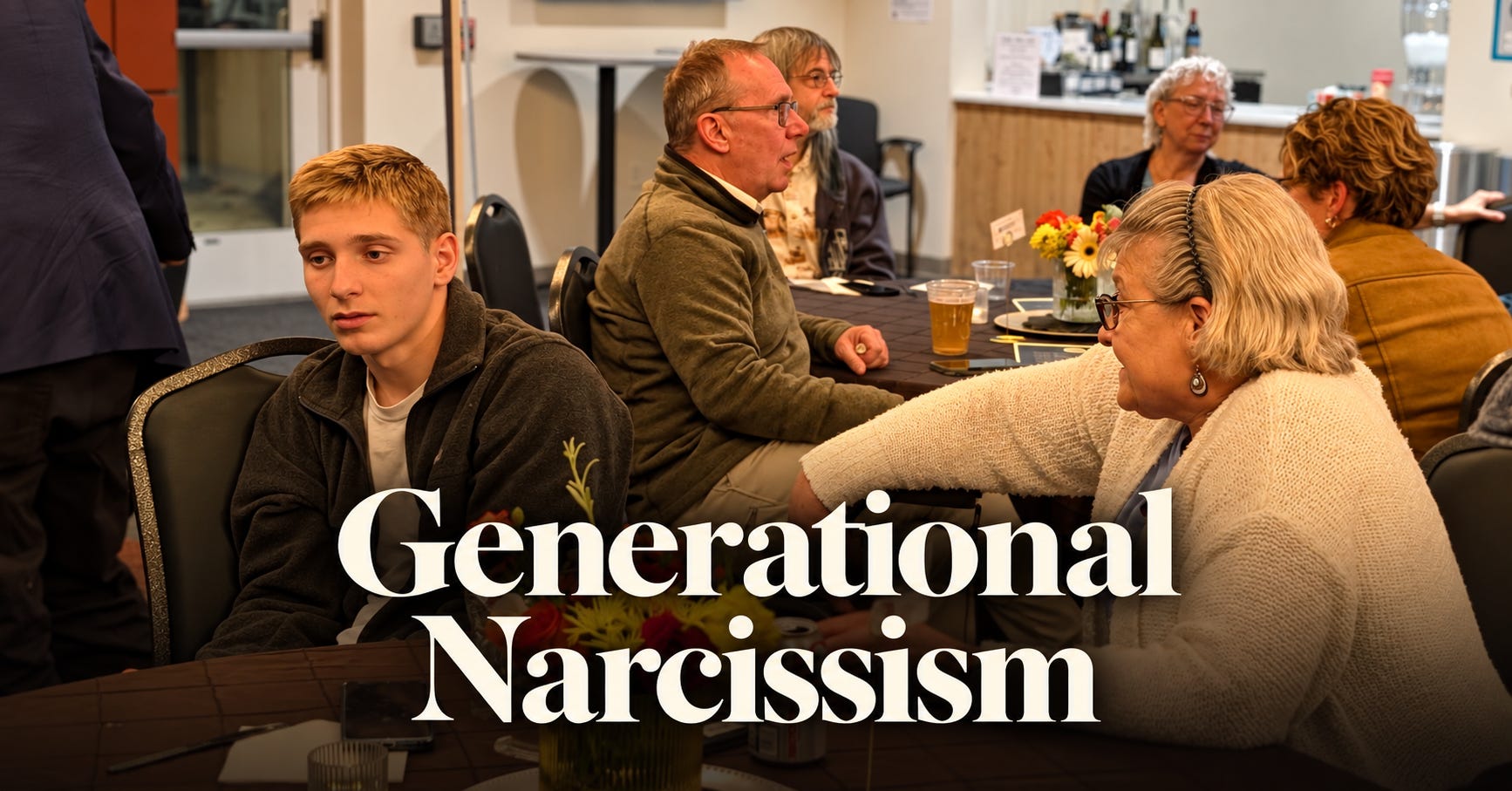
A recent conversation about being Gen X got me thinking about how differently self-centeredness can present itself. Looking at the generations before and after mine, I could see behaviors that appeared almost opposite yet seemed to arrive at the same place.
One person expects the world to accommodate them because of what they have earned. Another expects the world to accommodate them because of how they feel. Both can struggle to make room for anyone else.
It is an easy observation to make about other generations. The harder part is recognizing where my own generation, and where I personally, might do the same thing.
Before going further, a distinction matters. Narcissistic personality disorder is a clinical condition, not a label we should attach to everyone who behaves selfishly. It involves a broader pattern that can include exaggerated self-importance, entitlement, a need for admiration, and difficulty recognizing other people’s needs. This article is about everyday self-centered patterns, not diagnosing people or entire generations. Mayo Clinic
Those patterns deserve attention because they do not always look like vanity. Sometimes they look like hard work, independence, sacrifice, or even personal growth.
Different language, similar expectations
The version that came to mind when discussing some Baby Boomers was rooted in having paid your dues. “I worked hard. I sacrificed. I earned my place.” There is nothing wrong with taking pride in those things. Experience deserves consideration, and sacrifice deserves appreciation.
The problem begins when accomplishment becomes a permanent claim on other people’s obedience. A parent believes providing for the family gives them the right to direct their adult children’s lives. A leader believes years of service make their decisions immune to questions. Someone who endured difficult conditions dismisses any attempt to improve them because, “Nobody made it easier for me.”
In those moments, the past becomes a reason to stop listening in the present. Respect starts to mean agreement, and disagreement becomes ingratitude.
Among some people in younger generations, that same expectation can appear in the language of personal well-being. “I need to protect my peace. I need to honor my feelings. I need to do what is right for me.” Those can be healthy and necessary statements. People should be able to set boundaries, leave harmful situations, and build lives that do not destroy their health.
But healthy language can also be used to avoid uncomfortable responsibilities. An ordinary disagreement becomes “toxic.” Reasonable feedback becomes an attack. A commitment becomes optional as soon as following through feels inconvenient.
The issue is whether someone can recognize that other people have legitimate needs, too. A boundary can protect your time while still acknowledging a promise you made. A feeling can deserve attention without settling every question about what is fair.
These examples describe behaviors that can appear at any age. The generational contrast simply helped me notice how differently we can explain the same expectation: everyone else should adjust.
Gen X does not get a free pass
It would be convenient to stop there and declare that my generation sees through both versions. That would also make this article an example of the very problem I am describing.
Gen X can turn self-reliance into its own form of superiority. “I figured it out myself. Nobody held my hand. Why should anyone else need help?”
Independence is valuable. But when we use our ability to endure something as evidence that everyone else should endure it, we stop being curious about their circumstances. We can mistake emotional distance for strength and impatience for high standards.
Even the belief that we are the generation quietly holding everything together can become self-flattering. It gives us the important role in the story while reducing everyone else to a problem we have to manage.
Every generation has language that makes its own behavior sound reasonable. That is why examining the language alone will only get us so far. We also have to examine what the behavior costs other people.
The forms we miss
Some of the hardest self-centered patterns to recognize come wrapped in behavior we usually admire.
Consider the person who is always helping but keeps an invisible ledger. Every favor becomes something to collect later. When someone makes an independent choice, the response is, “After everything I have done for you?” The help may have been real, but it has become a claim on the other person’s freedom.
Or consider the person who always has the hardest story. You share a difficulty, and they immediately explain why theirs was worse. You share an accomplishment, and they redirect the conversation toward their own. Over time, you learn that there is little room for your experience unless it leads back to theirs.
It can also appear in an apology. Someone raises a legitimate concern, and the response becomes so focused on the embarrassment or distress of being confronted that the person who was hurt ends up providing reassurance. The original issue disappears before it is addressed.
None of these moments, by itself, establishes a diagnosis. People get defensive, misread situations, and have bad days. What deserves attention is a repeated pattern in which one person’s perspective consistently crowds out everyone else’s.
The quieter question underneath these interactions is often the most revealing: Is there room for two people here?
Look at what happens when accommodation ends
It is relatively easy to appear considerate when your preferences are being met. We learn more about ourselves when someone says no, gives us uncomfortable feedback, or needs something that competes with what we want.
Can we hear a concern without immediately building a defense? Can we appreciate someone’s help without assuming continued access to it? Can we accept that another person’s decision may disappoint us without being a deliberate injury to us?
These are questions I need to ask myself before using them to evaluate anyone else.
In leadership, that means noticing whether I welcome input only when it supports my direction. In family life, it means remembering that love and sacrifice do not give me ownership of someone else’s choices. In everyday conversation, it means listening long enough to understand instead of waiting for a chance to explain why I am right.
Having needs is part of being human. Maturity requires recognizing that our needs exist alongside the alongside the needs of others. Sometimes we should hold a boundary. Sometimes we should compromise. Sometimes we owe an apology and a change in behavior.
The conversation started with Boomers, Gen X, and younger generations. Where it left me was more personal.
Before I explain why my experience, my independence, or my feelings should carry the day, I need to ask: Have I made room for the person on the other side of this?
That answer says more about me than the year I was born.