


A while back, I had a conversation with one of my sons about an open gym he attended.
He told me there was some tension between him and another guy there. When I asked what happened, he shrugged and said, “He’s just a try hard.”
I paused.
“What’s a try hard?”
He explained, “You know, someone who always goes all out. Even when it’s just chill.”
“So,” I said, “someone who always gives their best?”
He smiled. “Yeah. Even when it’s not that serious.”
I could not help myself.
“How is that a bad thing?”
That conversation stuck with me.
When did trying hard become something to mock? When did consistent effort become socially risky?
And more importantly, what does that mentality do to a culture?
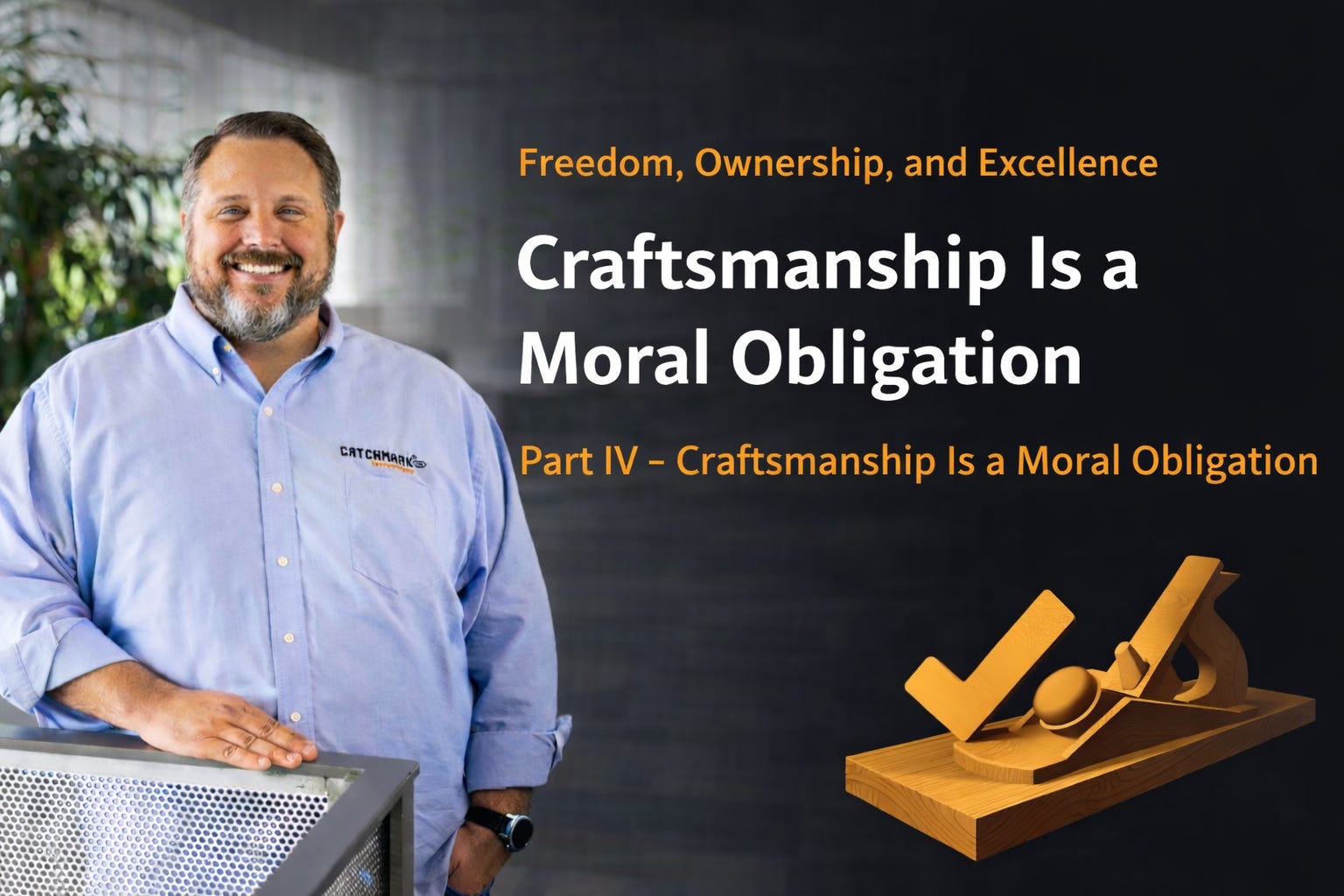
This is the fourth article in my leadership philosophy series. If freedom is the foundation, accountability the structure, and culture the environment, then craftsmanship is the standard we build toward inside it.
And I believe craftsmanship is not optional.
It is a moral obligation.
Excellence Is Respect
Craftsmanship is not about perfectionism.
It is about respect.
Respect for the customer.
Respect for the team.
Respect for the mission.
Respect for yourself.
When someone takes pride in their work, they are communicating something deeper than competence. They are communicating care.
In cybersecurity, in IT governance, in digital transformation, details matter. Sloppy configurations create risk. Half finished documentation creates confusion. Weak processes create exposure.
Precision is not vanity.
It is stewardship.
Excellence in execution is how you honor the responsibility you have been given.
Mediocrity Is Contagious
Culture compounds. So does effort.
If trying hard becomes embarrassing, average becomes the ceiling.
When someone consistently goes above and beyond and the response is eye rolling instead of appreciation, you have a problem.
Because high standards are fragile.
If excellence is mocked, high performers either tone it down or move on. And once they move on, mediocrity fills the vacuum quickly.
Mediocrity spreads faster than excellence.
That is why leaders must protect craftsmanship intentionally.
It does not survive passively.
Craftsmanship Builds Identity
There is something transformative about doing something exceptionally well.
Not occasionally. Consistently.
It shapes identity.
When a technician knows their configurations are airtight, confidence rises.
When a project manager runs disciplined, on time engagements, credibility builds.
When a leader communicates clearly and executes decisively, trust compounds.
Excellence builds internal pride.
And pride, when rooted in substance, fuels resilience.
People who take pride in their work are harder to discourage. They know what they are capable of because they have seen it in their own output.
That kind of confidence cannot be gifted. It must be earned.
The Lie of “Good Enough”
There are seasons where “good enough” is necessary. Deadlines exist. Tradeoffs exist.
But when “good enough” becomes the cultural norm, decay begins.
Small compromises in quality rarely stay small.
A rushed deliverable becomes a pattern.
A half thought through strategy becomes confusion.
A loosely enforced process becomes inconsistency.
In my world, whether in cybersecurity frameworks like CMMC or in strategic IT planning, maturity is built step by step. Baselines matter. Controls matter. Process discipline matters.
You do not drift into excellence.
You drift into weakness.
Excellence requires intention.
Leaders Set the Standard
If the leader tolerates sloppy thinking, the team will produce sloppy results.
If the leader prepares deeply, communicates clearly, and executes consistently, the team will rise.
Craftsmanship begins at the top.
It shows up in how meetings are run.
In how emails are written.
In how decisions are documented.
In how follow through is enforced.
People replicate what they see modeled.
If I want a culture that values excellence, I cannot be casual about my own output.
Trying hard is not embarrassing.
It is honorable.
Craftsmanship in the Small Things
There is a temptation to reserve excellence for the “important” moments.
The big client presentation.
The keynote speech.
The major contract.
But culture is built in the small, repetitive actions.
The internal email.
The process checklist.
The weekly update.
When excellence becomes habitual in small things, it naturally carries into big ones.
That is craftsmanship.
It is not about theatrics. It is about consistency.
The Standard We Choose
In this leadership philosophy, freedom matters. Accountability matters. Culture matters.
But what are we building inside that framework?
We are building work that reflects who we are.
If we believe in responsibility, our work should show it.
If we believe in ownership, our output should reflect it.
If we believe in excellence, it should be visible in the details.
Trying hard in everything you do should never be a punchline.
It should be the expectation.
In the next article, I will explore why leadership is stewardship, not status, and why carrying weight publicly is part of the cost of leading at a high level.
Because excellence without stewardship becomes ego.
And stewardship is what keeps excellence aligned with purpose.