


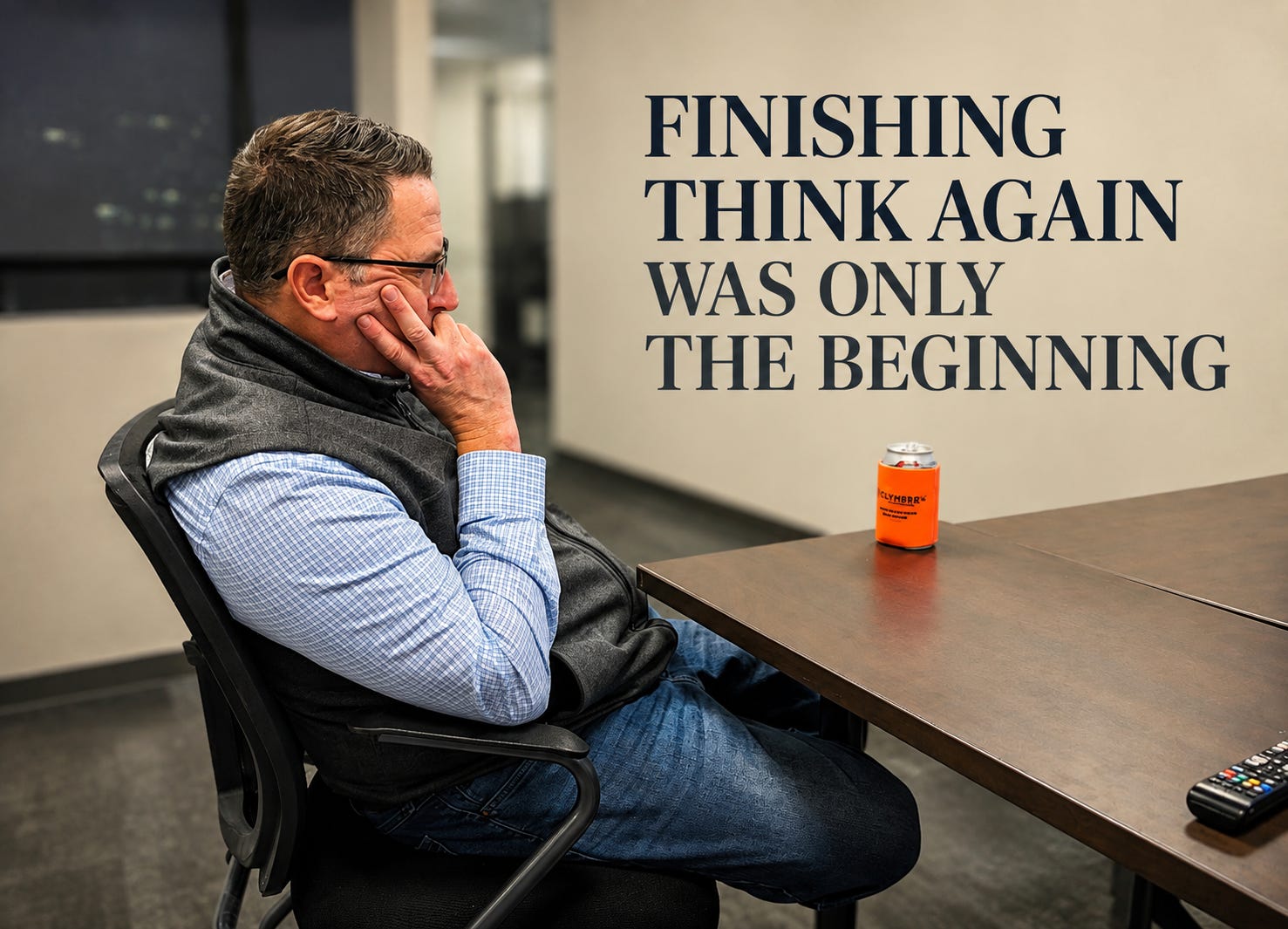
We recently finished reading Adam Grant’s Think Again as part of our CatchMark leadership Growth and Learning Meetings.
We did not select the book because our team lacks intelligence, experience, or strong opinions. We chose it because those qualities can sometimes make rethinking more difficult.
Experience teaches us valuable lessons, but it can also convince us that we have already found the answers. Expertise gives us confidence, but it can slowly turn that confidence into certainty. Leadership gives us authority, but authority can insulate us from the people most likely to recognize when we are wrong.
The better we become at defending what we believe, the easier it is to stop examining whether those beliefs are still true.
That is what made Think Again such a valuable book for our team.
The Real Threat Is Certainty
Most leaders understand the importance of learning. Far fewer are comfortable admitting that learning may require them to abandon something they once believed.
We like adding new ideas to our existing understanding. We are less enthusiastic about removing old assumptions from it.
Grant describes the tendency to think like preachers, prosecutors, and politicians. We preach when we defend beliefs we consider sacred. We prosecute when we focus on proving someone else wrong. We become politicians when we adjust our positions to gain approval or protect our standing.
Each of these modes has something in common. The conclusion has already been reached.
The only remaining task is to defend it.
Thinking like a scientist requires something different. It means treating our beliefs as hypotheses rather than permanent truths. We form an opinion based on the best information available, test it against reality, and remain willing to revise it when new evidence appears.
That sounds reasonable when written on a page.
It becomes much harder when the belief being tested is our own.
Confidence and Humility Can Coexist
One of the most useful ideas in the book is confident humility.
Leadership requires confidence. People need leaders who can make decisions, establish direction, and move forward without having every possible answer. A leader who is paralyzed by uncertainty cannot provide stability for anyone else.
But confidence without humility becomes arrogance.
Humility without confidence becomes hesitation.
Confident humility lives between those extremes. It allows us to say, “Based on what we know, this is the direction we are taking,” while remaining open to the possibility that new information may require a different direction.
Changing your mind is not necessarily evidence that the first decision was foolish. Sometimes it is evidence that you continued paying attention.
The goal is not to avoid being wrong. That is impossible. The goal is to recognize when we are wrong before pride turns a temporary mistake into a permanent problem.
Leadership Makes Rethinking More Difficult
The higher someone rises in an organization, the easier it becomes to receive agreement.
People may hesitate to challenge the leader. They may assume the leader knows something they do not. They may have learned that disagreement is unwelcome, even if no one has ever said so directly.
Leaders can then interpret the absence of opposition as proof that they are right.
It may only mean that people have stopped telling them what they really think.
This is why healthy disagreement is essential. A strong leadership team should not be a collection of people who validate one another’s assumptions. It should be a place where ideas can be examined, challenged, refined, and occasionally discarded without damaging the relationships between the people involved.
That requires trust, but it also requires accountability.
Everyone must be willing to explain their reasoning. Everyone must be willing to listen. Everyone must be willing to separate the quality of an idea from the identity of the person who offered it.
We should be able to challenge an idea without attacking a person. We should also be able to have our own idea challenged without treating it as a personal attack.
That is a leadership skill, not merely a personality trait.
Reading Is Not the Work
Our Growth and Learning Meetings are not intended to be traditional book club conversations.
The goal is not to prove that we completed the assigned chapters or remembered the most interesting examples. The goal is to find something that changes how we lead.
During these discussions, I want each person to identify an insight and connect it to a behavior or decision. We close by asking a practical question:
What will we do differently in the next thirty days?
That question matters because reading can create the illusion of growth. We underline a passage, discuss an idea, and feel as though progress has occurred.
But insight without application is only intellectual entertainment.
If Think Again does not change the way we handle disagreement, evaluate evidence, make decisions, or respond when someone questions us, then finishing the book accomplishes very little.
The value is not found in reaching the final page. It is found in carrying the habit of rethinking into the conversations that follow.
Rethinking Is Not Weakness
There is a difference between constantly changing direction and thoughtfully changing your mind.
Indecisiveness avoids commitment. Rethinking examines commitment.
A good leader does not reverse every decision when someone disagrees. A good leader listens carefully, evaluates the evidence, and remains willing to change when the facts justify it.
This matters because organizations often continue doing ineffective things for surprisingly simple reasons.
It is how we have always done it.
We have already invested too much to stop.
Changing course would mean admitting the original decision was wrong.
People expect us to remain consistent.
None of these reasons prove that the current direction is still the right one.
Consistency is valuable when it protects principles. It becomes dangerous when it protects outdated assumptions.
Sometimes the most responsible thing a leader can say is, “I believed this was right. I no longer do.”
That sentence does not reduce credibility when it is supported by honest reasoning. It often increases it.
The Question We Must Keep Asking
Finishing Think Again left me with a question that applies far beyond a leadership meeting:
What am I currently wrong about?
Not what was I wrong about five years ago. Those lessons are comfortable because they have already been resolved.
What am I wrong about now?
Which assumption about a person, customer, employee, strategy, or problem have I stopped examining? Where am I defending a decision because it is correct, and where am I defending it because it is mine? Have I created an environment where people can challenge my thinking, or have I trained them to remain silent?
Those are uncomfortable questions.
They are also necessary ones.
Leadership is not about being the person who always has the correct answer. It is about creating the conditions in which the best answer can eventually emerge.
That requires knowledge. It requires judgment. It requires experience.
It also requires the humility to admit that none of those things make us infallible.
We have finished the book, but the real work is just beginning.
The test will not be whether we remember what Adam Grant wrote. The test will be whether we become more curious when challenged, less defensive when questioned, and more willing to reconsider what we think we already know.
The strongest leaders are not those who never change their minds.
They are the ones who never stop examining them.